· 2 min read
What a Guitar Can Teach You About Building Apps Without Code
AI has genuinely changed how fast you can build software – but the cost of getting it wrong in production hasn't moved an inch.

Anatoly Silko
Founder, Rocking Tech
A prototype that cost £10,000 and took two weeks can now be built in a day, by someone with no technical background. That's real. What's also real is that none of the hard parts went away after it.
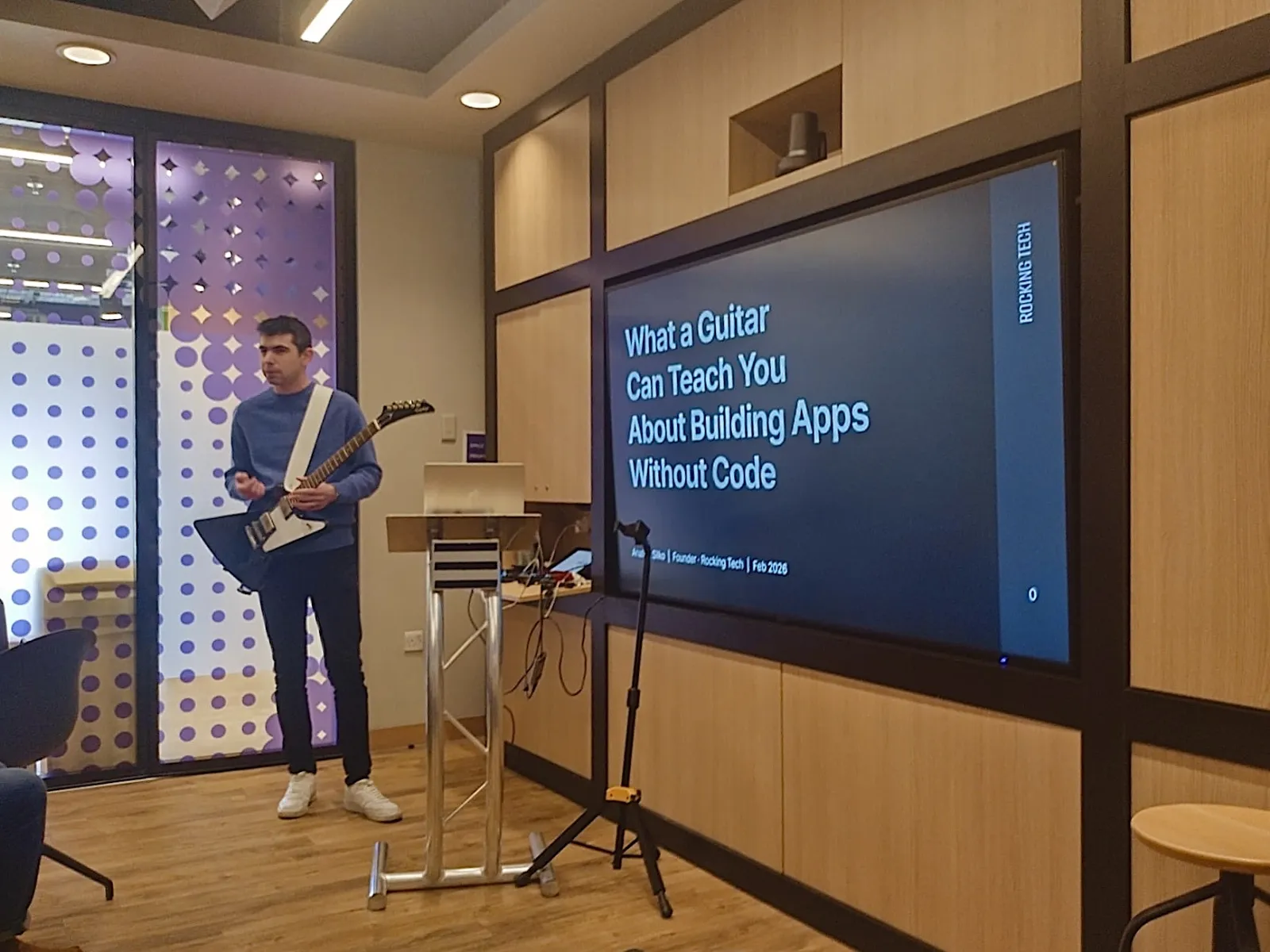
On Tuesday, Rocking Tech founder Anatoly Silko was invited to speak at two separate Milton Keynes events on the same day - a lunchtime session at the NatWest Accelerator hub, hosted by Debbie Lewis, and the IoTMK February evening meetup at MK:U Innovation Hub, organised by Lawrence Archard.
The title of both sessions was the same: "What a Guitar Can Teach You About Building Apps Without Code." It's a framing Rocking Tech stands behind - music, like software, rewards people who understand the instrument before they chase the output.
The barrier to starting has genuinely collapsed
AI tools – specifically large language models like Claude and ChatGPT – have compressed the cost and time of getting a working prototype from weeks and thousands of pounds down to hours and near zero. Tools like Cursor, Lovable, and v0.dev let you describe what you want and watch it get built. That's not hype. Anatoly demonstrated it live, with a guitar feeding raw signal into an AI-assisted prototype shaped by the audience in real time.
This matters most for founders wanting to test an idea before committing to a full build. The MVP discipline hasn't changed – you're still trying to test one specific assumption with real people – but the cost of running that test has dropped dramatically.
The barrier to finishing hasn't moved
This is where the talk got more pointed. Nearly 30% of AI-generated Python code contains potential security vulnerabilities, according to GitHub's own research. GDPR obligations apply the moment a prompt leaves your laptop and hits a third-party server. API pricing can change without warning. Code written quickly by an AI is significantly harder for a developer to maintain or extend later.
None of those are reasons to avoid these tools. All of them are reasons to use them with your eyes open.
Architecture matters too. A product where the AI layer is tangled directly into the application logic works fine until something needs to change – then you're untangling everything simultaneously. Keeping that layer separate and replaceable adds roughly 20% to the initial build. It tends to save multiples of that later.
The sequence that actually works
Write down the one assumption your plan depends on that you've never properly tested. Build the cheapest possible experiment to put it in front of real people. Talk to them – not friends, not AI-generated personas. When you have genuine signal, that's the moment to bring in a developer.
Most businesses skip some part of that sequence. The tools have never been better for the parts that get skipped.
If you're at the prototype stage and want to build it properly from the start, or you're not sure whether your current platform is production-ready, get in touch - we're happy to have a straight conversation about where you actually are and what makes sense next.
Ready to build what nothing off-the-shelf can do?
Book a free 30-minute call. We’ll discuss what you’ve tried, what’s not working, and whether a Discovery Sprint is the right next step. If it is, you’ll know exactly what to build – and the £4,500 comes off the build if you go ahead.