Reflecta — Privacy-First Reflection Platform
Professional learning and wellbeing tool built for Buckinghamshire New University

Anatoly Silko
Founder @ Rocking Tech · AI-Enabled Platforms for Growing Businesses
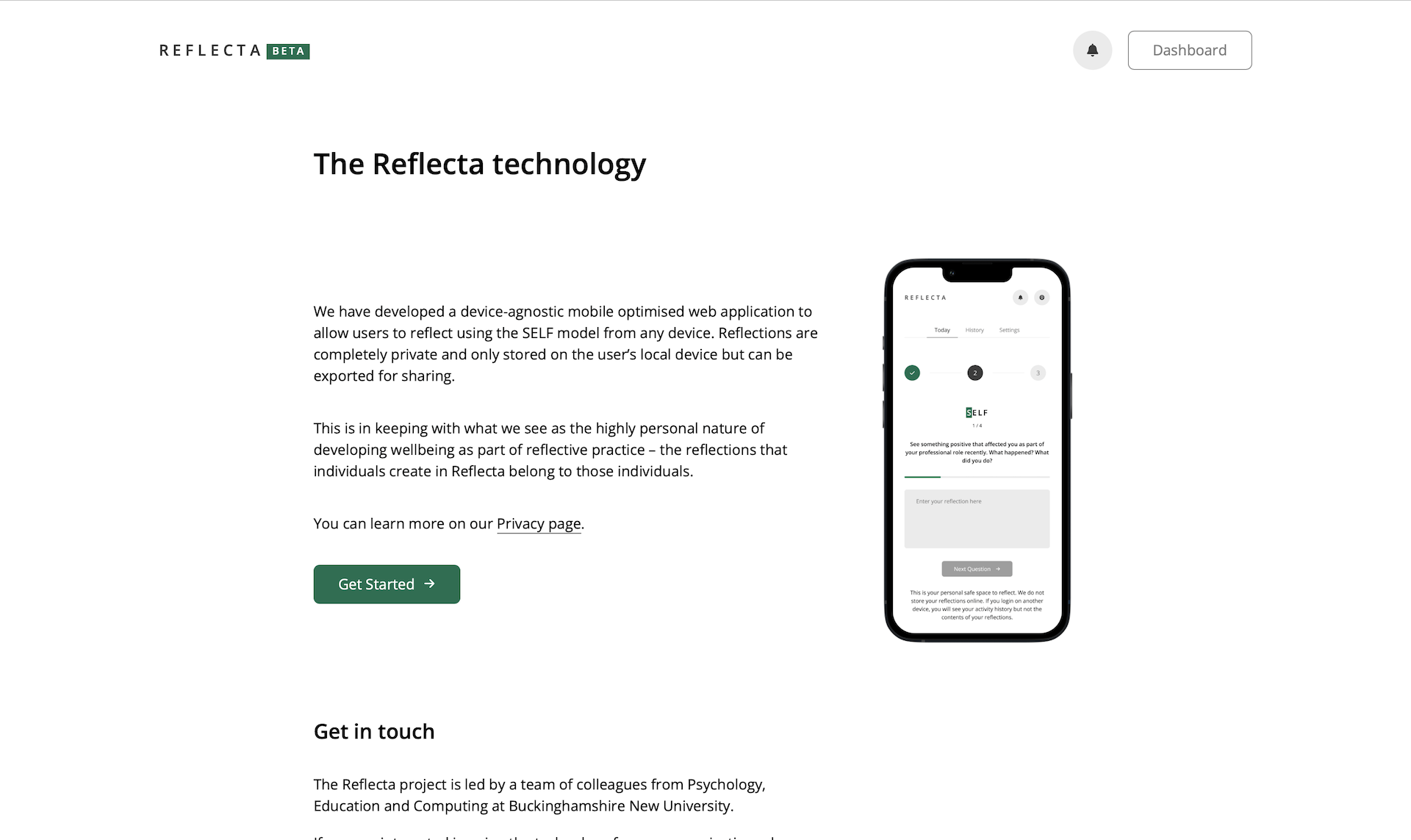
A research-informed web application built for Buckinghamshire New University to operationalise a new model of reflective practice grounded in positive psychology.
The Context
Reflection is a powerful tool for learning. Many professions, and most notably healthcare, require reflection to promote and capture ongoing professional development. In the UK, for example, the Nursing and Midwifery Council require written reflections as part of an auditable process for practitioners to maintain their registration.
These same professions are under significant strain in terms of the mental health of staff. NHS Digital data consistently shows that mental health issues including anxiety, stress, and depression are the most reported reason for staff sickness absence. Wellbeing is increasingly recognised as a precursor for effective practice, as per the updated professional standards of the Health and Care Professions Council.
Accordingly, wellbeing initiatives have seen considerable growth across healthcare and other sectors. Researchers at Buckinghamshire New University saw a missed opportunity to harness the professional requirement for reflection to support wellbeing. Existing models of reflection are effective pedagogically but do not counteract a natural human tendency to dwell on problems. In response, the SELF model was developed — a new reflective framework grounded in positive psychology:
- Start with something positive
- Explain key points of the experience
- Learn from the experience
- Frame the experience in terms of what is valued (these may be professional standards)
SELF has been shared at a number of conferences, with a theoretical paper for a mobile-optimised technology to support positive reflection presented at INTED2023 in Valencia. Underpinning research and a pilot study using the SELF model has also been presented at conferences including Advance HE’s Mental Wellbeing in HE Conference and Teaching and Learning Conference in 2023, and the International Assessment in Higher Education Conference in 2025. SELF is not seen as a fix for mental health, but a practical framework for engaging with wellbeing as part of regular workplace learning.
What the team needed was the technology to put the SELF model into practitioners’ hands.
The Brief
BNU commissioned a mobile-optimised web application to guide users through the SELF model. The project was led by a cross-disciplinary team from Psychology, Education and Computing, with Jon Jackson (Computing) authoring the technical brief and Rebecca Rochon (Education) leading on the pedagogical framework and research.
Core requirements included guided reflection through structured SELF prompts, a breathing exercise before each reflection, a personal reflection history with export capability, configurable reminders to encourage regular reflective practice, and — critically — a privacy architecture that kept personal reflection content off the server entirely.
The project followed an agile approach: requirements were refined iteratively through collaborative discussion between the academic team and Rocking Tech. The MVP needed to be live and usable by a pilot group within approximately two months of kick-off.
Privacy by Design
The most significant technical decision — and the one that defines this project — was where to store the reflection text.
Early in the project, the working assumption was that reflection text would be stored in the database alongside user accounts and session metadata. Through collaborative discussion between the academic team and Rocking Tech, we landed on a more radical approach.
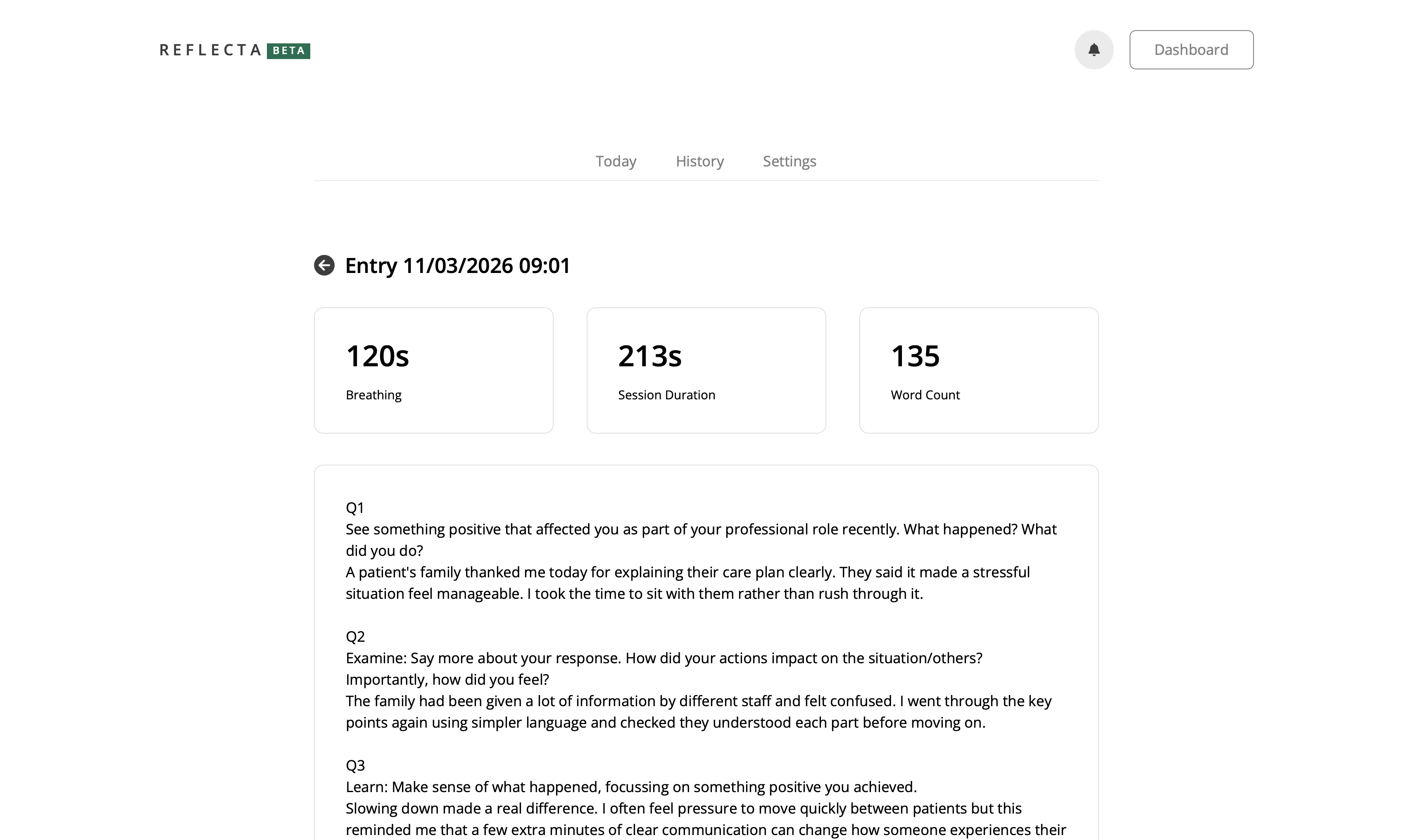
In the production application, reflection text is stored exclusively in the browser’s localStorage. The server stores only metadata: that a reflection occurred, its timestamp, breathing exercise duration, and word count. The personal content — what the practitioner actually wrote about their experiences, their feelings, their strengths — never leaves their device.
The principle behind this is straightforward: data that isn’t stored centrally cannot be leaked centrally. This aligns with what the UK GDPR calls data minimisation — collect and retain only what is necessary for the purpose. Reflecta needs to know that someone reflected, not what they wrote. So that’s all the server holds.
Users can export or print their reflections for sharing — for instance, as CPD evidence for revalidation or further development as part of an assessment — but that choice remains theirs. No database breach can expose what someone wrote in a vulnerable moment of professional reflection.
For a platform targeting healthcare professionals already navigating complex data governance requirements, this architecture removes an entire category of risk.
Stack and Infrastructure
The application was built on Laravel 9 with a Vue.js frontend, MySQL database, and deployed on a DigitalOcean droplet. We developed a custom UI Kit with BEM CSS methodology, LESS variables for consistent styling, and fully responsive layouts tested across devices.
Authentication uses magic links — a one-click email login that eliminates password friction for users who may be reflecting during a short break between shifts. The Vue Router provides seamless page transitions for a native-app experience without the overhead of app store deployment.
The platform was originally containerised with Docker for microservice-style deployment. Over time, running containers on a modest single-droplet server proved heavier than it needed to be — occasional database timeouts required manual restarts. We migrated to native nginx and PHP-FPM, which simplified the stack and resolved the reliability issues. Hosting now runs at $6 per month, which matters for a university-funded research project with no commercial revenue.
The Reflection Journey
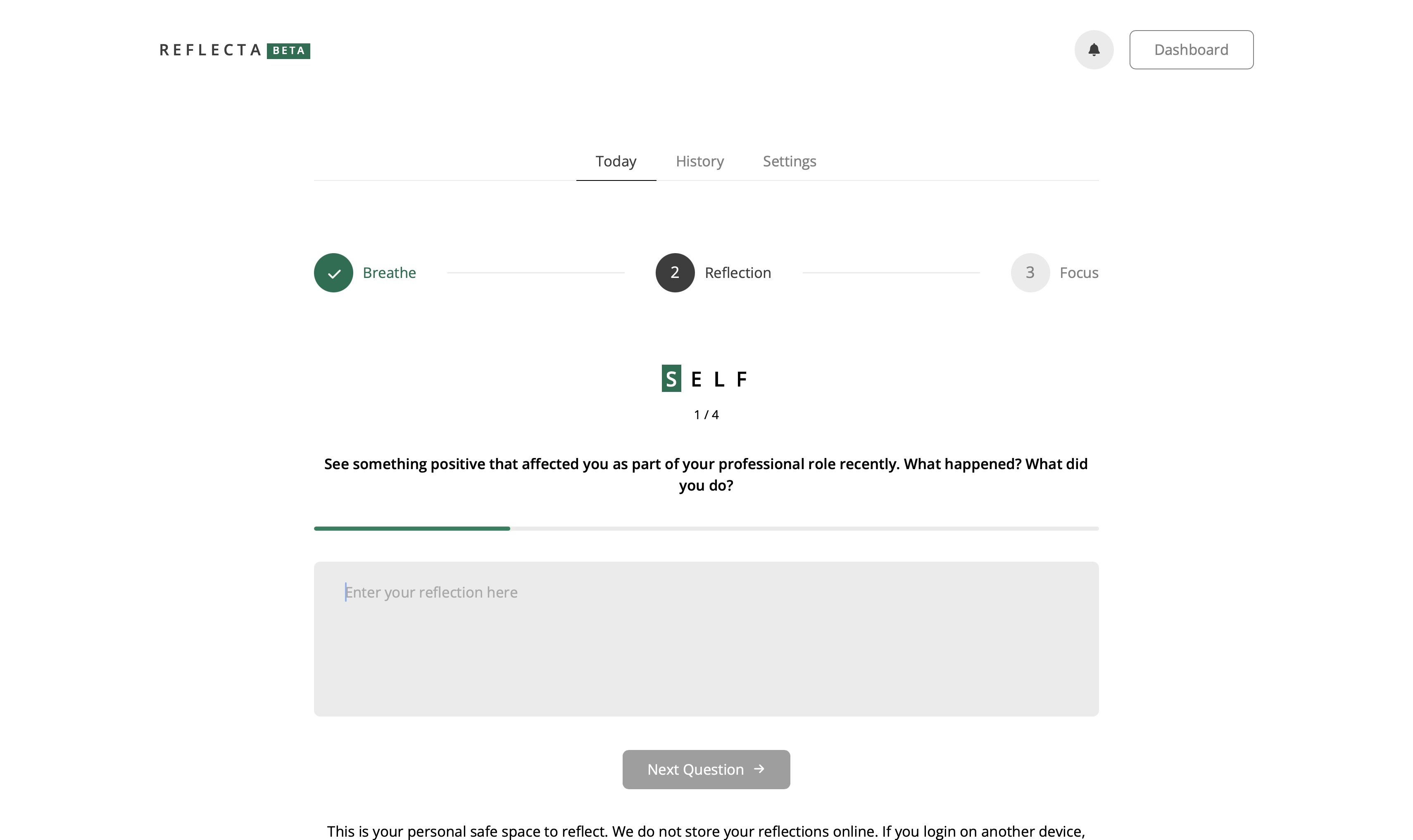
The user experience follows the SELF model sequentially. After logging in, the practitioner begins with a timed breathing exercise — a mindful pause before reflection. They then work through structured prompts covering each SELF stage, with localStorage preserving progress if the page is accidentally refreshed.
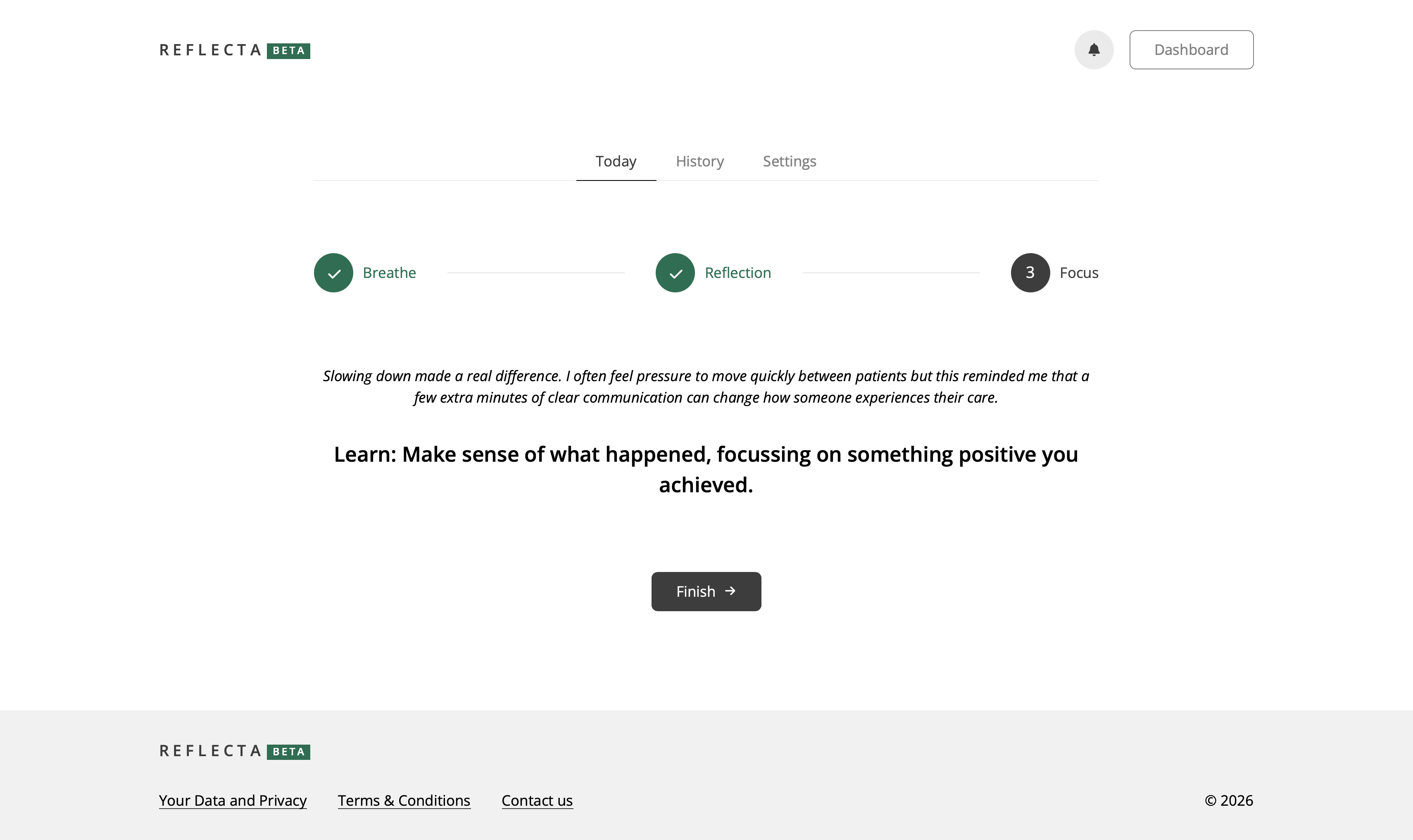
A focus page follows submission, prompting the user to revisit their identified strength and consider its impact. Configurable reminders (day and time) encourage regular practice without being intrusive. The history view displays reflection metadata — date, duration, word count — with the option to revisit content stored locally on the device used.
Reflection sessions can be exported for professional portfolios, making it straightforward to evidence CPD engagement for revalidation.
The Outcome
The platform launched in March 2023, piloted with users at BNU, and has since been shared at numerous other conferences as well as demonstrated to apprenticeship audiences at Queen Mary University of London.
Reflecta continues to run as an active platform at reflectaproject.com with plans to work on a configurable version for application in apprenticeship and professional learning.
Academic References
Rochon, R., Jackson, J. and Knight, J. (2023) ‘Mobile technology for professional development and wellbeing: The Reflecta project’, Proceedings of 17th International Technology, Education and Development Conference, Valencia, Spain, 6–8 March. pp. 8074–8078.
Rochon, R., Knight, J., Smith, M., Avery, C. and Allen, N. (2023) ‘Evaluating SELF: a new model of reflection for learning and promoting wellbeing’. Advance HE’s Mental Wellbeing in HE Conference 2023, Manchester, 16 May 2023.
Rochon, R., Knight, J., Smith, M., Avery, C. and Allen, N. (2025) ‘Could assessment be good for wellbeing?’, International Assessment in Higher Education Conference 2025, Manchester, 19–20 June 2025.
Rochon, R. and Smith, M. (2023) ‘Think about yourSELF: Reflection as a tool for both learning and wellbeing’. Advance HE Teaching and Learning Conference 2023, Keele University, 4–6 July 2023.
Ready to Build Something Real?
We build custom platforms for founders who’ve outgrown templates and no‑code. Laravel architecture, AI integration, one senior developer — no handoffs.