· 6 min read
What Happens When Your Laravel Developer Leaves
Your Laravel developer just handed in their notice. You have a month's notice, an application you depend on, and no clear picture of what it would cost — or take — to replace them. This is what actually happens next, backed by UK market data on replacement costs, security risk, and what most businesses get wrong.

Anatoly Silko
Founder, Rocking Tech

It usually happens on a Tuesday. Not a Monday — people don't quit on Mondays. It's mid-week, mid-afternoon, and your developer asks for a quick chat. By the time you get back to your desk, you have a resignation letter, a one-month notice period, and a growing awareness that you have no clear picture of what they've built, how it works, or who you'd even call to fix it if something went wrong.
For thousands of UK businesses running custom Laravel applications, this is not a hypothetical. It's a Tuesday that either happened already, or is coming.
This piece is about what happens next — and what it actually costs.
The knowledge problem nobody talks about
The first thing most MDs reach for is a job spec. That's understandable. The instinct is to replace the person, not the knowledge — as if hiring someone new will restore everything the departing developer carried around in their head.
It won't. And the data on this is sobering.
Research across hundreds of software projects consistently finds that the majority have a "bus factor" of one or two — meaning a single departure puts the entire codebase at risk. That's not a criticism of developers. It's the natural consequence of how bespoke applications get built: incrementally, by someone who knows the context, rarely with the time or incentive to document every decision along the way.
Your new developer — whoever you hire — will spend their first months learning what your last developer already knew. And you will pay for that learning twice: once in salary, once in the time your application sits still while they find their feet.
According to Oxford Economics, IT workers take an average of seven months to reach full productivity in a new role. On a codebase with no documentation, practitioners consistently estimate six to twelve.
What replacing a Laravel developer actually costs
The salary figure is the number most MDs focus on. The total cost is considerably larger.
UK recruitment agencies charge 15–25% of first-year salary for permanent placements — 20% is standard for tech roles. On a mid-level Laravel developer at £55,000, that's £11,000 before a single line of code is written. Senior roles push that figure to £13,750–£16,500.
But recruitment fees are roughly 18% of the real bill.
The Oxford Economics and Unum study — the most rigorous UK research on this topic — found that replacing an employee in the IT sector costs an average of £30,614 in total, with 82% of that figure attributable to lost productivity during the search and onboarding period. Critically, the IT sector had the longest time to optimum productivity of any sector studied: more than seven months.
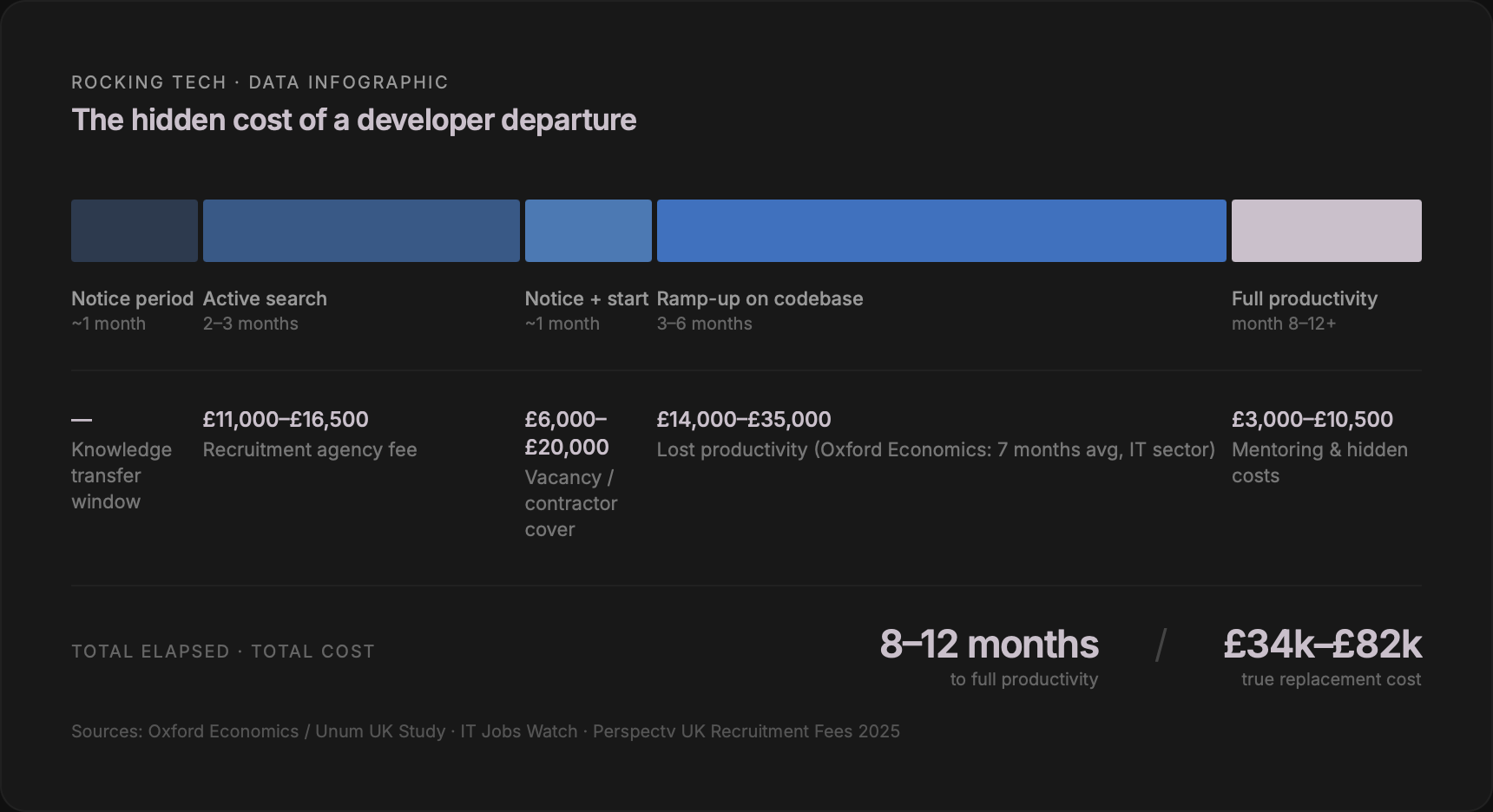
Run those numbers on a £55,000 salary and the total replacement cost lands somewhere between £34,000 and £82,000 depending on seniority, documentation quality, and how long the vacancy runs. The wide range is not imprecision — it reflects the difference between a well-documented handover and a developer who left in difficult circumstances.
Most small businesses are closer to the upper end than they'd like to think.
While you're searching, the clock is running on something else
Here is the part that doesn't make it into most conversations about developer departures: while you're interviewing candidates and negotiating start dates, your application is not standing still. It's ageing.
Laravel and PHP both follow fixed support lifecycles. Every version receives roughly two years of security patches, then nothing. As of early 2026, Laravel 11's security support ends this month. Laravel 10 stopped receiving patches in February 2025. If your application is running either version without active maintenance, you are already accumulating unpatched vulnerabilities.
PHP itself follows a similar pattern. PHP 8.1 reached end-of-life on 31 December 2025. PHP 8.0 in November 2023. Applications still running older PHP versions have had no security support for years.
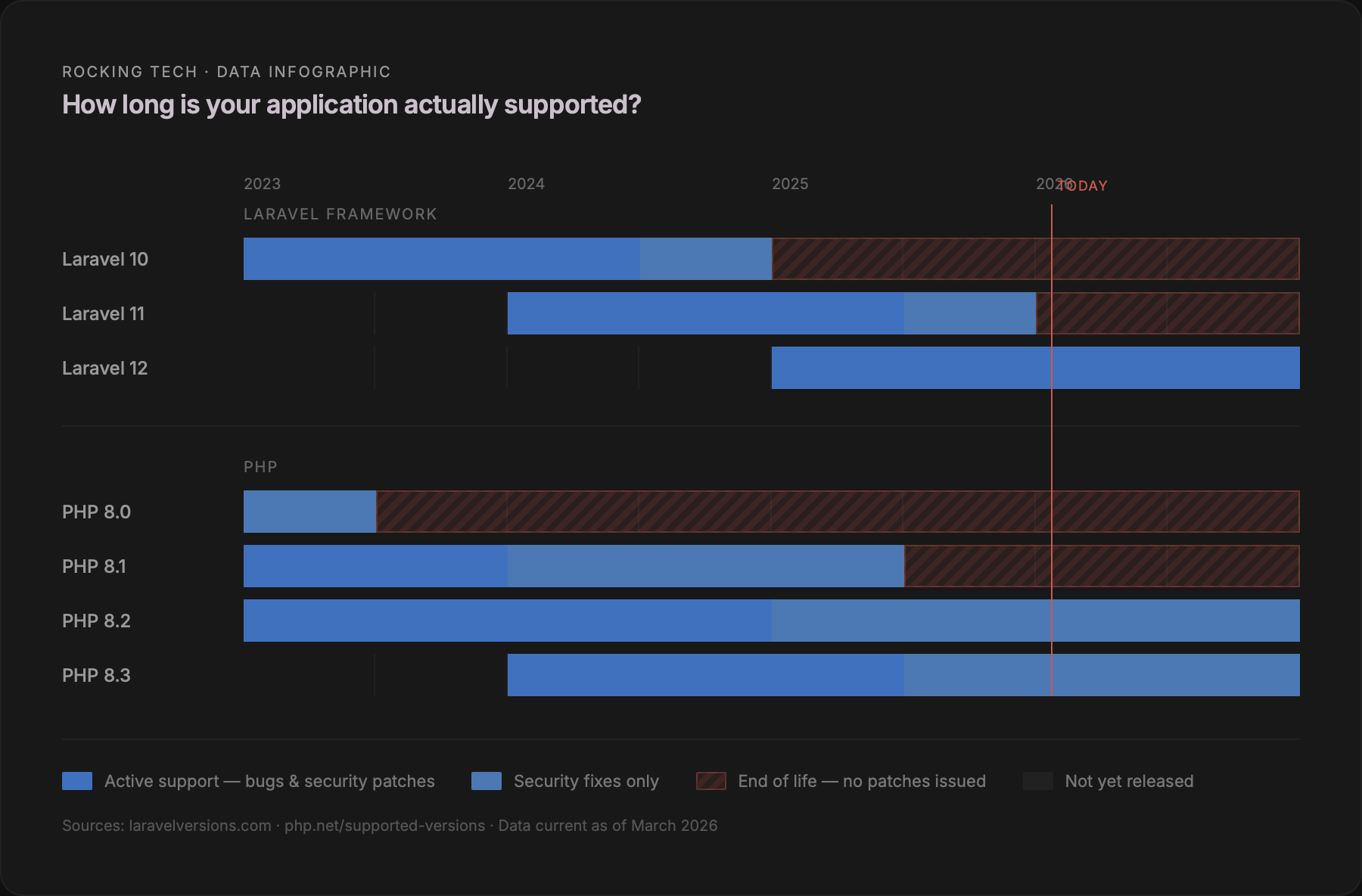
The vulnerability accumulation is not theoretical. PHP averages 15–18 new CVEs per year. Laravel itself averages three to four, but they tend to be severe — the average CVSS severity score for Laravel vulnerabilities in 2024 was 9.3 out of 10. Two of the most exploited have been added to the US Government's Known Exploited Vulnerabilities catalogue and are actively targeted by automated scanning tools.
Over 24 months without maintenance, a typical Laravel application will have accumulated 30 or more unpatched PHP vulnerabilities alone, alongside framework and dependency issues that grow with every Composer package the application relies on.
The UK Government's Cyber Security Breaches Survey 2025 found that 43% of UK businesses experienced a cyber breach or attack in the preceding year. The average cost of the most disruptive incident: £3,550 — but that excludes the incidents at the severe end of the scale, where IBM's UK data puts the average data breach cost at £3.29 million.
ICO enforcement is escalating regardless of business size. Fines in 2025 reached £19.6 million from just seven cases, compared to £2.7 million from 18 cases the year before.
What most businesses actually do
The honest answer, based on UK SME data and the pattern Rocking Tech sees consistently, is: not much. At least not immediately.
The first three months after a developer departs tend to be calm. Systems keep running. No customers complain. The MD concludes, consciously or not, that the urgency is lower than expected.
Months three to six bring minor friction — a small integration stops working, an SSL renewal becomes awkward, a dependency update gets skipped because nobody knows whether it's safe to apply. Each issue is manageable in isolation.
Beyond twelve months, the picture changes. Framework versions fall out of support. Hosting providers force PHP upgrades that require code changes nobody on the current team can confidently make. GDPR compliance questions arise that the application's architecture wasn't designed to answer.
The UK Government's SME Digital Adoption Taskforce identified this pattern directly — describing a prevalent "head in the sand" approach to technology among non-technical owners, and a large population of businesses that are aware they need technical support but lack a clear picture of how to act.
The triggers that finally force action are almost always external: a customer-facing function breaks in a way that's visible, a security incident occurs, a compliance deadline arrives, or a growth opportunity requires system changes that can't be made without deep knowledge of the codebase.
By that point, the cost of remediation is significantly higher than the cost of prevention would have been.
The comparison that changes the calculation
A managed support retainer for a Laravel application typically runs £450–£2,000 per month in the UK market, depending on hours and response time requirements. Enterprise-level support with higher SLAs and dedicated developer capacity sits above that.
Against the £34,000–£82,000 true cost of a full replacement hire — plus the seven-month productivity gap, plus the codebase risk that accumulates during the search — the arithmetic is not especially complicated.
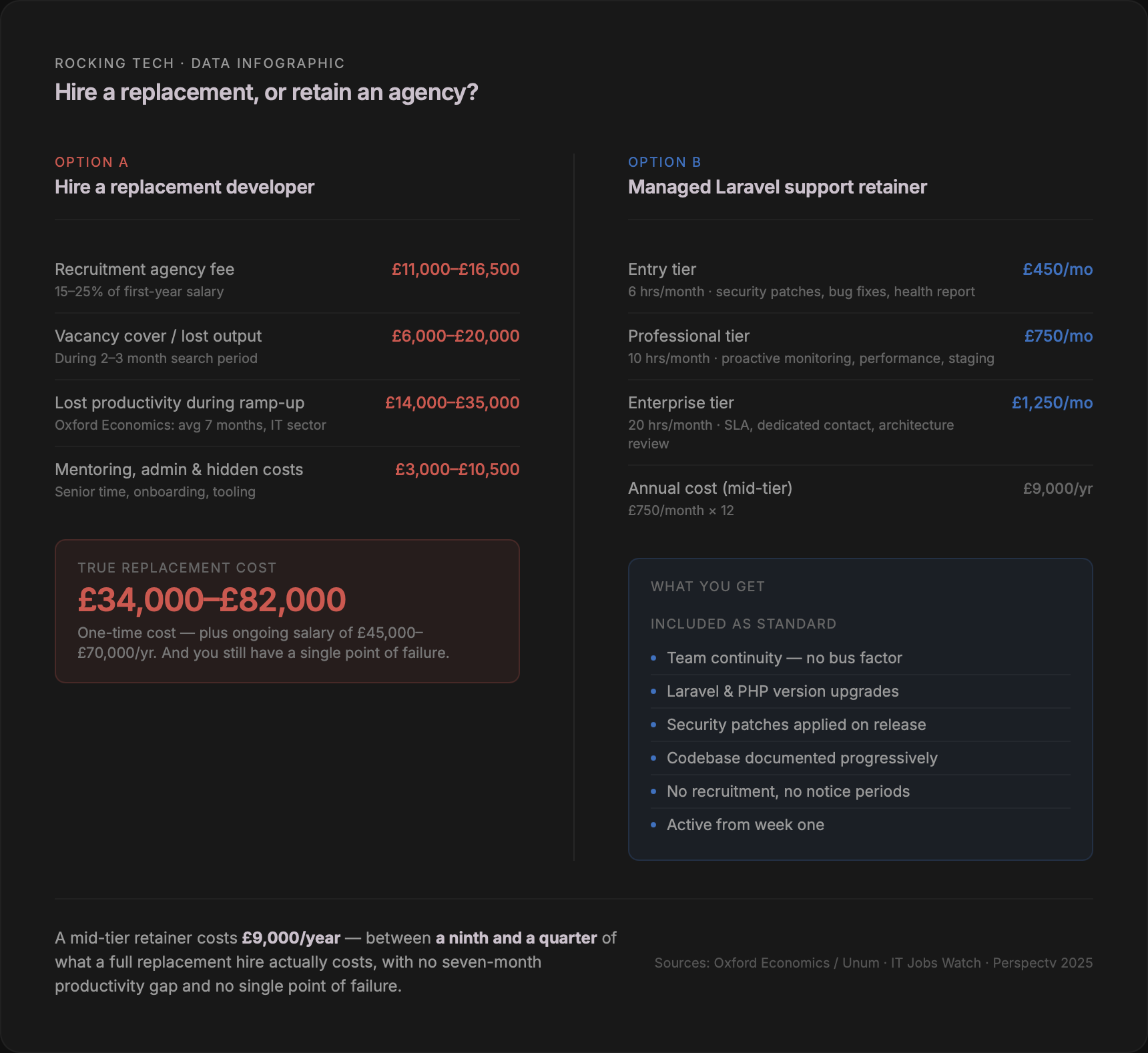
But the more important point is structural. Hiring a replacement developer solves the headcount problem. It does not solve the single point of failure. A sole in-house developer — however good — is still one resignation, one illness, or one competing offer away from the same situation.
An agency retainer operates differently. The knowledge about your application lives in documentation, in an internal team structure, and in systems designed to survive individual departures. The bus factor is not one. It is the agency itself.
What to do if you're already in this position
If your developer has already left, or has just handed in their notice, there are three immediate priorities.
First, document everything that can still be documented while they're still in the building — environment setup, deployment processes, third-party credentials, anything undocumented that only they know. A structured exit interview focused entirely on the application is worth more than the standard offboarding checklist.
Second, run a version audit. Find out what PHP version the application is running, which Laravel version, and when each reached or will reach end-of-life. This takes thirty minutes and gives you an accurate picture of your current exposure.
Third, get a codebase health assessment from a Laravel agency before you commit to a hiring strategy. The assessment changes the decision: what you learn may significantly affect whether you hire, what you hire, or whether ongoing support is the better path.
Stop worrying about your Laravel app
Book a free discovery call. We’ll discuss your situation and recommend the right plan.