· 5 min read
Automate Before Hiring: AI Workflows for UK SMEs
Your next hire can cost over £41,000 in its first year. Before you commit to a salary, three jobs — lead qualification, invoicing and onboarding — can be handed to AI agents instead.

Anatoly Silko
Founder, Rocking Tech

A £30,000 hire can cost more than £41,000 in its first year. The more interesting number is what it costs to hand the repetitive half of that role to an AI agent instead: a one-off £2,500, live in weeks. That gap is why a growing number of UK businesses now automate before hiring.
What your next hire actually costs
Employer National Insurance rose to 15% in April 2025, with the threshold cut to £5,000 (HMRC), so a £30,000 salary carries £3,750 in NICs before anything else. Pension adds around £713, agency recruitment runs 15–20% of salary, and equipment plus the slow ramp to full productivity make up the rest.
The figures are illustrative and worth confirming with your accountant, but the shape holds: the salary is the part you see, and it is rarely the biggest part.
The better question is whether the work overwhelming you needs a person at all. For most growing businesses, three jobs hit the ceiling first — lead qualification, invoicing and client onboarding — and all three are now things software does well rather than badly.
Lead qualification: an agent that never sleeps
The problem here is speed, not effort. Contact an inbound lead within five minutes rather than thirty and you are 21 times more likely to qualify it (Harvard Business Review / MIT, 2011 — US data, directional). Yet when researchers tested 114 companies, just one replied within five minutes (Workato). The window is tiny and almost everyone misses it, because no person can sit on the inbox around the clock.
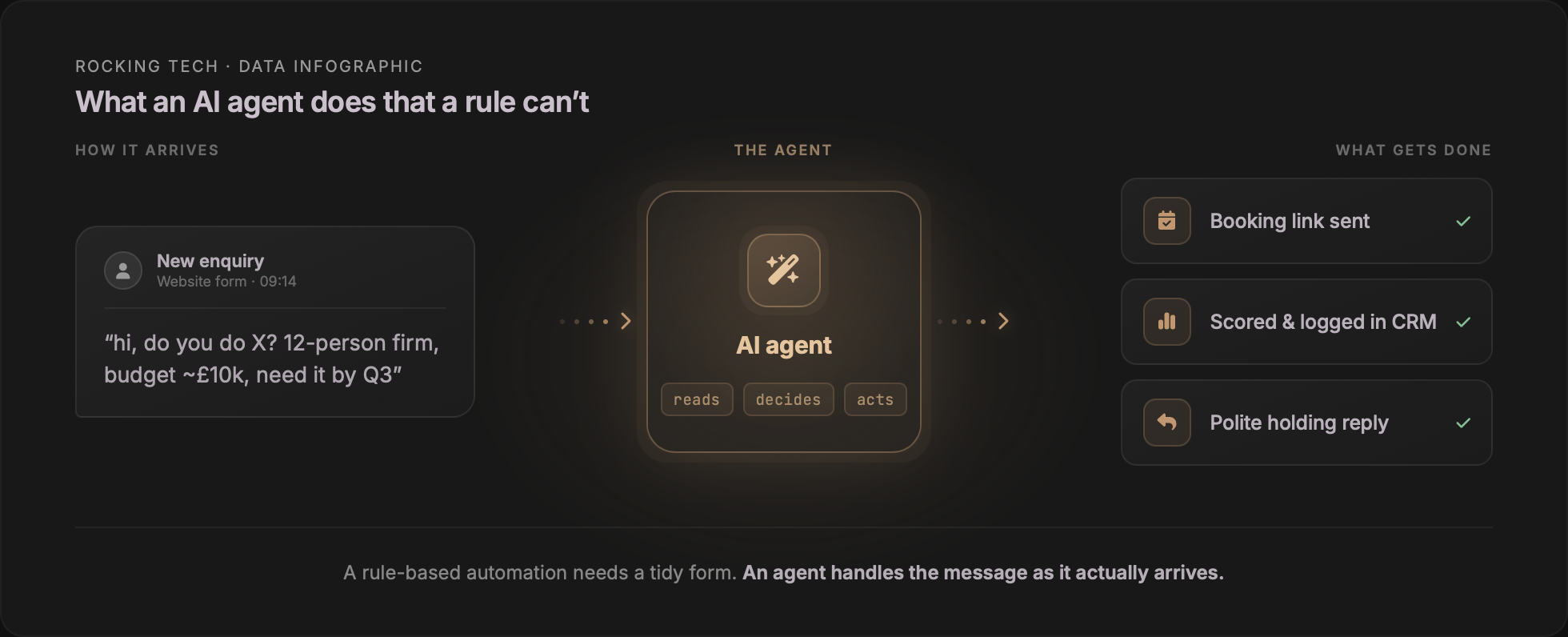
An AI agent can. Picture the enquiry that actually arrives: "hi, do you handle X, we're a 12-person firm, budget maybe £10k, need it live by Q3?" A rule-based automation chokes on that, because it isn't a tidy form. An agent reads it, works out what's being asked, scores it against your criteria, replies in seconds with the right next step, drops a booking link in front of the good ones, sends a polite holding note to the rest, and logs all of it to your CRM before you've finished your coffee.
That's the real shift — from automation that follows instructions to automation that makes decisions. The same agent handles the message that doesn't fit the script, which is exactly where the old tools fell over.
The limit is judgement. Score too tightly and you bin good leads, so the calls that matter run past a human before anything goes out. (More on choosing what to automate first: what to automate first and what to leave alone.)
Invoice processing: the finance admin you don't hire
Getting paid eats more time than most founders admit. Around half of small-business leaders spend four hours a week on payment issues (Sage, 2025), and the average SME is chasing five overdue invoices worth about £8,500 at any moment, losing roughly 90 minutes a day to it (Tide). Late payment is the norm, not the exception: 62.6% of invoices sent by UK SMEs are paid late (FreeAgent, 2024–25), draining almost £11 billion a year from the economy (DBT / Small Business Commissioner).
Now the automation. Invoices generate and go out on schedule. Reminders chase themselves. The bank feed reconciles without you. And the part that used to mean opening every attachment by hand: an agent reads an incoming supplier invoice, pulls out the line items, matches them against what was ordered, notices the one that's £200 over, and routes that single one for approval while clearing the rest. It handles the exception rather than handing it back to you.
It connects to the software you already run — Xero, QuickBooks, FreeAgent. (Whether Making Tax Digital applies to you from April 2026 is a question for your accountant; clean digital records simply fall out of a workflow like this anyway.)
Trust it blindly and it can mis-file something unusual, so anything touching money sits behind a check. To see whether a given workflow pays for itself first, our ROI framework for AI automation runs the maths.
Client onboarding: from "yes" to "ready" without you
The least glamorous job does the quietest damage. Hard UK data on onboarding is thin, but the admin it generates is the same kind that already costs SMEs hours a week — and it lands in the first fortnight, exactly when a new client is deciding how organised you are.
So automate the handover. The moment a deal closes, the agent fires the sequence: contract out for signature, payment set-up, a welcome message, the intake form that collects what you'd otherwise email back and forth for, the kickoff booked, the internal handoff sent. When a client returns documents out of order or skips a step, the agent adapts instead of stalling. They go from signed to ready while you sleep, and your team spends its time on the welcome that genuinely needs a person.
Over-automate that human part and a high-value client feels processed rather than welcomed — so the warmth stays manual and only the mechanics run themselves.
What it actually is
These three are the workflows our AI Automation Solution builds: £2,500 + VAT, up to three of them, and for most businesses exactly the three above. They run on OpenAI agents, Google Vertex AI, or self-hosted n8n — and where it's self-hosted, you own the workflows outright.
They are agents, not brittle rule chains: they read, decide, and handle the messy edge cases that break simpler tools. Most go live in two to six weeks, with 30 days of support after launch and running costs of roughly £20–100 a month on OpenAI or £10–50 self-hosting n8n. Data handling is GDPR-ready, and on anything sensitive an agent drafts while a human approves.
The real shift is from automation that follows instructions to automation that makes decisions.
When to automate before hiring — and when to hire anyway
This is about order, not ideology. Automation is excellent at volume, repetition and the judgement-light middle of a process. It is no substitute for the work that needs a person — owning a relationship, making a call you can't reduce to a rule, thinking something up. If that's your bottleneck, hire, and the £41,000 is simply the cost of doing it properly. (The Employment Allowance — £10,500 for 2025/26, eligibility rules apply — can offset much of the NIC, so the net figure is often lower.)
But if what's drowning you is lead chasing, invoice admin and onboarding logistics, that isn't three reasons to add a salary. Clear them first, and your next hire walks into a business where the repetitive work already runs itself — which is the only kind of hire worth making.
This article is general information about automation, not financial, tax or legal advice. Figures are illustrative — confirm your position with a qualified accountant or adviser.
Let us find the one thing worth automating
Book a free 30-minute consultation. We’ll look at your workflows and tell you honestly whether automating one of them is worth it. No commitment.