· 13 min read
What to automate first in your business and what to leave alone
EY estimates 30–50% of initial RPA projects fail — usually because the business picked the wrong process, not the wrong tool. Here is a scoring framework you can apply in an afternoon.

Anatoly Silko
Founder, Rocking Tech

Every growing business has a list of processes that feel like they should be automated — data entry between the CRM and the accounting system, proposal generation, lead follow-ups, onboarding paperwork, monthly reporting, client scheduling, invoice chasing. The list is usually somewhere between ten and twenty items long, and the founder knows that at least a few of them are costing real time every week. The problem is not awareness. The problem is that nobody can tell you which one to do first, and doing them all at once is a guaranteed way to waste money.
Get the sequence right and you prove the concept inside your own business within weeks. Get it wrong and you spend thousands of pounds automating something that saves nobody any meaningful time, then quietly conclude that automation does not work for businesses like yours. That conclusion would be wrong — but the experience that produced it was real, and the budget is already gone.
This article gives you a structured way to pick the right first target. It is a scoring method you can apply to your full list of candidate processes in a single sitting, without needing a technical background or an expensive discovery engagement to get started.
The failure rate is real, and the cause is not what most people assume
Ernst & Young's published guidance on RPA implementation states that 30 to 50 per cent of initial RPA projects fail (EY, "Five design principles to help build confidence in RPA implementations"). That is not a figure about all automation everywhere — it is specifically about the first wave of projects, the ones where organisations are learning what works. Deloitte's 2018 global RPA survey of 400 enterprises found that 63 per cent experienced delays and missed deadlines, and that only 3 per cent had successfully scaled their digital workforce (Deloitte, "The Robots Are Ready. Are You?", 2018). The 2022 follow-up, covering 479 executives across 35 countries, named the persistent barriers: integration difficulties at 62 per cent, skills gaps at 55 per cent, and inability to change business processes at 52 per cent (Deloitte, "Automation with intelligence", 2022).
Notice what is not on that list. Not the tools. Not the APIs. Not the AI models. Those work fine. What fails is the decision about which process to hand them.
For a five-to-fifty-person UK business spending somewhere between £2,500 and £25,000 on an automation project, the practical implication is uncomfortable: the dominant risk is not that the automation breaks, but that you spend the budget on the wrong process, see disappointing results, and never try again. The cost of the failed project is not just the invoice — it is every month you continue doing something manually that should have been automated a year ago.
The dominant risk is not that the automation breaks. It is that you spend the budget on the wrong process, see disappointing results, and never try again.
Why gut instinct makes a poor selection tool
Most founders pick their first automation target based on whichever process annoys them most, whichever one they saw automated in somebody else's case study, or whichever one a vendor demonstrated in a sales call. None of these are terrible starting points, but none of them account for the four variables that actually predict whether a project will deliver a return quickly enough to justify the next one.
We have written separately about how to calculate ROI on automation before you commission anything, so this article is not about the payback maths. It is about the step before the maths — deciding which process deserves the calculation in the first place.
The enterprise world has frameworks for this. UiPath publishes a detailed assessment algorithm that scores candidate processes on automation potential, ease of implementation, hours saved per year and strategic alignment (UiPath, "Automation Hub Detailed Assessment Algorithm", current). McKinsey recommends identifying the most critical business processes rather than chasing solutions to specific pain points (McKinsey, "The imperatives for automation success"). Deloitte's intelligent automation maturity model sequences organisations through pilot, implement and scale phases (Deloitte, 2022).
All useful. All designed for organisations with a Centre of Excellence, a programme office and a six-figure budget. None of them are built for a founder with fifteen processes on a whiteboard and ninety minutes before the next client call.
What follows is.
The VEER score — four dimensions, one sitting
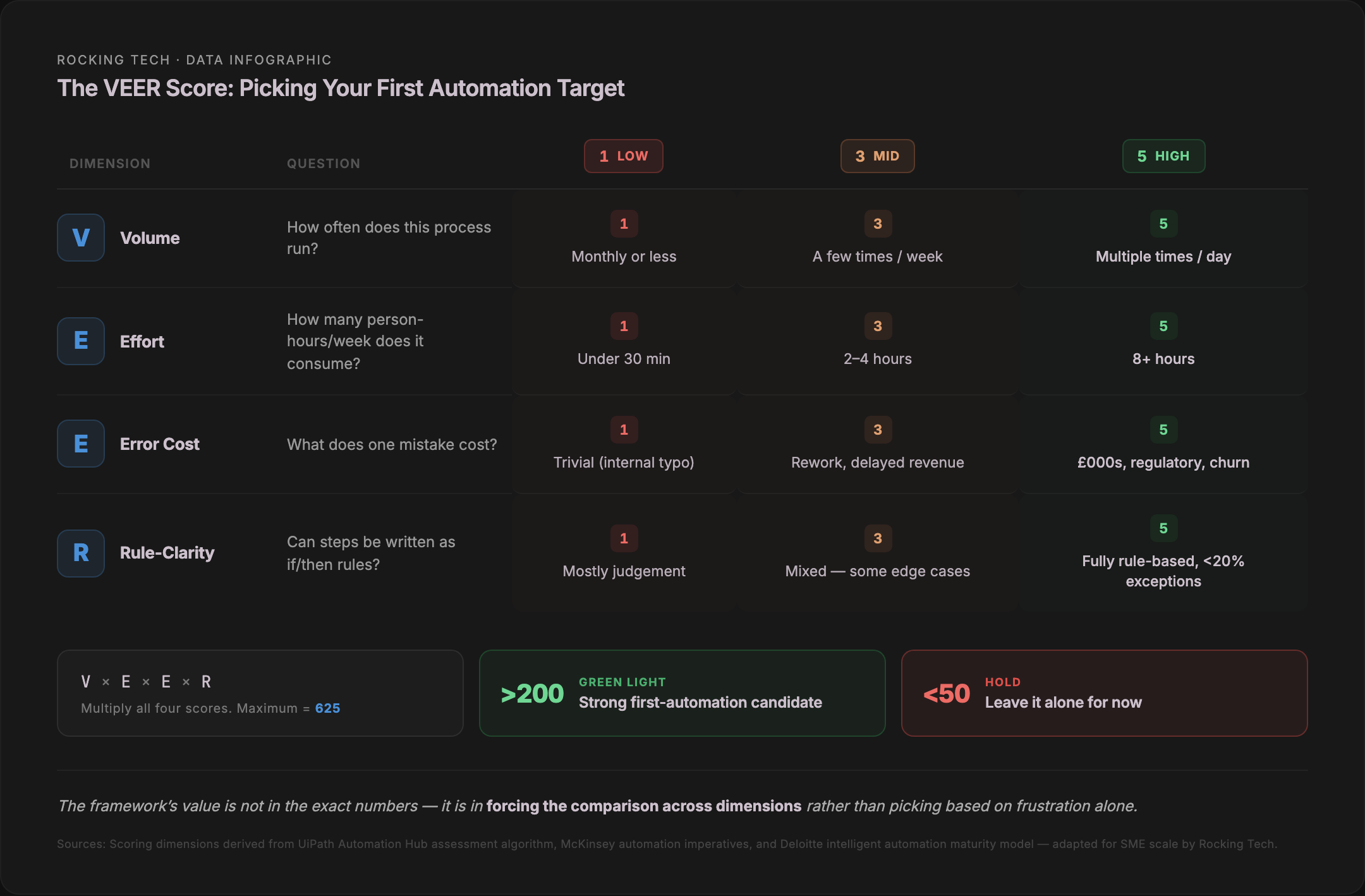
VEER stands for Volume, Effort, Error cost and Rule-clarity. These are the four dimensions that every credible automation framework measures in some form, stripped down to a scale a non-technical founder can apply without outside help.
V — Volume. How many times per week does this process run? Score 1 if it happens monthly or less, 3 if it runs a few times a week, 5 if it runs multiple times a day. Volume matters because automation compounds — a process that runs twice a day saves 520 manual executions a year, while a process that runs once a month saves twelve. Same build cost, radically different returns.
E — Effort. How many person-hours per week does this process consume? Score 1 if it takes under thirty minutes, 3 if it takes two to four hours, 5 if it takes eight hours or more. This is where the time-saving headline lives. Sage's 2025 research found that UK small businesses lose 24 working days per year to financial admin alone — what they described as "13 months of work for 12 months of pay" — and that 49 per cent of CEOs and COOs personally spend four hours a week on it (Sage, "The hidden admin burden on small businesses", May 2025). If your highest-effort process sits in that category, you already know where to look.
E — Error cost. What does a single mistake in this process actually cost? Score 1 if the impact is trivial — a typo in an internal note that someone catches the same day. Score 3 if errors create rework, customer friction or delayed revenue. Score 5 if a mistake triggers financial loss, regulatory exposure or customer churn. Error cost is not evenly distributed across your business. Equifax UK's research found that UK SMEs spend an average of 1.5 hours per day chasing late invoices, collectively representing £6.3 billion worth of time spent pursuing owed cash rather than growing the business (Equifax UK, "Tackling late and missing payments"). A wrong line on a VAT return starts at £100 in HMRC penalties and escalates. A wrong line on an internal stand-up note costs nothing. Processes whose errors carry financial, legal or trust consequences should score higher here, because preventing those errors is worth proportionally more.
R — Rule-clarity. Can every step of this process be written as an if/then rule, with exceptions covering fewer than 20 per cent of cases? Score 1 if the process requires case-by-case human judgement on most inputs, 3 if the core path is rule-based but a meaningful number of edge cases need human review, 5 if the inputs are structured, the logic is deterministic and exceptions are rare. This is the variable most founders underestimate. UiPath's automation assessment documentation and several published RPA suitability checklists converge on the same threshold: if exceptions and edge cases represent less than 20 per cent of total process volume, the process is a strong automation candidate (UiPath, "Automation Hub", current; AF Robotics, "The Automation-Ready Enterprise", 2024). Above 20 per cent exceptions, you will spend most of your budget on exception handling rather than on the happy path, and the result will feel brittle.
Multiply the four scores. Maximum is 625. Anything above 200 is a strong first-automation candidate. Anything below 50 is not worth touching yet. These thresholds are not magic numbers — they are a way to force the comparison and separate the top three from the bottom ten.
Running the score in practice
Block ninety minutes with whoever runs your operations. If that person is you, block ninety minutes with yourself and a spreadsheet.
Start by listing every candidate process. Walk the business mentally — anything done more than once a week by hand goes on the list. Do not filter at this stage; the scoring handles that. You will likely surface more candidates than you expected.
Score each one on the four dimensions, 1 to 5. You do not need precise measurements for this. The person who does the work knows whether it takes thirty minutes a week or eight hours. They know whether a mistake costs nothing or costs thousands. Rough-and-ready is the whole point — perfectionism here just delays the decision.
Multiply the four scores for each process. Highlight everything above 200.
Now apply two veto tests before committing to anything.
The first is the readiness veto. If the inputs to a high-scoring process are unstructured — handwritten notes, scanned PDFs in unpredictable layouts, free-text emails with no consistent format — drop it down the list even if the VEER score is high. Unstructured inputs mean expensive preprocessing, which inflates cost and delivery time. That does not make the process unautomatable — it makes it a poor first project.
The second is the customer-visibility veto. For your first automation, prefer processes where a failure is invisible to your customers. Internal data synchronisation between CRM and accounting software is low-risk if something goes wrong. An outbound AI voice agent calling prospects on your behalf is high-risk. Start where mistakes are cheap and quiet. Build trust — with your team and with yourself — before you automate anything customer-facing.
Then pick the top one to three. Not five. Not ten. The most common failure mode in the UK SME automation market is trying to scope too many processes at once. It is well-documented enough that credible UK agencies explicitly warn against it in their published pricing guidance.
Finally, set a measurable target before any build work begins. "More efficient" is not a metric. "Reduce monthly invoice processing time from 14 hours to 2 hours within 8 weeks" is a metric. Without a number you cannot know whether the project succeeded, and you cannot build the business case for the next one.
Where UK SME time actually goes
Not all processes are equal candidates, and the data tells you where the biggest pools of recoverable time sit.
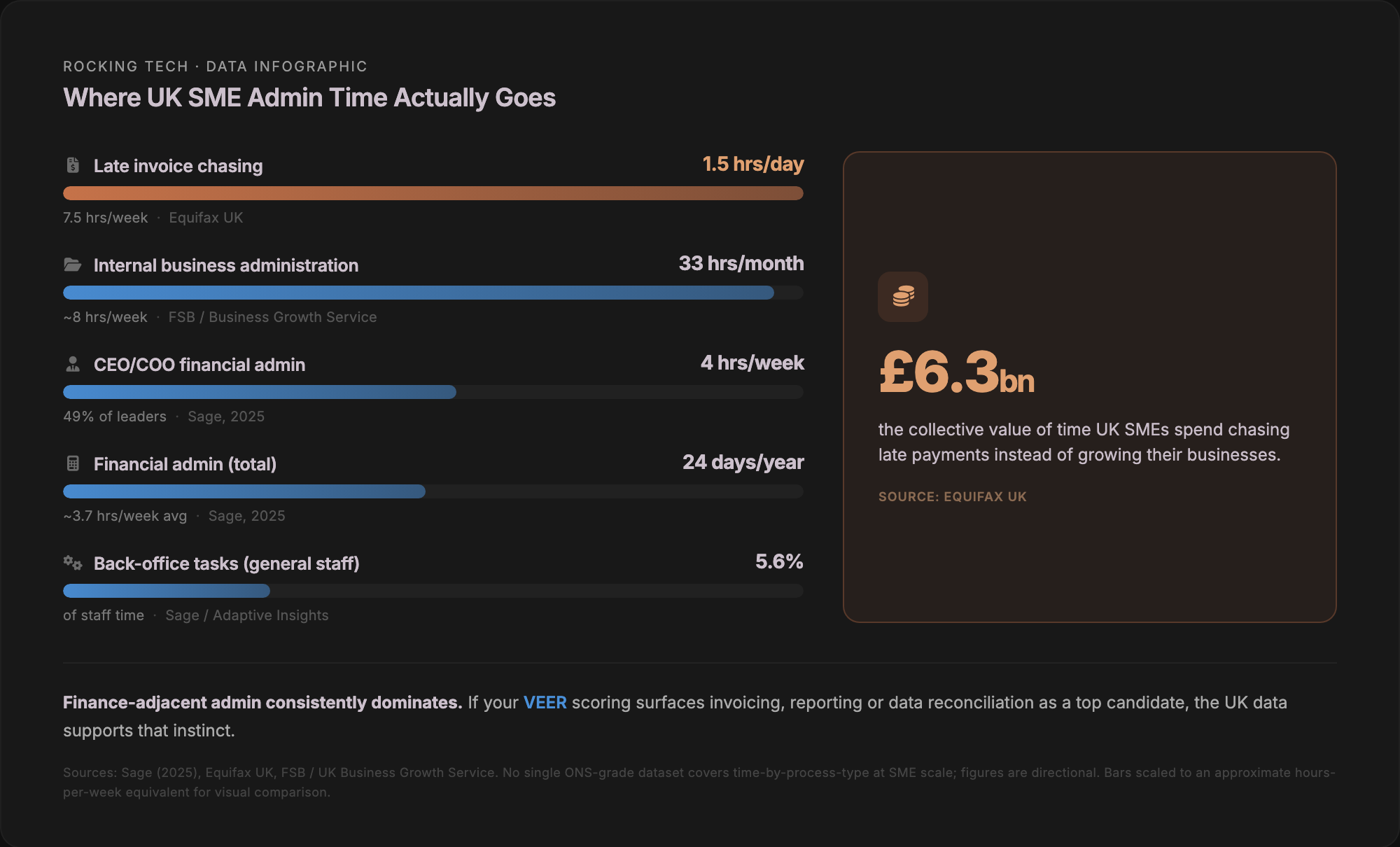
Sage's 2025 research is the most granular UK-specific source on this: 24 working days per year lost to financial admin per SME, with accounting administration consuming more than 20 per cent of total admin time (Sage, 2025). Equifax UK puts a finer point on the invoicing piece: 1.5 hours per day per SME chasing late invoices, collectively worth £6.3 billion to the economy (Equifax UK). The Federation of Small Businesses and the Business Growth Service estimate 33 hours per month on internal business administration across UK SMEs — roughly eight hours a week, or a full working day, spent on work that generates no revenue and produces no competitive advantage (FSB / UK Business Growth Service).
There is no single ONS-grade dataset that breaks SME time down by process type, so these figures are assembled from three sources and should be treated as directional rather than definitive. But the pattern is consistent: finance-adjacent admin dominates, followed by compliance and HMRC obligations, followed by customer admin like onboarding, scheduling and quoting. Stock management and inventory sit lower unless you are in ecommerce or manufacturing.
This matters for your VEER scoring because the highest-effort processes cluster around invoicing, reporting, data reconciliation and compliance — exactly the processes that also tend to score highly on volume and rule-clarity. Finance admin is often the right first target not because it is the most exciting work to automate, but because the maths simply works better than anywhere else on the list.
Error cost is not uniform, and that changes the priority order
We covered the ROI calculation methodology in a previous article in this cluster, so the formulas are not repeated here. But one finding from the research deserves its own section because it directly affects how you score the error-cost dimension of VEER.
A 2026 government-commissioned study by London Economics estimated the total economic cost of late payments to UK businesses at almost £7 billion a year — approximately 0.13 per cent of total business turnover (London Economics, GOV.UK, 2026). The average SME is owed roughly £22,000 in unpaid invoices at any given moment (Equifax UK).
At the individual process level, vendor research from invoice-processing platforms estimates that roughly one in eight manually-processed invoices requires rework — a figure broadly consistent with what we see in our own discovery workshops, though the exact rate varies by industry (Rossum; Shipamax). A widely referenced IDC/Cognisco study of 400 US and UK businesses put the cost of employee misunderstanding, which includes data-handling errors, at $624 per employee per year (IDC/Cognisco, "Counting the Cost of Employee Misunderstanding", 2008). That study is now nearly two decades old, so treat it as directional rather than precise — but the underlying principle holds regardless: manual processes accumulate small errors that compound into real cost, and the compounding is faster in some processes than others.
The practical takeaway for your VEER score is straightforward. A process that handles money, compliance or customer commitments should get a higher error-cost score than one that handles internal coordination, even if both feel equally frustrating day to day. The financial exposure is different by orders of magnitude.
What makes a process ready to automate — and what makes it a trap
A high VEER score is necessary but not sufficient. Some processes score well across all four dimensions but will still make a poor first project because of structural readiness problems that the score does not capture.
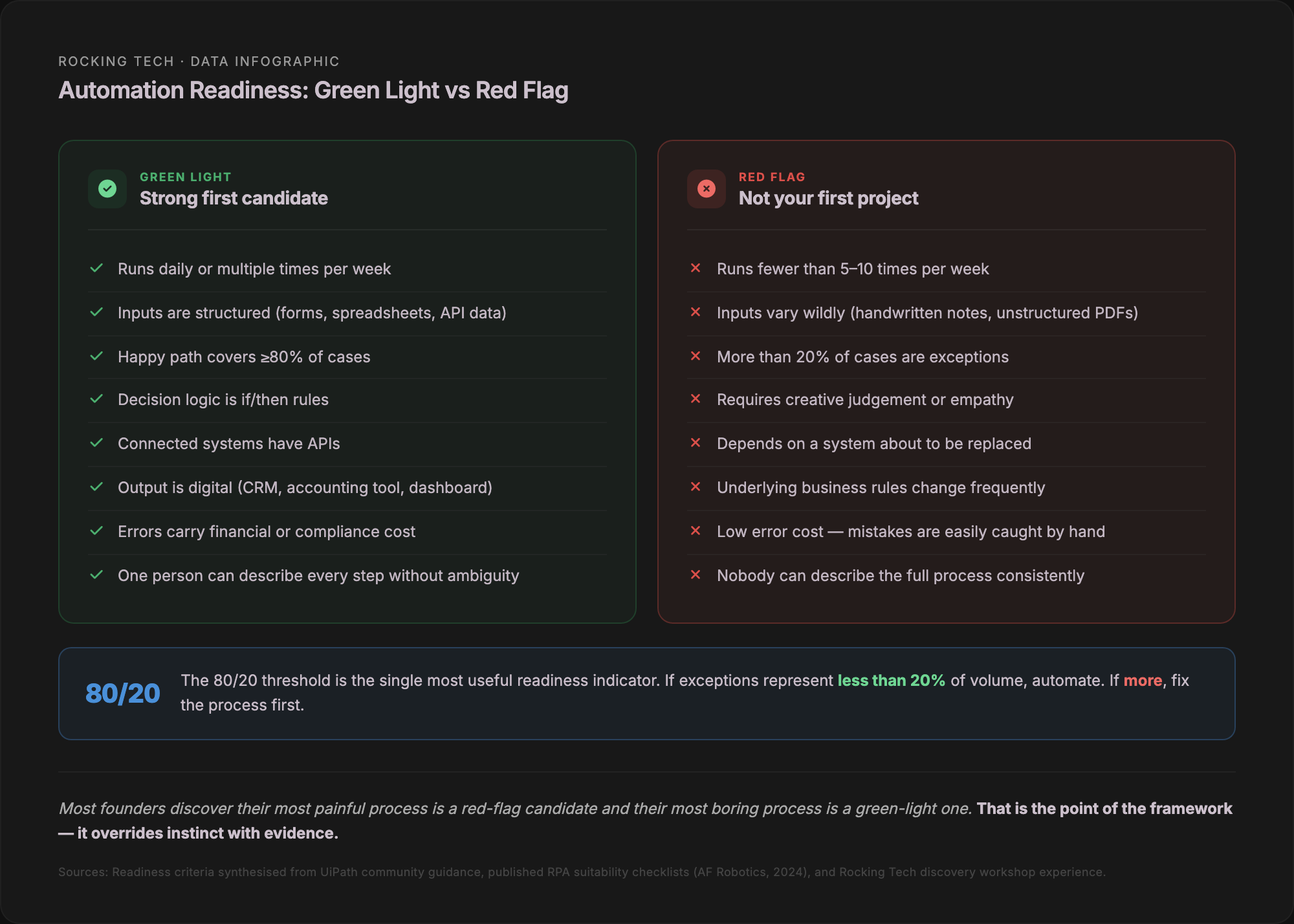
A process is a strong first-automation candidate when most of the following are true: it runs at least once a week, inputs arrive in a predictable and structured format, the happy path covers 80 per cent or more of cases, the decision logic is rules-based rather than requiring case-by-case judgement, the systems involved have APIs or stable interfaces, and the output goes into a digital destination — a CRM, an accounting tool, a dashboard — rather than a paper file or somebody's inbox.
A process is a poor first candidate when it requires creative judgement or empathy (negotiation, complex sales conversations, sensitive HR decisions), when inputs vary wildly in format, when more than 20 per cent of cases are exceptions, when the underlying business rules change every few weeks, or when it depends on a system that is itself about to be replaced.
This is why the five tasks every growing business should delegate are the tasks they are — they pass these readiness tests cleanly. And it is why the processes that feel most painful, which are usually customer-facing and judgement-heavy, are often the worst place to start.
What happens when businesses automate the wrong thing first
Specific, named case studies of automation projects that started with the wrong process are rare — businesses do not publish their mistakes. But the pattern that emerges from published post-mortems, typically written up by the agencies called in to fix the problem, is remarkably consistent.
In one case documented by a UK automation consultancy, a logistics company spent four months building an AI demand-forecasting system (Relay Automate). Technically impressive work. Saved exactly zero hours of manual labour, because the forecasts still had to be typed into the ERP by hand. The bottleneck was order entry, not prediction accuracy. The right first project was the boring one — automating the data transfer between systems. They built the showcase before they built the plumbing.
Another published example describes a mid-sized manufacturer that spent six months automating invoice processing (Autonoly). They mapped every step and successfully automated steps one, three, eight and nine. The real problem lived in steps four through seven. The result was a faster broken process: automation that executed the wrong workflow more efficiently than a human ever could.
A third, from a staffing firm: the team tried to automate payroll without first standardising the data flow or onboarding processes feeding into it (AF Robotics, 2024). The outcome was broken bots, duplicate records and frustrated teams. After stepping back and running a proper readiness assessment, re-mapping the documentation and data flow reduced payroll processing time by 70 per cent.
In every case the automation itself worked fine. It just worked on the wrong thing.
From score to action
The VEER score gets you to a shortlist. Here is the sequence that turns that shortlist into a working automation.
This week: block ninety minutes with operations. List every recurring manual task on one page. For each one, capture three numbers — times per week, hours per week, and the rough cost of a single mistake. Apply the VEER score. Highlight everything above 200.
Next thirty days: from the highlighted list, eliminate anything that fails the readiness or customer-visibility veto. Book a discovery conversation with a UK automation specialist. Use a fixed-fee engagement as your benchmark — it should include a discovery workshop, the build itself, integration with your existing tools, documentation, training and a defined support window. If a quote exceeds £10,000 without a paid pilot stage, push back.
Sixty to one hundred and twenty days: implement one automation. Measure against the baseline you set before the build started. If you hit the target, repeat the VEER exercise with the experience you have now earned. Second automations tend to be cheaper and faster — the integration plumbing from the first project (API connections, authentication, data mappings) is typically reusable.
Three situations that change the playbook
Your top-scoring process is customer-facing and is also your single biggest revenue lever — inbound lead qualification, say, or proposal generation. In that case, skip the customer-visibility veto and treat it as a higher-risk, higher-reward bet. Buy more discovery time. Accept that the first version will need closer monitoring than a back-office automation would.
Your team is already running more than five Zapier or Make zaps that frequently break. The right first project here is not new automation — it is consolidation and observability. You need to know what is running, what is failing silently, and where the data is actually going. We have written about when businesses outgrow middleware platforms and what the options look like when that happens.
Your bookkeeping is more than two weeks behind reality. Fix that with a human before you automate it. Automating a process that runs on inaccurate data does not fix the accuracy problem — it scales it.
The framework is free — the build does not have to be expensive
Everything above is designed to be useful whether or not you ever speak to us. A reader who applies the VEER score, picks the right first target and finds a local freelancer to build it has got genuine value from this article. That is the point.
But if you want the build done properly — discovery workshop, production-grade workflows, integration with your existing CRM, email and accounting tools, documentation, team training and post-launch support — that is what our AI Automation Solution exists to do.
Let us find the one thing worth automating
Book a free 30-minute consultation. We’ll look at your workflows and tell you honestly whether automating one of them is worth it. No commitment.