· 9 min read
n8n vs Make vs Zapier for UK Businesses
Zapier, Make and n8n all work — for simple stuff. The question most founders eventually face is not which platform to pick, but what to do when all three stop being enough.

Anatoly Silko
Founder, Rocking Tech

Most businesses I work with started on Zapier. It connected their CRM to their email tool, ran a few workflows, and worked fine — until it didn't. The workflows got complicated, the bills crept up, someone left and nobody could untangle what they had built, and now there is a stack of automations that half the team is afraid to touch.
The conversation always starts the same way: "Which platform should I be on?" But the real question — the one underneath — is usually different. It is not about which tool to pick. It is about whether the tool-based approach still fits what their business needs.
This article is that answer. Not a feature comparison spreadsheet. Not a pricing calculator. A founder's guide to what each platform genuinely does well, where each one hits a wall, and what the options look like when your workflows have outgrown drag-and-drop.
We have covered the broad automation landscape and how to calculate ROI before committing to anything elsewhere. This piece goes deeper on the three platforms that dominate the UK market — and on the moment when none of them is the right answer.
What the three platforms actually do
If you have not used any of them, the short version is this. All three let you connect your business tools — CRM, email, accounting, Slack, Shopify, whatever — and automate the handoffs between them. New order comes in, invoice gets created, confirmation email goes out, CRM gets updated, team gets notified. No developer needed. You build it in a visual editor, it runs in the background, and your team stops copying data between systems.
Zapier is the most popular. Over 7,000 app integrations, the simplest interface, and a natural-language builder that lets you describe what you want in plain English. It is the fastest to set up and the easiest for a non-technical team to maintain. For straightforward, linear workflows — trigger happens, actions follow in sequence — Zapier is hard to beat.
Make (formerly Integromat) sits in the middle. It has a visual canvas where you can see your entire workflow as a diagram, with branching paths, loops, and error handling built in. It is more powerful than Zapier for complex logic and materially cheaper at volume. The trade-off is a steeper learning curve — expect a few hours before you are comfortable with how it thinks.
n8n is the most technically capable. It supports custom code, AI agent workflows, and can be self-hosted on your own server for full data sovereignty. The AI stack alone — over 70 nodes for language models, vector stores, and agent architectures (docs.n8n.io/advanced-ai/langchain) — is deeper than anything Zapier or Make offers. The trade-off is that n8n expects you to be technically comfortable, or to have someone on your team who is.
All three are good at what they do. The problems start when your business asks them to do things they were not designed for.
The hidden cost nobody talks about
The pricing pages for these platforms show low monthly numbers. And those numbers are real — if your workflows are simple and your volumes are modest. But every platform counts your usage differently, and the differences matter more than the headline price.
Zapier charges per action step. A five-step workflow costs five tasks every time it runs. Make charges per module, including the trigger and any filters or loops — and loops multiply fast when you are processing lists of items. n8n charges per workflow run regardless of how many steps are inside it, but its cloud pricing has a sharp cliff between its mid-tier and business plans with no option in between.
The practical result: a workflow that processes 500 orders per day can cost under £50 a month on Make, several hundred pounds on Zapier, and over £500 on n8n Cloud — for the same work (zapier.com/pricing, make.com/en/pricing, n8n.io/pricing — all accessed May 2026). The platform you choose determines whether automation is a rounding error on your P&L or a line item that makes you wince.
But here is the thing most comparison articles miss: the platform bill is rarely the real cost. The real cost is what happens inside your business when the workflows get complicated.
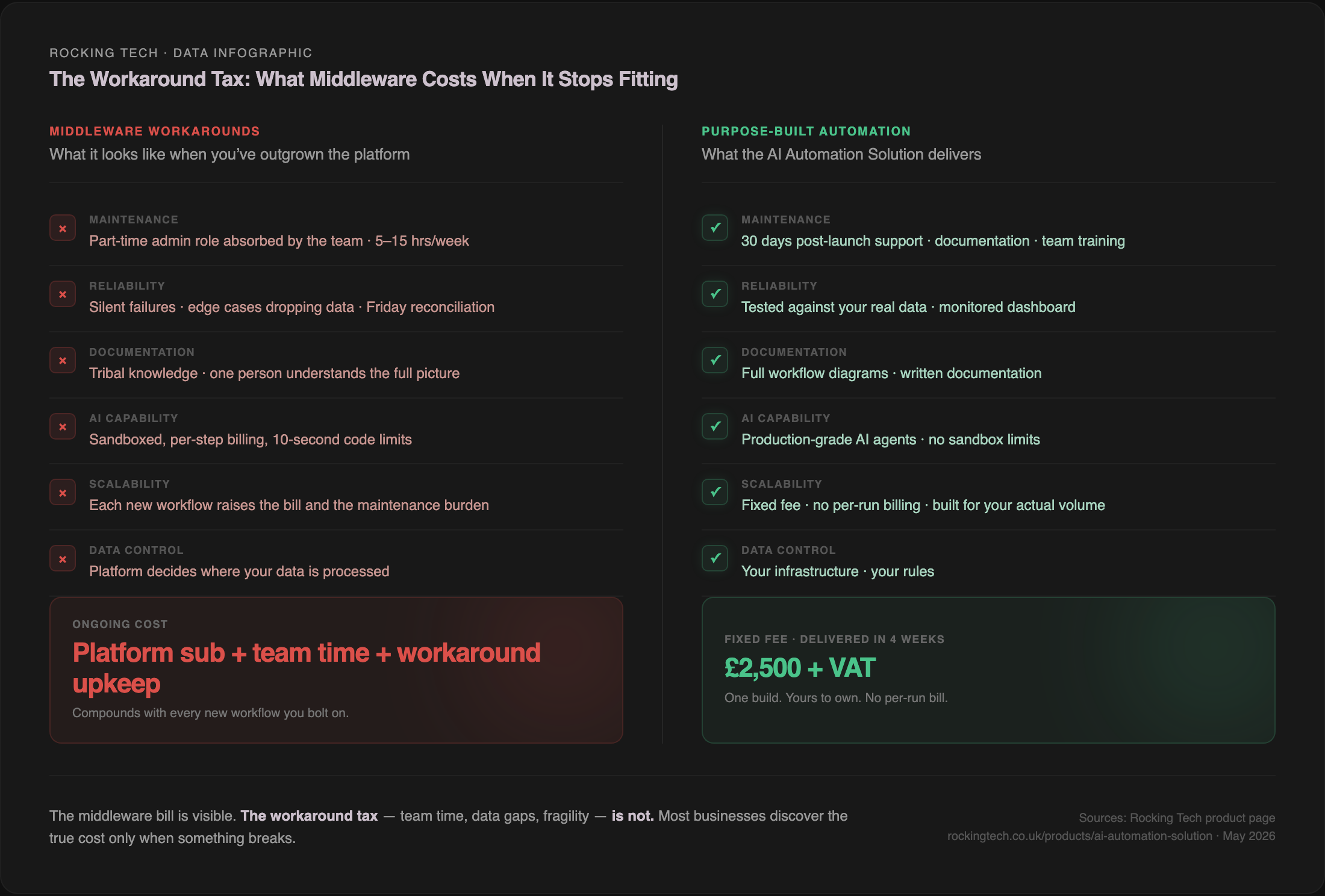
The platform bill is rarely the real cost. The real cost is the 15 hours a week your team spends maintaining workarounds that exist because the platform cannot do what your business actually needs.
Where middleware breaks down
Every automation platform works on the same basic principle: if this happens, do that. Trigger, action, done. That model handles roughly 80% of business automation cleanly. The remaining 20% is where things go wrong — and that 20% typically consumes 80% of your team's time and attention.
Workarounds multiply. Your workflow needs to retry a failed API call with an increasing delay between attempts. The platform does not support that natively, so someone builds a workaround using code steps and delays. That workaround works — until the API changes its error format and the code step silently fails. Nobody notices for three days. By then, 1,500 orders have fallen through a gap.
AI workflows hit hard limits. You want a workflow that receives a customer email, classifies the intent, searches your knowledge base for the right answer, drafts a response, and routes complex queries to a human. On most platforms, every step in that chain is a separately billed operation — and if the AI needs to reason through multiple steps, each reasoning cycle multiplies the cost. More importantly, the platform's sandboxed code environment gives you ten seconds of execution time and no access to external libraries. You are building a sophisticated system inside a box designed for simple handoffs.
Nobody else can touch it. The person who built your Zapier workflows leaves, goes on holiday, or gets promoted into a role where they no longer have time for maintenance. The rest of the team looks at the workflow editor and sees a diagram they do not understand, connected to systems they did not set up, with logic that was never documented. This is the automation equivalent of the developer departure problem — and it plays out the same way.
Data falls through the gaps. Your CRM says one thing, your accounting system says another, and someone on the team spends every Friday afternoon reconciling the difference. The automation was supposed to keep everything in sync. It does — except for the edge cases, the error states, and the data formats the platform's built-in connectors do not handle. Those exceptions accumulate quietly until the reconciliation becomes a permanent fixture.
If you recognise this pattern, you are not alone. We documented ten signals that a business has outgrown its software stack — and the automation middleware layer is where most of them originate.
The GDPR question that actually matters
For UK businesses handling personal data — and that is nearly all of you — there is one question worth asking about your automation middleware that most founders skip: where does the data go?
Zapier processes everything through US-based servers and explicitly states there is no EU-only option (zapier.com/legal/data-privacy). Make routes EU customer data through EU-based servers but sits behind a US parent company. n8n Cloud runs on Azure in Frankfurt — EU-hosted, but the infrastructure provider is American.
For low-sensitivity data, this is manageable under the current UK-US Data Privacy Framework. For patient records, legal case files, student data, or financial information — the kind of data the ICO actively investigates — the Transfer Risk Assessment (ICO guidance finalised 17 November 2022) gets harder to pass.
We are not lawyers, and this is not legal advice. But the architectural question of where your automation middleware processes data is worth raising with your DPO before you commit to a platform. If data sovereignty matters to your business, it is a factor in the decision — not just the price.
Five signs you have outgrown middleware
The comparison above — Zapier versus Make versus n8n — assumes your workflows fit inside a platform. At a certain point, they stop fitting. The symptoms are consistent enough to list.
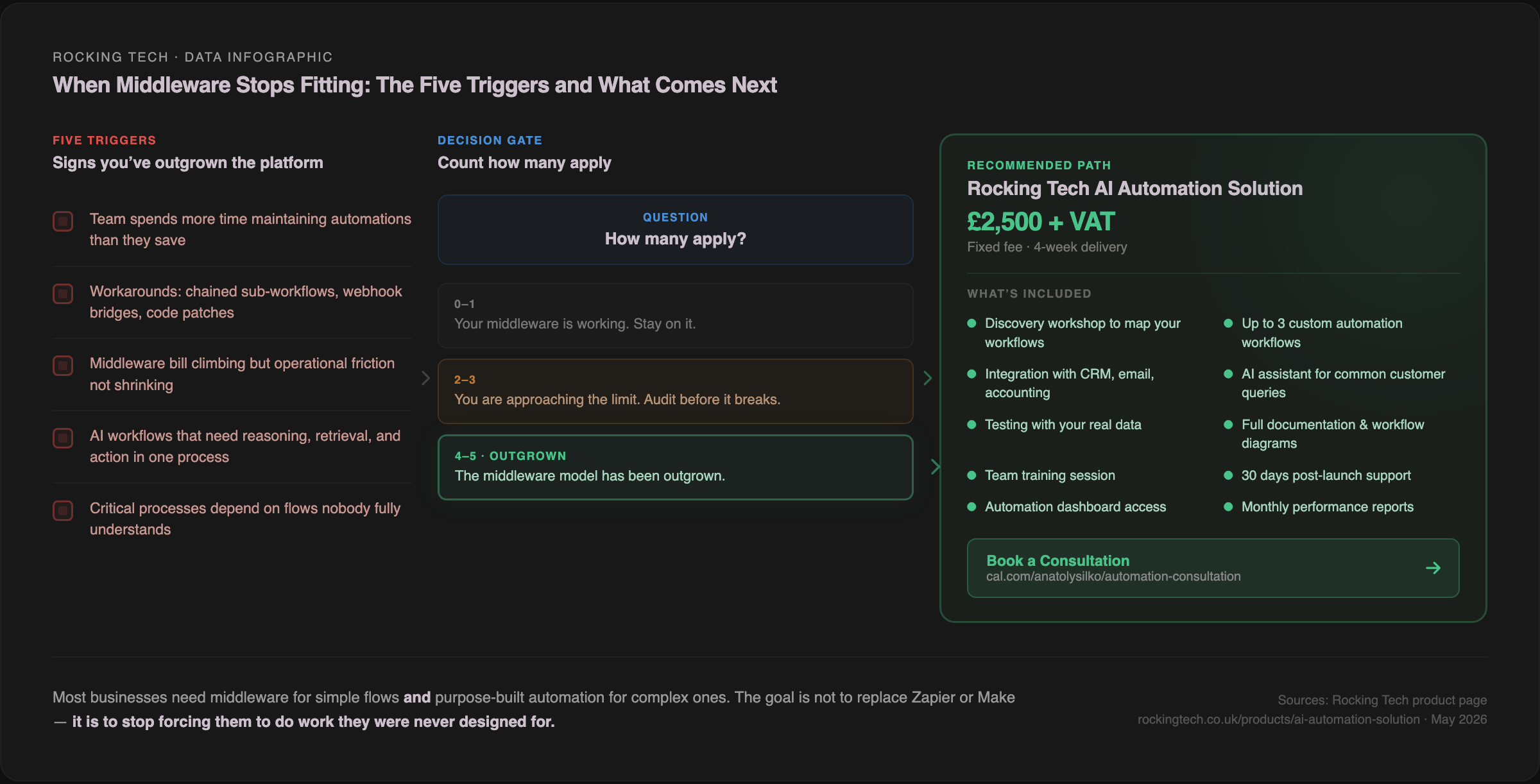
Your team spends more time maintaining automations than they save. The original promise was efficiency. The current reality is that someone on the team has become a part-time Zapier administrator, debugging failed workflows, updating broken connectors, and explaining to colleagues why the system did something unexpected. The hours saved by automation are being eaten by the hours spent keeping automation running.
You are building workarounds for what the platform cannot do. Chaining sub-workflows via webhooks. Using code steps to parse data the built-in modules cannot handle. Splitting a single logical process across four separate scenarios because the platform cannot manage the complexity in one place. These workarounds work — until they break, and then nobody can debug them because the logic is spread across multiple places that nobody mapped.
Your middleware bill keeps climbing but the results are not improving. Each new workflow adds to the monthly cost. Each new integration adds to the maintenance burden. The total spend on automation tools is growing, but the operational friction is not shrinking — it is just moving from one place to another.
You need AI that does more than call an API. The moment a workflow needs to classify, reason, retrieve context from a knowledge base, and take action based on the result — all within a single process — you are building software, not configuring a platform. The middleware tools will let you approximate it. The approximation will be fragile, expensive, and impossible for anyone other than the original builder to maintain.
Critical business processes depend on flows that nobody fully understands. Your order processing, your client onboarding, your invoicing — they run on automations that were built by one person, documented by nobody, and understood in their entirety by no one currently on the team. That is not automation. That is a liability.
What purpose-built actually means
When we say "purpose-built automation," we do not mean "replace Zapier with something more expensive." We mean: take the specific workflows that have outgrown middleware, and build them properly.
Properly means a discovery workshop where we map exactly what your workflows do — not what you think they do, but what actually happens when a real order, a real customer enquiry, or a real invoice moves through your systems. The gap between those two things is where every automation project either succeeds or fails.
Properly means integrating directly with the tools you already run — your CRM, your email platform, your accounting system — rather than routing everything through a middleware platform that adds a layer of cost, complexity, and fragility between your systems.
Properly means testing against your real data, not a sample dataset that conveniently avoids the edge cases your business encounters every day.
Properly means documentation your team can actually use. Workflow diagrams. Written explanations. A training session. Not a Zapier canvas that one person built and nobody else can read.
And properly means a fixed price. Not a monthly bill that scales with your success. Not per-run pricing that punishes you for growing. A fixed-fee engagement that delivers working automation in four weeks, with 30 days of post-launch support built in.
That is what we build. For the workflows that belong on middleware — the simple, low-volume, linear handoffs — we will tell you to stay on Zapier or Make. We are not here to replace tools that work. We are here for the 20% of your workflows that consume 80% of your time, your middleware budget, and your team's patience.
What the UK data says about where most businesses are stuck
The ONS Management and Expectations Survey (March 2025, approximately 55,000 UK businesses) found that the top barrier to AI adoption was not cost or technology. It was identifying the right use cases — cited by 39% of respondents. The BCC/Intuit "Turning Point" survey (September 2025, 1,500+ UK business leaders) found that while 35% of SMEs were actively using AI, only 11% said they used technology to a "great extent" to automate or streamline operations.
The gap between "we have automation tools" and "our automation actually works" is where most UK businesses are stuck. They know the platforms exist. They have probably signed up for one. What they lack is not a better tool — it is someone who can look at their actual processes and tell them what is worth automating, what is not, and how to build the things that are worth it so they actually hold up in production.
That is not a technology problem. It is a scoping problem. And no middleware platform — however well-designed — solves a scoping problem. Middleware solves execution once you know what to build.
The short version
Zapier, Make, and n8n are all good tools. Zapier is the fastest to set up and the easiest for non-technical teams. Make is the best value for complex visual workflows. n8n is the most technically capable, especially for AI and data sovereignty.
Use them for the simple stuff. They are built for it and they are good at it.
But when your workflows involve AI reasoning, custom business logic, regulatory-sensitive data, or processes that your business genuinely depends on — that is not middleware territory. That is engineering. And engineering is what we do.
Let us find the one thing worth automating
Book a free 30-minute consultation. We’ll look at your workflows and tell you honestly whether automating one of them is worth it. No commitment.