· 14 min read
Signs You've Outgrown Your Current Software Stack
Your operations didn't break in a single moment. They've been degrading gradually while you explained away each symptom. The data on when UK SMEs actually hit the wall is more specific than most owners realise.

Anatoly Silko
Founder, Rocking Tech

There's a particular conversation I have over and over. A founder describes a problem — a spreadsheet that keeps corrupting, a CRM that needs three workarounds to capture what they actually do, a Friday afternoon that the operations manager spends reconciling data between systems — and they describe it as a quirk. As something they're going to fix when there's time.
What they're describing is the wall. They just don't have the language for it yet.
Roughly 258,000 UK businesses sit in the 10–250 employee band right now (DBT Business Population Estimates, start of 2025). They employ 16.6 million people and generate just over half of UK private sector turnover. A meaningful share of them are running operations on stacks that stopped fitting two years ago, paying a hidden tax in productivity, staff retention, customer experience, and risk that nobody has added up.
This article does the maths. It walks through the ten signals that, taken together, mean a business has outgrown its current stack — with the actual numbers behind each one — and ends with what to do about it. If you're nodding along to five or more, the question isn't whether to act. It's how.
What the UK SME stack actually looks like in 2026
Two-thirds of UK sole traders still manage their finances in spreadsheets (Sage / IPSE survey of 1,000 UK sole traders, September 2025). Amongst employing SMEs, 32% use spreadsheets as their primary customer data tool, and half of micro-businesses have no CRM at all (Digital Socius UK CRM statistics, 2025). The Be Certified SME Digitalisation Report, surveying 700 UK SMEs in October 2025, found only 34% have digitalised compliance and certification processes — the operational backbone where spreadsheets are most stubbornly entrenched.
The pattern across these numbers is the same. The finance side gets attention because it's regulated. The operational side — the workflows that actually run the business — gets duct tape.
Sitting on top of that duct tape is a steadily expanding SaaS layer. The average UK company holds 27 SaaS subscriptions (Cledara, March 2026). For SMEs in the 50–250 employee band, global benchmarks put the figure between 44 and 96 applications (Productiv / BetterCloud, 2024 — global, no UK-specific breakdown). Average UK company-level SaaS spend sits at approximately £165,000 per year (Cledara, March 2026). On a per-employee basis, the range across studies sits between £3,000 and £5,500 — meaning a 50-person SME is realistically spending £150,000–£275,000 annually on subscriptions alone, before integration, training, or maintenance costs.
And more than half of those licences are unused. Zylo's 2025 SaaS Management Index — which tracks 100 million licences across portfolios — found 52.7% of seats sit entirely idle, up from 51% in 2023 and 40% in 2022 (Zylo, January 2025). Productiv's parallel analysis reaches 53% (Productiv, 2024). IT Brief UK estimates the average British SME wastes £10,000 per year on unused software while SaaS prices climb at five times standard G7 inflation (IT Brief UK / Fasthosts, 2025; Vertice SaaS Inflation Index, 2026).
The waste is the easy part to calculate. The harder cost is what fragmentation does to the business itself.
When spreadsheets break: hard limits and UK horror stories
Excel imposes a ceiling of 1,048,576 rows per worksheet, 32,767 characters per cell, and a practical file size cap of 2GB on desktop (Microsoft Support, current). Google Sheets allows 10 million cells per workbook but becomes "fairly unusable" beyond 100,000 rows when formulas are involved (Row Zero, 2024). The legacy .XLS format — still in active use across UK SMEs — caps at 65,536 rows.
That last number matters more than it should.
The most consequential UK spreadsheet failure of recent years was Public Health England's loss of 15,841 positive COVID-19 test results between 25 September and 2 October 2020. PHE developers used the older .XLS format. Each test result occupied multiple rows, so each template held only about 1,400 cases before silently truncating further data. By 5 October, just 51% of affected cases had been contacted (BBC News, The Register, 5 October 2020). The system was, in Matt Hancock's own words to Parliament, "legacy" — a replacement had been commissioned in July but hadn't arrived in time.
PHE was working at extreme volume under impossible pressure. The lesson isn't that spreadsheets are bad. It's that nobody noticed what they were costing until the bill landed all at once.
The Police Service of Northern Ireland inadvertently published the personal data of approximately 10,000 serving officers and civilian employees in August 2023 when a spreadsheet tab containing a complete SAP download was included in a Freedom of Information response. The ICO levied a £750,000 fine, with potential legal costs exceeding £200 million (PSNI incident report, 2023–2024). NHS Lothian discovered a spreadsheet error specifying air flow for critical care rooms at the new Royal Hospital for Children and Young People in Edinburgh, leading to remedial works costing £16 million (European Spreadsheet Risks Interest Group). The Office for Budget Responsibility once corrected an error that swung borrowing projections by approximately £9.5 billion in a single update.
These are extreme cases. They're useful because they document what was always true: spreadsheets accumulate errors silently, and the people who built them are systematically overconfident about their accuracy. Professor Raymond Panko at the University of Hawaii has run the definitive longitudinal study since 1995. His audits of 113 real-world organisational spreadsheets found 88% contained errors, with 1–5% of formula cells wrong on average — a figure stable across two decades of replication (Panko, EuSpRIG 2015). A London-based Coopers & Lybrand audit cited in his work found 90% of spreadsheets with more than 150 rows contained errors.
If you're running operations on a workbook with thousands of cells, multiple errors are statistically certain. The only question is whether they've already cost you money or whether they're still waiting to.
The integration tax
The MuleSoft 2025 Connectivity Benchmark Report, surveying enterprise IT leaders globally, found that integration challenges cost organisations an average of $6.8 million annually in lost productivity and delayed projects. Only 29% of applications were typically connected, and 95% reported integration challenges (MuleSoft / Salesforce, January 2025 — global, includes UK). Those figures are enterprise-weighted, but the proportional pattern holds for SMEs at smaller absolute scale.
For UK SMEs specifically, the most informative recent event is the March 2026 retirement of Xero's native HubSpot CRM integration. The two most popular tools in their respective categories — accounting and CRM — no longer talk to each other directly. The native connector had carried a 2.2-star rating on the HubSpot marketplace, reflecting years of accumulated dissatisfaction (Invoice Stack, March 2026). UK SMEs running this combination now have three options: pay for third-party middleware from $49/month upward, build their own integration, or revert to manual reconciliation. As one user posted on the HubSpot community forum: "I am currently looking at which CRM to choose for our company and the fact that this one does not integrate with Xero is the tipping point for going with another."
That's the real shape of integration debt. Not a single dramatic failure, but a slow accumulation of broken connectors, deprecated APIs, and middleware bills that grow faster than the business does.
A UK consultancy documented a manufacturing client whose Zapier bill jumped from £400 to £1,200 in a single month when their "simple" new-order workflow consumed nine tasks per execution across 200 daily orders — 54,000 tasks per month (ThatAPICompany case study, 2024). Another client's inventory workflow ran 500 times daily at 12 tasks each, costing £17,500 per year for a single business process. A construction company had to upgrade from Professional (£99/month) to Team (£399/month) solely because one accounting app was classified as "premium."
This is the integration tax made concrete. It's not a line item on anyone's budget. It's spread across middleware bills, API rate-limit overages, manual reconciliation hours, and the cost of staff who've quietly stopped trusting the data because they've seen it fail too many times.
Then there's the swivel chair cost. A Harvard Business Review study of office workers at Fortune 500 companies found digital workers toggle between apps and websites approximately 1,200 times per day, losing roughly four hours per week to reorientation — about five working weeks per year (HBR, August 2022 — global). The Qatalog and Cornell University Workgeist Report found it takes 9.5 minutes to regain productive workflow after switching applications, with employees spending 59 minutes per day searching for information across systems (Qatalog / Cornell, 2021).
If your operations team is alt-tabbing between five tools to fulfil a single order, that's not a process. It's a tax.
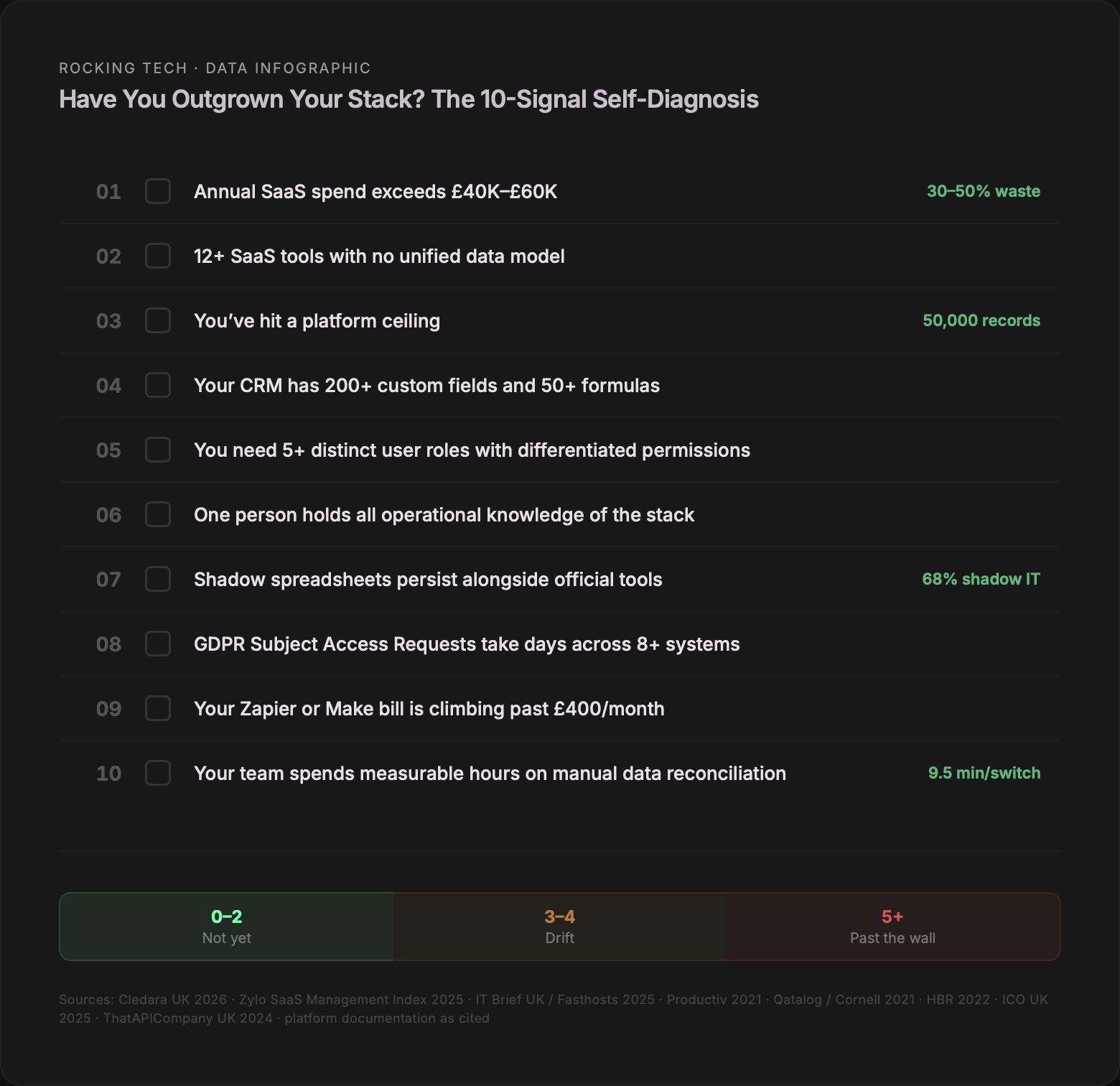
The thresholds that signal you've actually outgrown the stack
Most of the symptoms above are individually defensible. A growing Zapier bill could just mean growth. A bit of manual reconciliation is normal. A spreadsheet that's getting unwieldy can wait until next quarter.
The pattern is what matters. The thresholds in the scorecard above are drawn from platform documentation, industry benchmarks, and practitioner research. Each one is a signal on its own. Five or more in combination means the wall has already arrived. A few of them deserve more detail.
The platform ceilings move faster than you think. Airtable's Team plan caps at 50,000 records; Business at 125,000. The API rate limit is five requests per second per base. Pricing has soared — the Team plan jumped 67% and Business 87.5% in 2024–2025 (Servalian, 2025). One user managing a recurring service business posted plainly on the Airtable community forum: "Sadly, I need to migrate away from Airtable due to the lack of a scale plan that makes any sense. We are right up against the 50,000 record limit." The support team reportedly advised against the Enterprise plan because the user only needed more records, not more users — but Enterprise would have exceeded $60,000/year.
Custom field counts are the canary. HubSpot's free tier allows only 10 custom properties; paid tiers go up to 1,000 per object. Salesforce caps at 1,000 per object depending on edition. Airtable imposes a hard 500-field-per-table limit. When you're approaching these numbers in any of them, you've already reached the point where forcing the tool to fit your business costs more than building software around your actual process.
Most owners explain away the symptoms one at a time. The pattern is what matters.
The bus factor in operations is rarely discussed but always present. Generic.de's field research captures it precisely: "A former employee or external service provider is regularly called upon for maintenance or knowledge queries" and "changes to certain software are avoided because 'it's too risky' or 'nobody knows what would happen'" (generic.de field research, 2025). Only 30% of employees feel they have the correct tools to do their jobs, and 25% would consider leaving because of inadequate tooling (Gartner IT Symposium, cited 2024).
Shadow IT is the symptom nobody calls a symptom. Productiv's State of SaaS report found that 68% of app portfolios in companies with fewer than 500 employees consist of shadow IT — tools acquired without IT knowledge to fill gaps in sanctioned software (Productiv, 2021). Gartner projects that 75% of employees will acquire, modify, or create technology outside IT's visibility by 2027, up from 41% in 2024 (Gartner, cited by IEEE Computer Society, 2024). Remarkably, shadow IT tools show higher engagement than sanctioned tools (54% vs 40%), which is the data point that should worry every owner. Staff are voting with their feet against the official stack.
These signals don't appear in isolation. They cluster. If you recognise five or more, you've outgrown your stack — not "approaching the limit" or "thinking about it next year," but already past the point where the tax exceeds the cost of replacement.
What it actually costs to keep waiting
The Asana Anatomy of Work Global Index — which surveyed over 10,000 knowledge workers including a UK-specific cohort — found UK workers lose 61% of their time to "work about work": meetings, status chasing, duplicated effort, and tool-juggling, leaving just 27% for skilled work and 12% for strategy (Asana, UK findings, 2021–2023). UK workers lose 227 hours per year to duplicated or obsolete work and 157 hours per year to unnecessary meetings.
McKinsey estimates employees spend 1.8 hours per day searching for and gathering information — effectively, "hire five but only four show up" (McKinsey / IDC — global, legacy figure). Organisations with fragmented app ecosystems face 30% higher digital friction (Gartner, 2025).
Then there's the staff retention dimension. Stack Overflow's 2024 Developer Survey of 65,000+ respondents across 185 countries found only 19% of developers were satisfied with their job, with 62% citing technical debt as their top frustration and 30% reporting knowledge silos impact productivity 10+ times per week (Stack Overflow, 2024). Docusign's Digital Maturity Report found 21% of workers would resign over low-value, meaningless work — the busywork that fragmented tooling generates by design (Docusign, 2024). In a 6,000-worker Asana study, 80% of UK knowledge workers reported feeling close to burnout.
None of this shows up on the P&L as "stack debt." It shows up as longer hiring cycles, higher payroll, slower delivery, complaints from customers about slow responses, and a creeping inability to act on management decisions because the data needed to act sits across eight systems that don't agree with each other.
Forrester data indicates 74% of customer experience technology implementations fail due to organisational silos (CX Quest / Forrester, 2024). Only 24% of customers agree their supplier delivers exceptional CX, despite 80% of business leaders believing they do.
That gap is where outgrown stacks live.
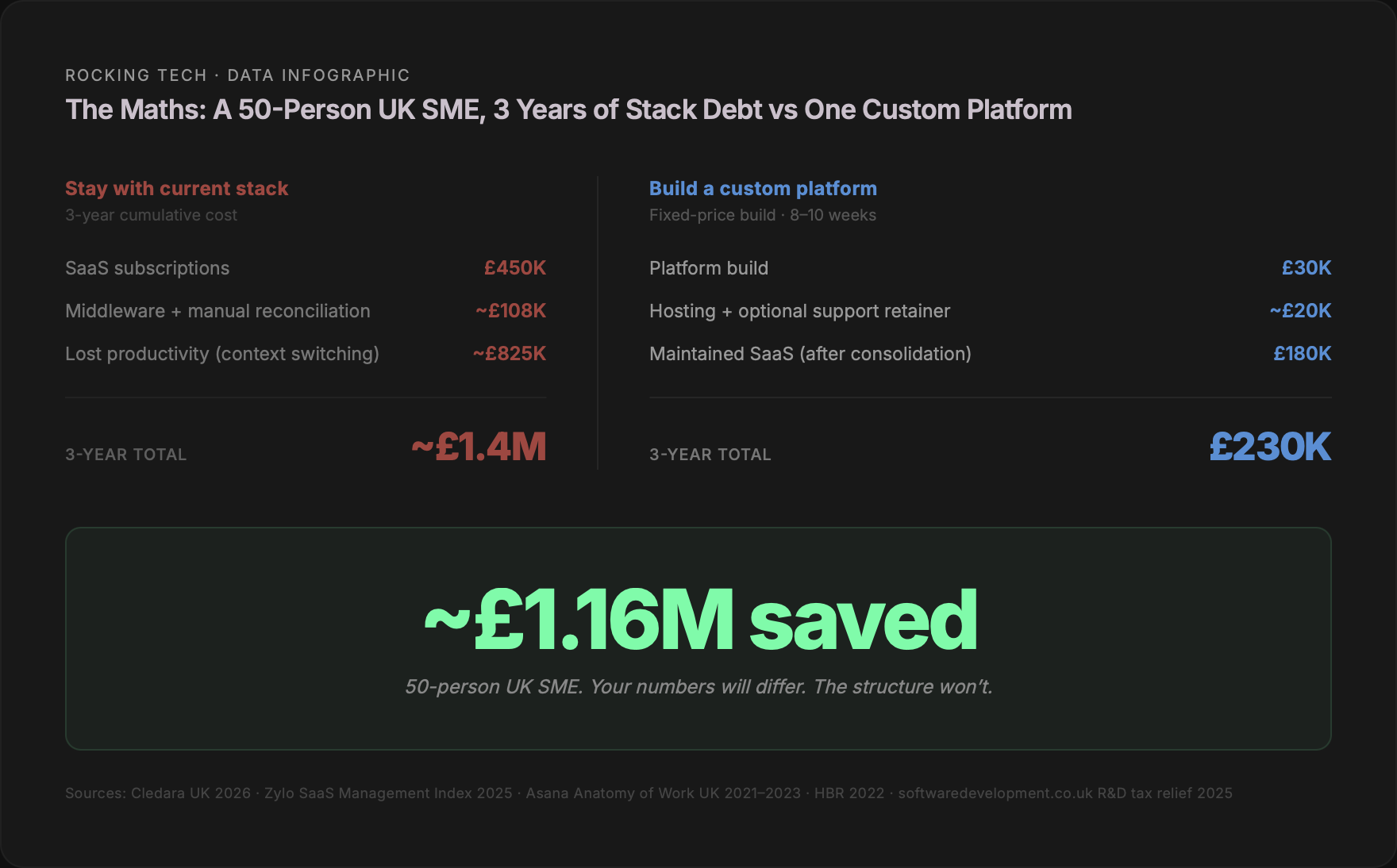
When NOT to build
This article is about recognising when bespoke development is the right answer. It's worth being clear about when it isn't.
Configuration genuinely solves the problem when the business process is generic, the tool covers 90%+ of your requirements, and the vendor's roadmap aligns with where you're going. If you're a B2B service business using a standard CRM for a standard inbound lead workflow, and the only friction is that nobody on your team has been trained properly, the answer is training and process — not software.
Switching tools is the right answer when you've outgrown your current SaaS but a different SaaS would fit. Not every "outgrown the tool" moment is an "outgrown the category" moment.
You should not build when:
You can't articulate what "done" looks like. Vague requirements are the leading cause of project failure — they account for 39% of cases (Beta Breakers, 2024). The Standish Group's CHAOS reports consistently find only 31% of custom software projects succeed on budget, time, and scope. A J.L. Partners study of 600 software engineers (250 UK, 350 US) found 65% of Agile projects miss time, budget, or quality, but projects with documented requirements are 50% more likely to succeed (Engprax / J.L. Partners, May 2024).
The pain is primarily training and adoption. New software won't fix a culture that doesn't use the existing tools.
You don't have budget for ongoing maintenance. Bespoke software is never finished.
Your processes aren't actually unique. If a generic tool with thoughtful configuration would do the job, building bespoke just means owning a custom version of something cheaper to buy.
The single most expensive mistake I see is building bespoke too early — for processes that hadn't yet stabilised, by founders who couldn't articulate what they needed, into businesses that didn't have the operational maturity to run their own software. We've written separately about why your MVP doesn't always need to be an app. If that piece describes your situation, the answer isn't a custom build yet.
The second most expensive mistake is building bespoke late — when the integration tax has been compounding for years, when the bus factor is one, when staff are leaving because of the tooling, and when emergency replacement happens under pressure from a regulatory deadline or a system collapse. We've written about the real cost of rescuing a freelancer-built MVP, and the same dynamics apply here at greater scale. Reactive replacement consistently costs three to nine times the cost of prevention.
The window between "too early" and "too late" is where the right call lives.
What "ready to commission a bespoke build" actually looks like
Stripping out the noise, an SME is objectively ready for a bespoke platform conversation when most of the following are true at once.
You've validated the process. You know what the business actually does, day to day, and you can explain it without reference to a specific tool. You've been doing it long enough that the workflow has stabilised — it's not changing weekly because you're still figuring it out.
You've hit the wall. Five or more of the signals in the scorecard above apply. You're not theorising about the future. You're paying for the symptoms now.
You have budget readiness. UK custom platforms start in the £25,000–£35,000 range for internal tools and operations platforms, climb to £35,000–£50,000 for customer-facing products, and reach £50,000–£75,000 for complex SaaS with multi-tenant architecture. Under UK R&D tax relief, qualifying bespoke software development can claim a 25% rebate (profitable firms) or up to 33% (loss-making firms), reducing a £50,000 build to £37,500 net (softwaredevelopment.co.uk, 2025). If your annual SaaS waste is already exceeding the entry tier, the maths is straightforward.
You have an internal owner. Someone on your side will hold the spec, sign off decisions, and use the system once it's built. Bespoke platforms that get built into a vacuum and handed to a team that didn't ask for them fail at the same rate as off-the-shelf rollouts that nobody's been trained on.
You can articulate the problem. You don't need a finished spec. You need to be able to describe what's broken and what success looks like. Translating "we're drowning in spreadsheets and our Friday afternoons are gone" into a written specification is what discovery is for.
If those five things are true, the conversation is no longer about whether to act. It's about who you trust to execute.
What we build at Rocking Tech
I've spent the past decade building custom platforms for funded startups, international professional organisations, universities, and the NHS. Through Rocking Tech I've delivered 15+ production systems, all in Laravel and Vue.js, with full ownership of every architectural decision. We're a small delivery team — clients get senior thinking from day one, not a junior developer learning on their project.
Every project we deliver falls into one of three tiers, all fixed-price, all quoted individually after a discovery conversation. No hourly billing. No scope ambiguity. No surprise invoices.
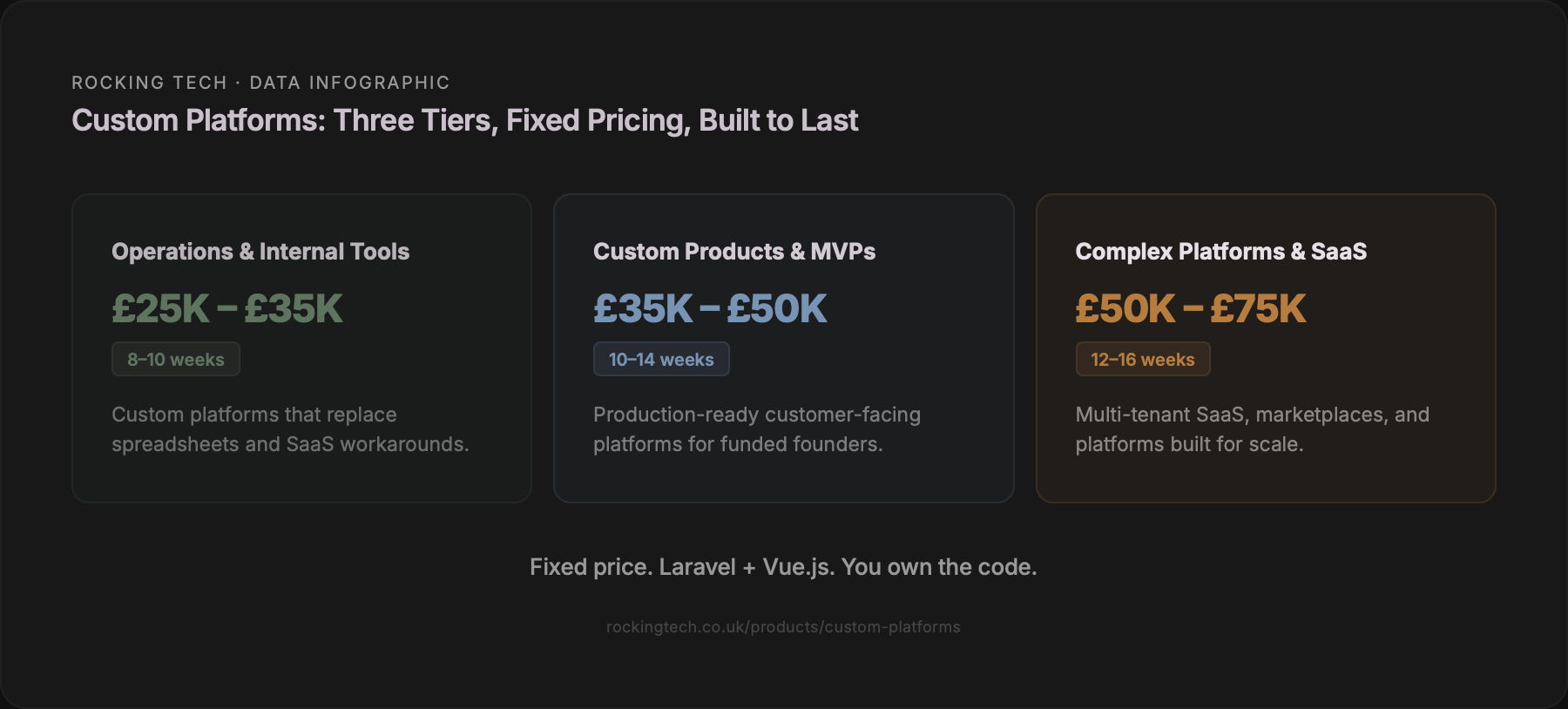
For most of the businesses I described at the start of this article — the ones running on Excel and SaaS sprawl — the right entry point is the Operations & Internal Tools tier. £25K–£35K, 8–10 weeks, custom dashboards and workflow automation that replace the tools that have stopped fitting. We integrate with the systems you're already running: HubSpot, Salesforce, Xero, QuickBooks, Stripe, GoCardless, email platforms, and custom APIs. Integration complexity is assessed during discovery and built into the fixed quote.
Every project includes discovery and strategy, full-stack development in Laravel and Vue.js, custom UI/UX design, testing, deployment, documentation, and one month of post-launch support. Server setup and security are included; hosting is set up in your name with a provider like DigitalOcean or Hetzner (typically £10–50/month) so you control the infrastructure. You own all code, design files, and documentation upon final payment. Laravel and Vue.js were chosen deliberately — they have massive developer communities, so if you ever need to hire developers or switch agencies, you won't be locked into obscure technology.
Projects start with a 30% deposit and a kick-off meeting to align on scope. You receive a written proposal with timeline and fixed pricing within 3–5 business days of the discovery call. Weekly progress updates throughout. Staging environment access. Regular check-ins. After the included one-month support window, you can either request changes ad hoc or sign up for a Laravel Support Retainer for ongoing development and maintenance.
If you're not yet sure what to build — if the symptoms are clear but the solution isn't — the right starting point is the Platform Discovery Sprint: three weeks, £4,500, fully credited against any subsequent build commissioned within 30 days. The deliverable is a written specification, architecture diagram, phased roadmap, and a build-buy-or-fix recommendation. You can take that document anywhere — including to a different agency. The point is to make sure whatever gets built is the right thing.
If your budget is under £20,000, we're not the right fit, and I'll tell you so on the call. That's not snobbery — it's economics. Below that threshold, proper discovery, design, and development can't be done responsibly. You'll get better value from a focused freelancer or a no-code specialist.
But if you've recognised your business in the patterns above, and you have budget approved, the next step is a 30-minute discovery call. No sales pressure. We discuss what you've tried, what's not working, and whether a custom build is the right next step. If it isn't, I'll tell you that too.
Ready to build what nothing off-the-shelf can do?
Book a free 30-minute call. We’ll discuss what you’ve tried, what’s not working, and whether a Discovery Sprint is the right next step. If it is, you’ll know exactly what to build – and the £4,500 comes off the build if you go ahead.