· 11 min read
The Real Cost of a Freelancer-Built MVP That Needs Rescuing
You hired a freelancer to build your MVP. It's half-finished, undocumented, and the developer has gone quiet. Now you need to understand what rescue actually costs — and whether what you have is worth saving.

Anatoly Silko
Founder, Rocking Tech

You found someone on a platform. They seemed credible — good reviews, reasonable rate, a portfolio that looked solid. You agreed a price, paid a deposit, and waited for your product to materialise.
Months later, you're holding something that sort of works on their laptop but crashes in production. There are no tests. There's no documentation. The database is held together with string. You can't deploy it without their help, and they've stopped replying to messages.
You are not unusual. This is one of the most common paths into professional software development — and one of the most expensive.
How common is this?
No major research body has published a specific failure rate for freelancer-built software projects. That's worth stating honestly, because a lot of content in this space invents statistics or presents marketing claims as data. The Standish Group, PMI, Clutch, and GoodFirms have never isolated freelance engagements as a category.
What does exist is the surrounding evidence. The Standish Group's CHAOS Report found that across all software projects, 19% fail outright and 50% are delivered over budget, late, or with reduced scope — only 31% succeed on all measures (Standish Group, CHAOS 2020). PMI's 2025 data puts outright failure at 13%, with another 37% challenged (PMI, "Step Up" 2025). Smaller projects fare better — roughly 90% success — but an MVP with multiple user roles, payment processing, and third-party integrations is not a small project, regardless of what the freelancer quoted.
For startups specifically, the numbers are grimmer. Roughly 90% fail over their lifecycle (CB Insights, BLS). Feature creep — the single most predictable failure mode when a non-technical founder works with an unsupervised developer — extends MVP timelines by 40–60% (AlterSquare, 2025).
The platform-specific data is murkier. No freelance marketplace publishes project completion rates, and the satisfaction surveys that do exist come from companies selling alternatives to freelancers — which makes their methodology hard to trust. What is visible is the pattern: Upwork community forums are full of clients describing abandoned projects, unresponsive developers, and codebases they can't deploy. The complaints are consistent enough to be structural, even if nobody has quantified them reliably.
The freelancer's quote was the price of the first attempt. The rescue is the price of learning what "cheap" actually costs.
What's actually inside a failed freelancer build
I've audited enough inherited codebases to recognise the patterns before I open the repository. The problems are remarkably consistent, regardless of technology, geography, or how much the founder originally paid.
One agency that publishes openly about this reports that roughly 50% of their project intake involves inheriting existing platforms, and in none of those cases have they had support from the previous provider (MarsBased, "Audit the code you inherit"). Their audits consistently find hardcoded passwords, no separation between business logic and views, unused libraries throughout the codebase, and zero test coverage — meaning every change introduced to the system breaks something else.
A well-documented case study describes a company inheriting a site from a departed freelancer that contained nearly 900,000 files for what should have been a 9-page application (Arc.dev, "Freelance Developer Horror Stories"). The freelancer had modified the framework core to write every SQL query to a text file, creating nested directories by date and time — running unchecked for three years. Another founder hired the cheapest freelancers for a comparison platform. Communication barriers and vague specifications produced something so far from the original brief that the company ran out of money before a viable product could launch.
These aren't outliers. Across every source I reviewed — agency audit reports, CTO writeups, founder post-mortems — the same defects appear with depressing regularity:
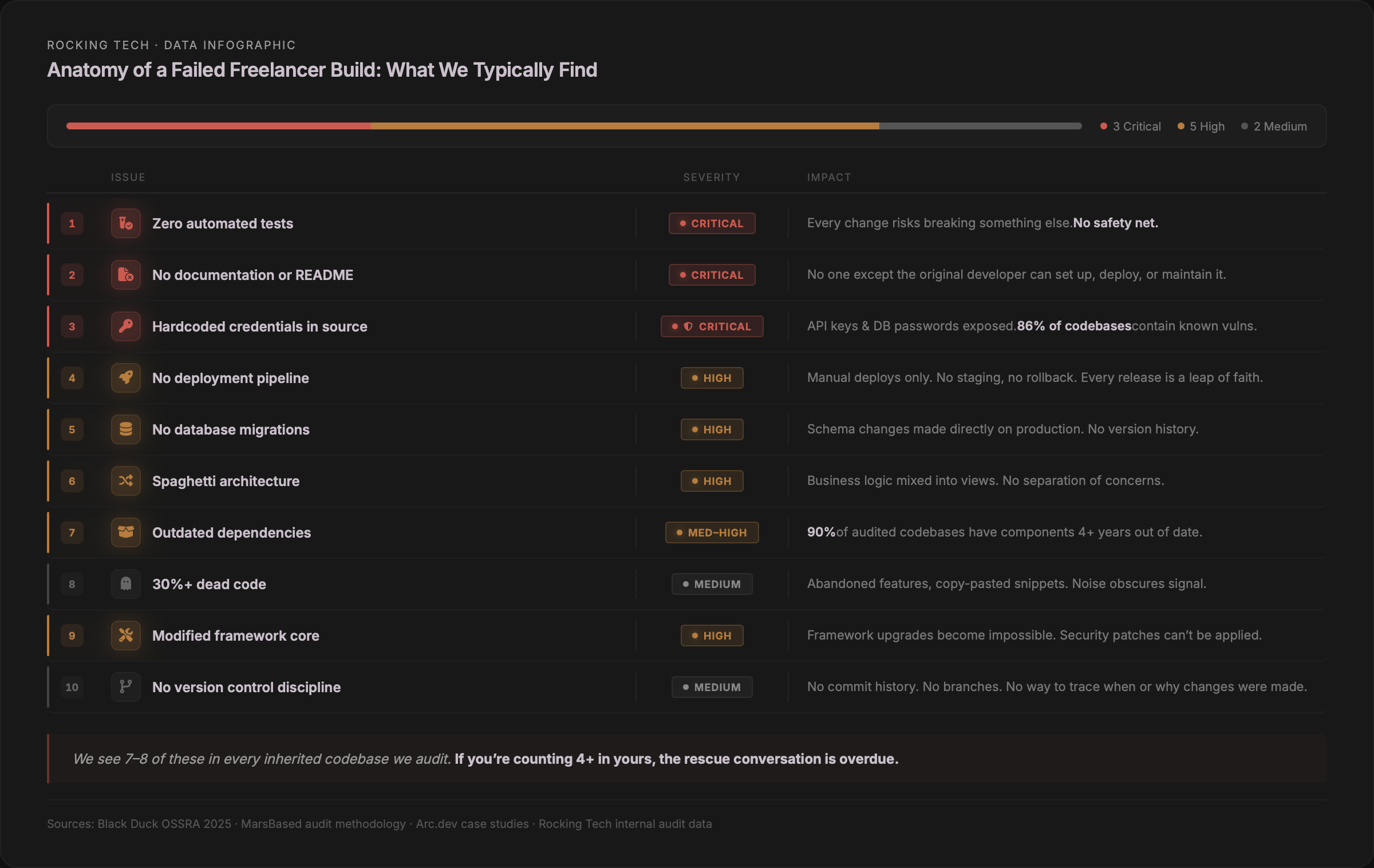
Zero automated tests. The freelancer tested by clicking through the application manually. Every future change is a gamble.
No documentation or README. There is no record of how to set up the development environment, deploy the application, or understand the business logic. The knowledge exists only in the freelancer's head — and they're not answering emails.
Hardcoded credentials. API keys, database passwords, and third-party service tokens embedded directly in the source code. The 2025 Black Duck Open Source Security and Risk Analysis report found 86% of audited commercial codebases contained known open-source vulnerabilities (Black Duck OSSRA, 2025). Freelancer-built MVPs without any dependency management process are likely in worse shape — and in our experience, most of them have none.
No deployment pipeline. The freelancer deployed by copying files to the server manually. There is no staging environment, no automated deployment, no way to roll back a broken release.
Spaghetti architecture. Business logic mixed into views. Database queries scattered across every file. No consistent patterns, no separation of concerns. The codebase resists change at every level.
Dead code everywhere. Copy-pasted snippets from Stack Overflow, abandoned features left in place, commented-out blocks that nobody removed. Developers who inherit these codebases commonly report 30%+ dead code — functions that are never called, routes that lead nowhere, entire files that serve no purpose.
If you've already noticed some of these in your own codebase, we've written a detailed guide on how to audit a Laravel codebase you've inherited — it covers the specific checks you can run yourself before engaging anyone.
The real cost of rescue in the UK
This is where founders' stomachs drop. The freelancer quoted £8,000 for the MVP. The rescue — just understanding what's broken — starts at more than they expected.
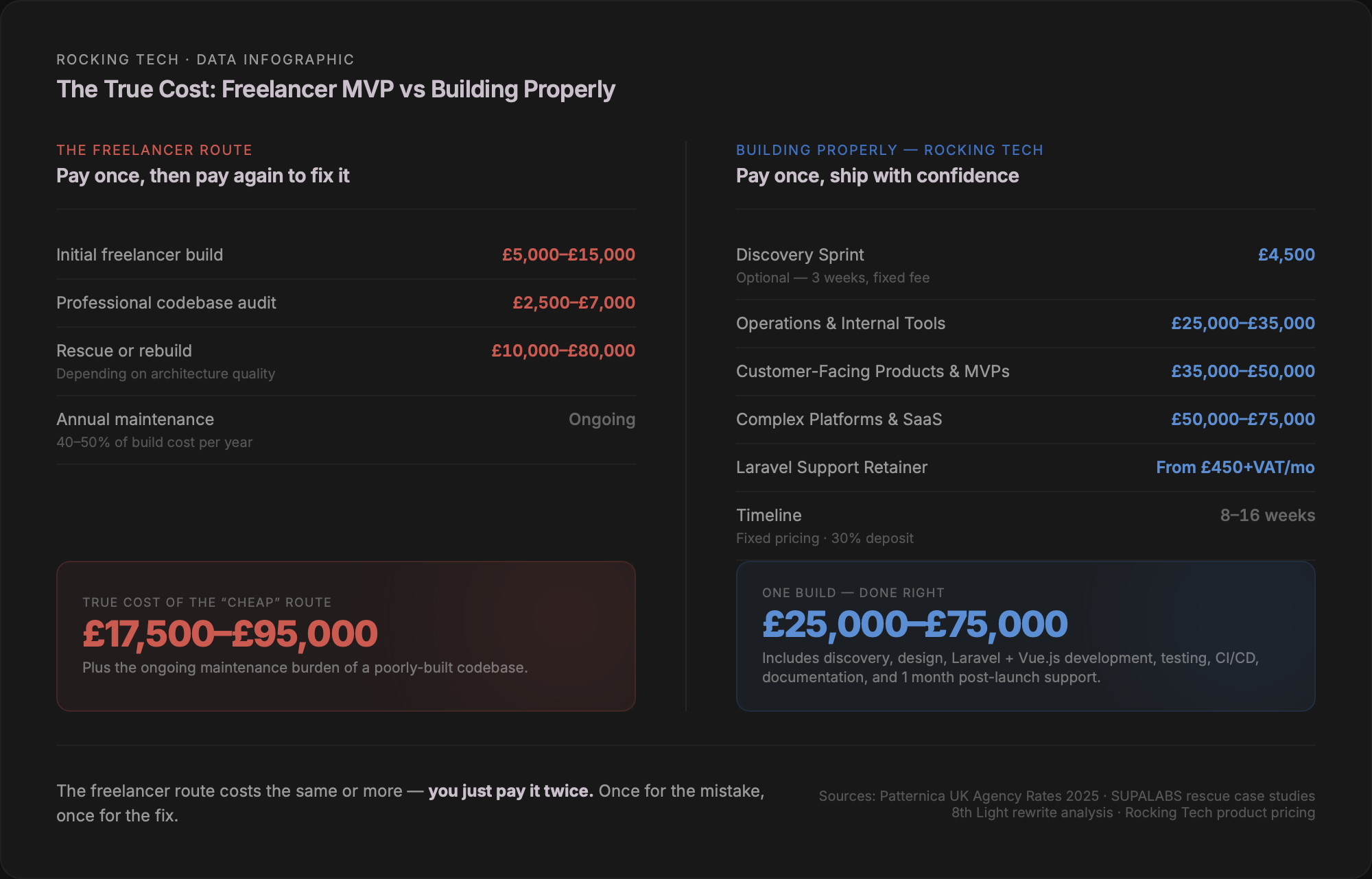
UK agency blended day rates in 2025 sit between £525 and £700 per day excluding VAT (Patternica, UK Agency Rates 2025). Senior Laravel developers command approximately £550/day; QA sits around £400/day; project management around £500/day. A professional codebase audit — architecture review, security check, dependency analysis, risk assessment — takes 5–10 working days depending on complexity. That puts the audit alone at £2,500–£7,000 before any code is written.
The rescue itself depends entirely on what the audit reveals. If the architecture is fundamentally sound but the implementation is messy — missing tests, poor code quality, no deployment pipeline — a rescue engagement typically runs £10,000–£35,000 and takes 4–8 weeks. If core architectural decisions are wrong — the database schema doesn't support the actual business logic, authentication is bolted on as an afterthought, the framework has been modified beyond recognition — you're looking at a partial or full rebuild: £25,000–£80,000 and 8–14 weeks.
Here's the number that matters: building the same application properly from scratch, with discovery, architecture, testing, documentation, and deployment, costs £30,000–£80,000. The same range as the rebuild.
The maths is brutal. A founder spends £10,000 on a freelancer, gets a broken codebase, then spends £15,000–£30,000 on rescue. Total outlay: £25,000–£40,000. Building it properly the first time: £25,000–£35,000 for internal tools, £35,000–£50,000 for customer-facing products. The freelancer's quote was not the cost of the product. It was the cost of the first attempt.
One consultancy published a detailed analysis showing the true cost of rewrites typically reaches 2.55x the initial estimate when accounting for catch-up costs, undiscovered scope, and team productivity differentials (8th Light, rewrite cost analysis). Another documented a case where a company spent $900,000 on a partial rewrite — more than twice the original development cost — to fix fundamental architectural problems (Idea Link, 2024).
And then there's ongoing maintenance. Well-built software costs roughly 15–20% of the initial build cost per year to maintain (LimeUp, 2025). Poorly built codebases push that to 40–50%. Developers spend 42% of their working time on maintenance and technical debt rather than building new features (Stripe, Developer Coefficient). McKinsey puts the accumulated cost of technical debt at 20–40% of a company's entire technology estate (McKinsey Digital, 2022).
We've covered the Laravel-specific version of this calculation in How much does it cost to rescue a neglected Laravel codebase? — but the principle applies to any stack.
Why platform freelancers fail at higher rates
The structural problems with hiring through freelance platforms for a production software build are not about individual competence. Some platform freelancers are excellent. The problem is that the system is designed to match buyers with the cheapest available option, not the most appropriate one.
Upwork's published median rate for web developers is $30/hour — approximately £24/hour (Upwork, 2025). At that rate, a £10,000 budget buys roughly 400 hours of development time. That sounds like a lot until you account for the reality: no project management infrastructure (that's the founder's job now), no quality assurance process, no code review, no architecture oversight, and no one ensuring the developer's decisions will hold up in production.
The rating systems create a dangerous illusion of quality. Upwork's average freelancer rating is 4.9 out of 5 stars — a figure their own community forums describe as vastly overinflated. Freelancers can have negative reviews removed by issuing refunds. Cancelled projects generate no feedback at all. The worst outcomes are invisible. PeoplePerHour scores 3.5 out of 5 on G2, with quality of support rated 4.9 out of 10 (G2, PeoplePerHour reviews).
The information asymmetry is the killer. A non-technical founder cannot evaluate code quality. The application appears to work — buttons click, pages load, data saves. The problems are invisible: the database has no indexes, the authentication can be bypassed, the deployment requires SSH access to a server the freelancer controls, and the code is so tightly coupled that adding a feature means rewriting three others. By the time these problems surface, the freelancer has been paid and moved on.
We wrote about the parallel failure mode — founders who built with AI tools like Lovable or Cursor and hit the same wall — but the freelancer version is actually harder to diagnose, because at least a vibe-coded app has consistent (if flawed) patterns. A freelancer build is uniquely unpredictable.
The documentation problem nobody talks about
The most expensive thing a departing freelancer takes with them is not the code. It's the context.
How does the application deploy? What environment variables does it need? Which third-party services does it depend on, and where are those accounts? What was the reasoning behind the database structure? Why does this particular function exist? What happens if this scheduled task fails?
None of this is written down. It never is.
One agency co-founder reports that in roughly half their inherited project intake, they've never once received support from the previous developer (MarsBased, "Audit the code you inherit"). No handover, no documentation, no README explaining how to get the application running locally. The first task for any rescue team is what practitioners call "software archaeology" — figuring out how to compile the software, set up a development environment, deploy it, and run whatever tests exist (Simple Thread, "Handing Off a Software Project").
A proper software handover includes: access to all source code repositories, a comprehensive README, pinned and codified dependencies, automated tests, testing and staging environments, all third-party account credentials, documentation of assets outside source control, and project history (issue trackers, change logs). Most freelancer projects deliver none of these. The code arrives — if it arrives at all — as a zip file or a private repository the freelancer controls.
The knowledge-loss cost is real and measurable. Onboarding a new developer onto an undocumented codebase takes weeks, sometimes months. Partial rebuilds frequently result because the new developer can't understand the existing code well enough to work with it safely.
This is why every project we deliver at Rocking Tech includes documentation and a complete handover as standard — because we've seen what happens when it's missing. You own all code, design files, and documentation upon final payment. We use Laravel and Vue.js specifically because they have large developer communities: if you ever need to hire developers or switch agencies, you won't struggle to find someone who understands the stack. That's a deliberate architectural decision, not an accident.
Red flags you probably missed
Looking back, the warning signs were there. They always are. Here's what experienced technical advisors watch for — the specific patterns that predict project failure before a line of code is written.
They quoted within minutes of seeing the brief. A proposal sent five minutes after you posted the job is a copy-paste template (Povilas Korop, LaravelDaily). They haven't read your requirements. They're bidding on volume, not fit.
They pushed for fixed-price billing with no discovery phase. Counterintuitively, a developer who insists on a fixed price without first understanding the scope is either padding the quote to cover risk or planning to cut quality to maintain margins (Founder Institute, "Can My Freelance Developer Deliver an MVP"). A credible developer asks questions before quoting — a lot of questions.
They said yes to everything. No pushback on scope. No suggestions to reduce complexity. No opinions about what should be deferred. A good developer argues with you about what to build first. A freelancer who agrees to everything is either planning to learn your stack on your budget or building without thinking through the implications (ENO8, "Software Developer Red Flags").
They were instantly available. No other clients, no existing commitments, ready to start tomorrow. This means either they have no work (which raises questions about quality), or they're running multiple projects simultaneously and yours won't get the attention it needs.
Your project went into a black box. Infrequent updates. No invitation to see the code as it develops. No staging environment where you can test progress. Demos only at the end. By the time you see the output, it's too late to course-correct.
There was no version control discipline. No git history, or a git history with meaningless commit messages like "fix" and "update." No branches. No pull requests. No way to trace when or why any change was made.
If you're currently working with a developer and recognising these patterns, the legal foundations article covers the contractual protections you should have in place — IP assignment, code ownership, and offboarding procedures — before the relationship deteriorates further.
When to rescue and when to rebuild
Not every failed freelancer build needs scrapping. The question is whether the foundation — the database design, the authentication model, the core architecture — is sound enough to build on. If the architecture is right and the implementation is messy, rescue makes sense: clean up the code, add tests, fix the deployment, document everything. That typically costs 40–60% less than a complete rebuild (SUPALABS, "Software Project Rescue," 2025).
If the architecture is fundamentally wrong — and it often is — rescue costs approach rebuild costs, and you end up with a patched version of a bad foundation. At that point, you're better off starting properly.
This is exactly the question our Platform Discovery Sprint is designed to answer. For £4,500 over three weeks, we assess what you have, identify what's broken, and deliver a recommendation: fix it, refactor it, or rebuild it — with a phased roadmap and budget ranges for each option. The sprint produces a standalone deliverable you own regardless of whether you proceed with us. If you do proceed to a Custom Platform Build within 30 days, the £4,500 is credited in full against the build cost. If not, the report is yours — take it to any developer you like.
Most founders who come to us after a failed freelancer experience don't know whether they're sitting on £5,000 of salvageable work or £5,000 of technical debt that will poison everything built on top of it. The discovery sprint answers that question with data, not guesswork.
What building properly actually looks like
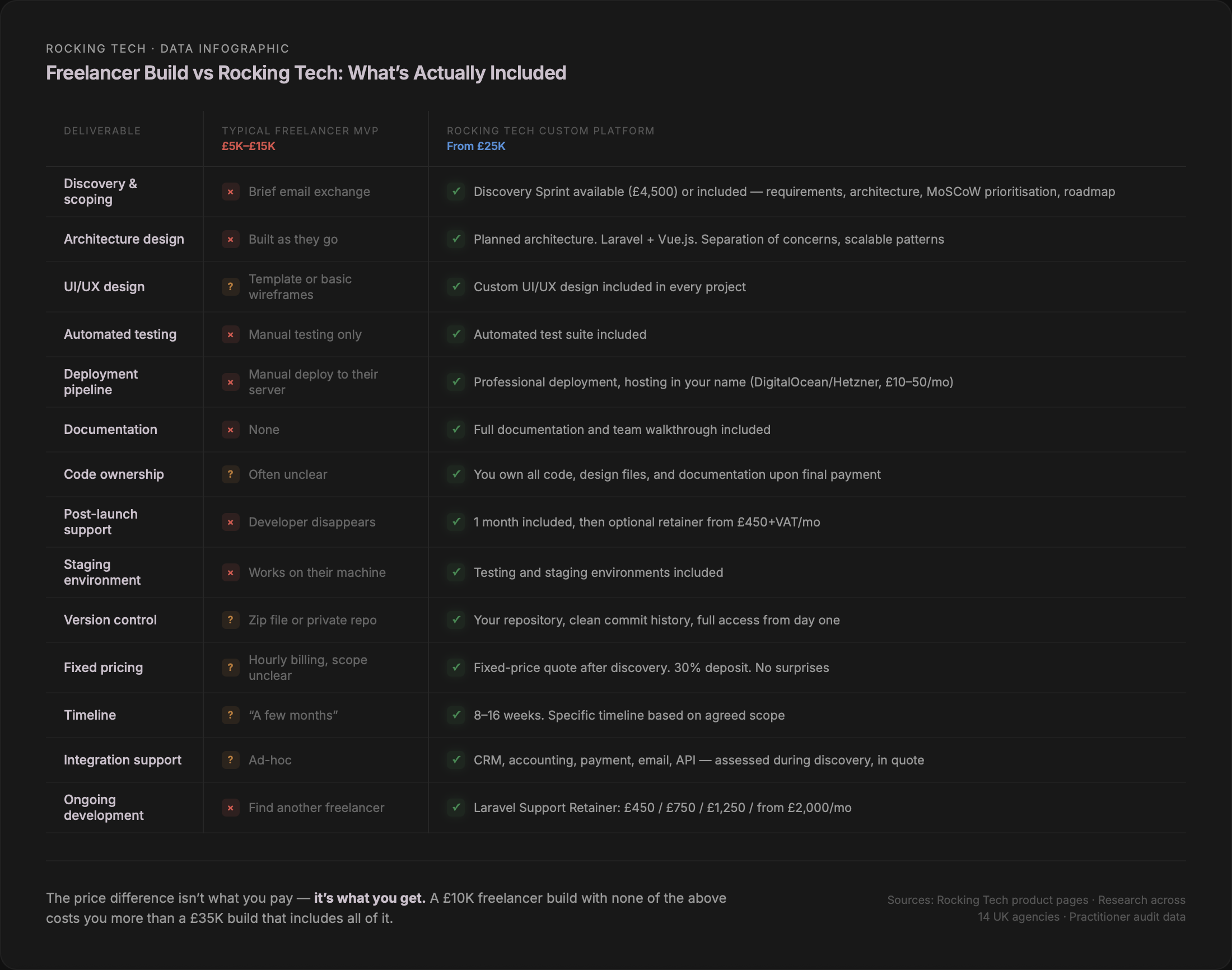
Every project we deliver includes discovery and strategy, full-stack development in Laravel and Vue.js, custom UI/UX design, testing, deployment, documentation, and one month of post-launch support. Projects start with a 30% deposit and kick-off meeting to align on scope and deliverables. We provide a fixed-price quote after discovery — no hourly billing, no scope ambiguity, no invoices that arrive larger than expected.
Most projects fall between £25,000 and £75,000 depending on complexity. Internal tools and operations platforms typically cost £25,000–£35,000. Customer-facing products and MVPs sit in the £35,000–£50,000 range. Complex SaaS platforms with advanced features run £50,000–£75,000+. Simpler projects complete in 8–10 weeks. More complex platforms with multiple integrations, payment processing, and custom features take 12–16 weeks.
The critical difference isn't the price. It's what you get for it. You get code you own. Documentation you can hand to any developer. A deployment pipeline that doesn't depend on one person's laptop. An architecture designed to accept change rather than resist it. And a technology stack — Laravel and Vue.js — with a massive developer community, so you're never locked into a single provider.
If your budget is under £20,000, we're probably not the right fit. That's not snobbery — it's economics. Below that threshold, proper discovery, design, and development can't be done responsibly. You'll get better value from a focused specialist or a no-code approach, and we'd rather tell you that now than take your money and deliver something compromised. We wrote about why your MVP doesn't always need to be a custom build — sometimes the right answer is not to build at all.
But if you've already tried the cheap route and you're holding the result, you know why the £25,000 minimum exists.
Ready to build what nothing off-the-shelf can do?
Book a free 30-minute call. We’ll discuss what you’ve tried, what’s not working, and whether a Discovery Sprint is the right next step. If it is, you’ll know exactly what to build – and the £4,500 comes off the build if you go ahead.