· 4 min read
Custom MVP vs No-Code: When Your Idea Needs Real Engineering
No-code will carry more of your product than most engineers admit, then stop dead at limits its own documentation already lists. Here is how to tell, before you build, whether your idea sits on the custom-engineering side of that line.

Anatoly Silko
Founder, Rocking Tech

No-code will carry a startling amount of a product idea - further than most engineers admit out loud. It also stops dead at a line its own documentation has already drawn. The founders who get caught out are the ones who only find that line after they've built a business on the wrong side of it. So the first test is one of fit: whether your idea sits in the majority of cases no-code handles well, or the minority it can't.
Where the ceiling actually sits
No-code platforms are honest about their limits. You just have to read the docs before you sign up, not after.
Take Airtable. It caps records per base by plan - 1,000 on free, 50,000 on Team, 125,000 on Business, 500,000 and up on Enterprise (Airtable, 2026). Webflow does much the same with its CMS, and its own help centre admits the field-level limits "cannot be bypassed with any plan": five reference fields per collection, one hundred items per list on a page (Webflow, 2026). Bubble takes a different route again, metering compute in Workload Units and charging overage at $0.30 per 1,000 - with, in its own words, no cap on the maximum charge (Bubble, 2026).
Different platforms, same message. These caps are the shape of the tool, and a better build won't get around them.
A common estimate among specialist agencies is that no-code handles around 70 to 80 per cent of common needs well.
The interesting bit is the remainder. That 20 to 30 per cent is exactly the work a custom build exists for, and it's where we spend our time.
No-code doesn't fail loudly. It works beautifully right up to the line its own documentation drew for you, then asks you to rebuild everything on the other side.
The signals your idea is in the harder 20 per cent
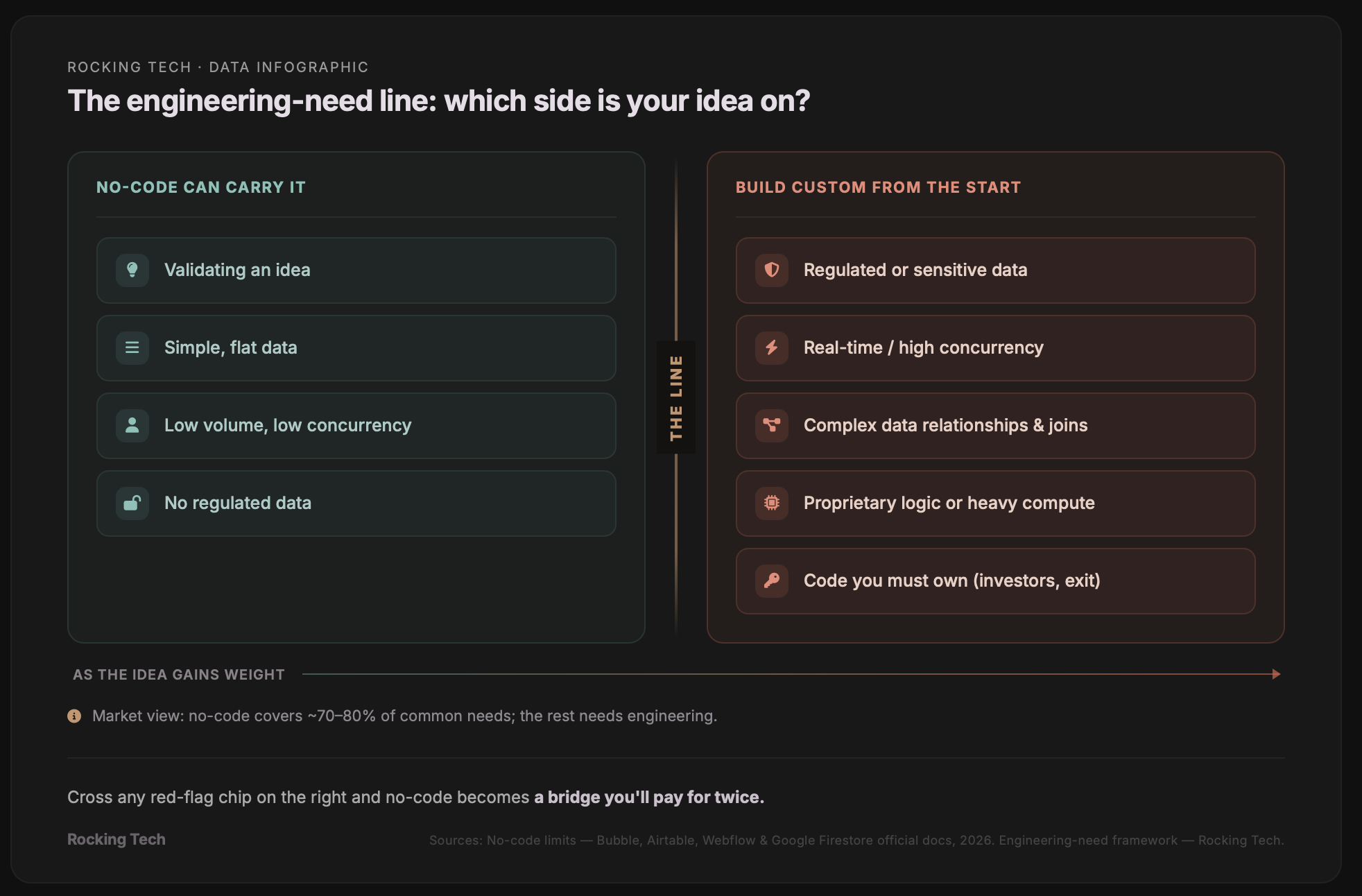
Some products cross the line on day one, by their nature.
Regulated or sensitive data is the clearest case. Bubble's own docs say plainly that apps built on it "won't achieve HIPAA compliance", and recommend against using it where that compliance is required (Bubble, 2026).
Real-time behaviour and high concurrency is another. Adalo concedes in its own benchmarks that performance can drop past 50 to 100 concurrent users (Adalo, 2026). Google's Firestore, which sits under several app builders, puts a documented 270-second ceiling on any single transaction (Google Firestore, 2026).
Complex data relationships - joins, aggregations - hit the same walls. Webflow's five-reference-field cap is one of them.
One engineer, writing in InfoWorld, put it as well as anyone: low-code and no-code are great for prototyping and testing an MVP, and fall short when it comes to scaling. His own product needed a complete rebuild and a migration of every user.
Working out which side of that line you're on is the whole game. It's why we put a free MVP Readiness Score in front of every build - an honest read on whether no-code will hold before you spend a penny.
The cost that is invisible at launch
No-code's price looks small at signup. The real bill arrives with success.
Subscriptions scale with seats, records and compute. Bubble's uncapped overage means a popular workflow can quietly run up charges while it keeps serving users.
Then there's the exit. Bubble exports no usable source code, so moving off it means rebuilding from scratch rather than porting what you've got.
Founders describe the trap in their own words. One, on Indie Hackers, called the lock-in "the price I paid" - everything lived inside the platform, and leaving meant starting again.
For a product that was always going to cross the line, that's the cost of building once with no-code and then a second time properly.
UK agencies typically quote a lean-to-standard custom MVP at roughly £15,000 to £80,000, with regulated builds well beyond that. Weighed over two or three years against rising subscriptions plus a likely rebuild, the one-off number often reads differently.
Our Custom Platform Builds start at £25,000 plus VAT. If you want to test the maths first, a Platform Discovery Sprint at £4,500 plus VAT scopes the build, the data model and the real cost before anything's committed.
When no-code is still the right answer
None of this is an argument to over-build.
Most ideas don't survive long enough to need scale. ONS figures show 38.4 per cent of UK businesses born in 2019 were still trading five years later (ONS, 2024).
If you just want to find out whether anyone wants the thing, and it touches none of the red flags above, no-code is faster and cheaper. Starting there is the sensible bet, and we'll say so plainly.
Sometimes the honest answer is that your MVP doesn't need to be an app at all, or that off-the-shelf software still fits.
The decision flips when the idea itself carries real engineering inside it: regulated data, proprietary logic, an architecture that has to hold up under load, or a codebase an investor will expect you to own.
When that's true from the start, the cheapest route is the one that doesn't ask you to build the same product twice. That's the point where a custom build stops being the expensive option and becomes the economical one.
Ready to build what nothing off-the-shelf can do?
Book a free 30-minute call. We’ll discuss what you’ve tried, what’s not working, and whether a Discovery Sprint is the right next step. If it is, you’ll know exactly what to build – and the £4,500 comes off the build if you go ahead.