· 12 min read
When to Build Custom vs Stick with SaaS: A Decision Framework for UK SMEs
SaaS list prices rose 12.2% in 2024 — more than four times general inflation. But "custom is cheaper" is not the same as "custom is right." Here is the honest framework, with the maths and the specific thresholds where the answer changes.

Anatoly Silko
Founder, Rocking Tech

The build-versus-buy question is the most expensive decision most growing businesses get wrong — in both directions. Build too early and you burn capital on a system that solves yesterday's problem. Buy too long and you pay a compounding tax in workarounds, middleware, and staff hours that quietly exceeds the cost of building.
This article gives you the arithmetic, the framework, and the specific thresholds. Some of those thresholds will tell you to stick with HubSpot and train your team properly. Others will tell you the maths tipped two years ago and nobody noticed.
The specific comparison: what are we actually talking about?
Before any framework, we need to agree on what we are comparing. "SaaS versus custom" is meaningless without specifics, and most agencies blur the comparison to make custom look cheaper than it is. Here is the honest version.
The full SaaS stack. A 50-person UK business running HubSpot Sales Hub Professional, Asana Advanced, Slack Business+, Microsoft 365 Business Premium, Xero Ultimate, HubSpot Marketing Hub Professional, Zapier Team, and an HR platform. The full stack costs roughly £65,000–£90,000 per year at current UK list prices depending on seat counts and add-ons. At Enterprise tiers it clears £150,000+. At Starter tiers for a smaller team, it sits around £30,000–£42,000.
But a custom platform does not replace all of that. Nobody builds a bespoke version of Xero. Nobody rebuilds Slack. The realistic comparison is between the custom platform and the specific SaaS tools it replaces — typically the CRM, the marketing automation, the operational workflow logic, and the middleware holding them together. The commodity tools (accounting, team messaging, email, calendar booking) stay SaaS in both scenarios.
The replaced SaaS capability for a 50-person business looks more like this: HubSpot Sales Hub Professional for 15 active sales users at £85/seat/month (£15,300/year — TheMarketingBlog UK pricing, March 2026), HubSpot Marketing Hub Professional at its £780/month base (£9,360/year), the operational portion of project management, Zapier Team at roughly £4,800/year, and 0.2 FTE of admin time spent on workarounds between systems at roughly £7,000/year. That comes to approximately £40,000–£50,000 per year in replaced capability — not the £90,000 full stack. The rest of the stack stays SaaS regardless.
The custom platform. A bespoke Laravel application replacing that operational core. Built by a UK agency at £25,000–£75,000. Hosted on managed infrastructure at £10–£50 per month. Maintained on a retainer at £450–£2,000 per month. Xero, Slack, Microsoft 365, and your booking tool stay exactly as they are.
That is the real comparison. Not "replace everything with code" versus "buy everything off the shelf." The question is always: which parts of your stack should be custom, and which should stay SaaS?
Where the crossover actually sits
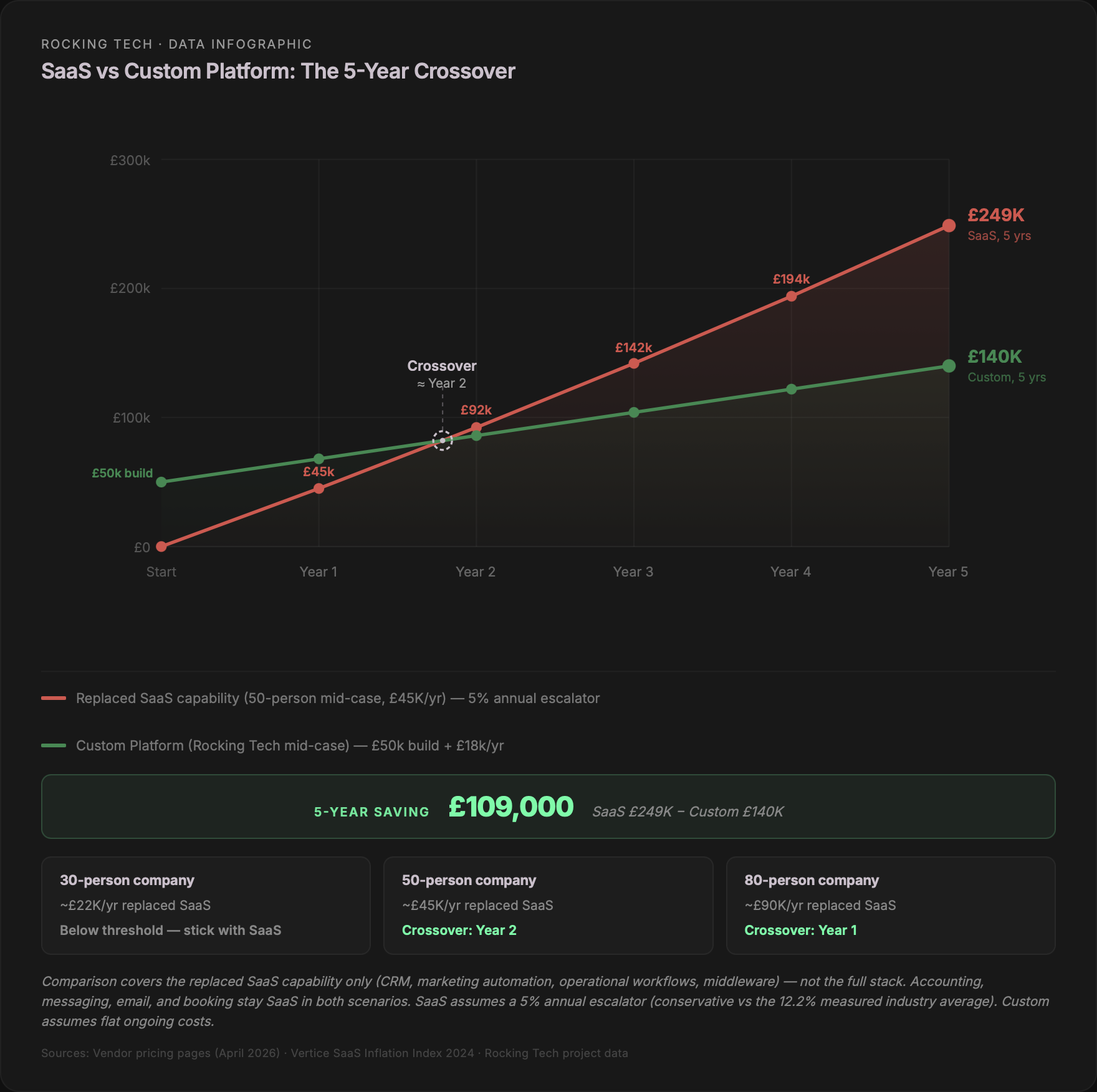
With a mid-case £50,000 build and roughly £18,000 per year in ongoing costs (hosting, retainer, change requests), custom becomes cheaper than the replaced SaaS capability at any annual spend above approximately £35,000 over three years or £28,000 over five years.
For the 50-person mid-case — £45,000 per year in replaced SaaS capability — the maths works out like this. Three-year SaaS cost with a 5% annual escalator: £141,900. Three-year custom cost: £104,000. Five-year SaaS: £248,700. Five-year custom: £140,000. The crossover happens mid-way through Year 2 — not immediately, because the upfront build cost means SaaS is cheaper in Year 1. By Year 5, the cumulative saving is approximately £109,000.
That escalator is conservative. The Vertice SaaS Inflation Index measured 12.2% in 2024, the highest on record and 4.5 times G7 consumer inflation (Vertice, January 2025; CFO Dive, January 2025). Salesforce raised list prices 9% in August 2023 and another 6% on Enterprise editions in 2025. Microsoft hiked UK cloud products 9–15% in April 2023 and added a 5% monthly billing surcharge in 2025 (SaaStr, 2025). At the actual measured inflation rate rather than the conservative 5%, the crossover moves earlier and the five-year saving grows substantially.
But the comparison also ignores the risk profile of custom builds. McKinsey's Oxford study found large IT projects average 45% over budget and 56% under expected value (McKinsey, 2012). A defensible model applies a 1.3–1.5× risk multiplier to build estimates. Even with that multiplier, replaced SaaS capability above £45,000 per year still favours custom over five years.
Below the £35,000 threshold? SaaS wins. A 30-person team whose replaced capability costs £20,000–£25,000 per year should not build — the economics do not justify it even over five years. Above £80,000 in replaced capability — common in 80-person businesses running Enterprise-tier CRM — the crossover happens in Year 1 and the five-year saving exceeds £250,000.
The arithmetic tells you where the crossover sits. It does not tell you whether the thing you would build is worth building. For that, you need a different kind of test.
When SaaS is genuinely the right answer
In four categories — CRM, project management, accounting, and scheduling — the SaaS market has matured past the point where most businesses should consider custom alternatives. The global CRM market exceeded $128 billion in 2024 (Gartner, June 2025), growing at 13.4% annually. Over 91% of companies with more than ten employees now use a CRM (Grand View Research, 2024). UK cloud accounting has reached 67% market penetration (Mordor Intelligence, 2025). These are not products with gaps. They are products that have been solving the same problems for a decade.
Geoffrey Moore's Dealing with Darwin drew the distinction between core activities that differentiate your business and context activities that simply need to happen. Martin Fowler's Utility-vs-Strategic dichotomy estimates roughly 5% of business processes are genuinely strategic (Fowler, 2011). The other 95% should be packaged software, configured close to default. That is not a failure of ambition — it is capital efficiency.
Here is the practical test. Stick with SaaS if any of these describe your situation:
1. Your workflows are already well-served by existing platforms. If your sales pipeline, project tracking, invoicing, and scheduling look broadly like every other business in your sector, a well-configured SaaS stack will do the job. HubSpot's custom objects (launched October 2020 at Enterprise tier) let non-developer administrators model bespoke data — manufacturing warranties, real estate transactions, education enrolments — without writing code. Salesforce Flow Builder handles cross-system automations that would have required a developer five years ago. A UK letting agent tried building in-house first, found it "too time-intensive," moved to a SaaS CRM, and now runs over 700 automated workflows including a property upload tool that saves agents 20 minutes per listing (HubSpot Case Studies, Accommodation.co.uk). A UK law firm configured its CRM with custom objects to handle 10,000+ leads daily (Unmatched Agency, Hattons case study). These are businesses that looked at custom and correctly chose SaaS instead.
2. Your team is under 30 people. At smaller headcounts, the replaced SaaS capability typically stays well below the crossover threshold. A 20-person team with five sales users on HubSpot Sales Professional and a standard marketing setup might spend £15,000–£20,000 per year on the capabilities a custom platform would replace — not enough to justify a £50,000 build plus ongoing maintenance, even over five years.
3. You do not have the capacity to maintain custom software. A bespoke platform requires ongoing maintenance — security patches, version upgrades, monitoring. If you cannot credibly access that capacity, SaaS offloads the burden to the vendor. Building without maintenance is how £50,000 rescue projects happen.
4. The SaaS category is mature and competitive. CRM, accounting, project management, helpdesk, booking, email marketing, HR — these are solved categories. The market leaders have been competing for a decade. Building custom in a mature category is manufacturing your own office furniture when the shops are full of it.
5. Your annual SaaS spend on the capability in question is under £35,000. Below this threshold, the three-year economics favour SaaS even accounting for Vertice's measured inflation rate.
If your business process looks like a well-served version of "track leads, manage deals, run campaigns, schedule meetings, send invoices" — and most do — SaaS is the right answer. An honest assessment of most SME workflows reveals far less uniqueness than the founders believe.
If three or more of those five points describe your business, stick with SaaS. Configure it properly. Train your team. Do not hire a developer.
When SaaS quietly becomes the more expensive option
We have covered the ten diagnostic signals that indicate a business has outgrown its stack — the integration tax, the platform ceilings, the shadow IT. This section covers four compounding failure modes that accelerate once you are locked in.
1. Vendor lock-in is contractually engineered. Salesforce's master subscription agreement auto-renews for terms equal to the expiring term unless written notice arrives within a 30–60 day window (Redress Compliance, 2025). Licence counts cannot be decreased mid-term. Early exit triggers liability for 100% of remaining contract value. HubSpot's data portability is more constrained than most operators realise: exports cap at 250 columns per file, 300 exports per 24-hour window, and workflows, sequences, and dashboards cannot be exported as portable files at all — they leave only as a metadata spreadsheet and a screenshot (HubSpot Knowledge Base, 2026). CRM-to-CRM migrations are commonly quoted at $30,000–$100,000 with three to six months to full team productivity (Aptitude 8, 2025).
2. Price escalation is structural. The Vertice SaaS Inflation Index — drawn from contracts across 16,000 vendors — measured 12.2% year-on-year inflation in 2024 (Vertice, January 2025). Per-employee SaaS spend rose from $7,900 in 2023 to $9,100 in 2025 — nearly 15% in two years (Vertice SaaS Inflation Index Report, 2026). Twenty-eight percent of renewals tracked in late 2025 included "shrinkflation" — value reductions without corresponding price decreases (Vertice Insights, 2025). Sixty percent of SaaS vendors deliberately mask their pricing publicly.
3. Deprecation events damage operations without recourse. Google forced Universal Analytics customers onto GA4 by July 2023, breaking dashboards and retaining only 14 months of data by default. Atlassian ended Server support in February 2024, forcing 250,000+ customers to Cloud or Data Center (Atlassian, October 2020). Twitter/X killed its free API tier in February 2023 — third-party tools like Tweetbot and Apollo shut down within weeks (AppleInsider, June 2023). Slack changed its free plan in September 2022 to retain only 90 days of message history, then began deleting older messages in August 2024 (Slack Help, 2024).
4. Breaches at the vendor expose your data regardless of what you did right. The MOVEit Transfer exploit in May 2023 hit more than 2,700 organisations and approximately 93 million individuals — including BBC, British Airways, Boots, and Transport for London. The Snowflake credential theft of mid-2024 affected roughly 165 customer environments including AT&T (109 million records) and Ticketmaster (560 million records) (Silent Breach, 2024). Okta's support-system breach in October 2023 exposed all 18,400 support users (Bleeping Computer, November 2023). The ICO fined LastPass £1.23 million following the 2022 breach exposing over one million UK data subjects. The ICO fined 23andMe £2.31 million in June 2025 for 6.9 million exposed users globally (ICO, June 2025).
You can do everything right inside your SaaS tenant and still be breached, deprecated, or repriced because of decisions made by a company you have no influence over. With a custom platform, you own the code, the data, and the infrastructure. You control the upgrade timeline. Nobody can deprecate your features, raise your per-seat costs, or expose your database through a shared-tenancy vulnerability.
The four-question framework
The academic research on build-versus-buy converges on one insight: the decision is about strategic specificity, not cost alone. Williamson's transaction cost economics (Nobel, 2009) says build when asset specificity is high. Moore's core-versus-context says build only what differentiates. Gartner's Pace-Layered Strategy says buy Systems of Record, build Systems of Innovation. Thoughtworks' "Bounded Buy" principle (Technology Radar, November 2018) says vendor products must stay modular and contained within a single business capability. Forrester reframed the binary entirely in 2021: "pure buy doesn't exist, and pure build is often impractical" (Forrester, 2021).
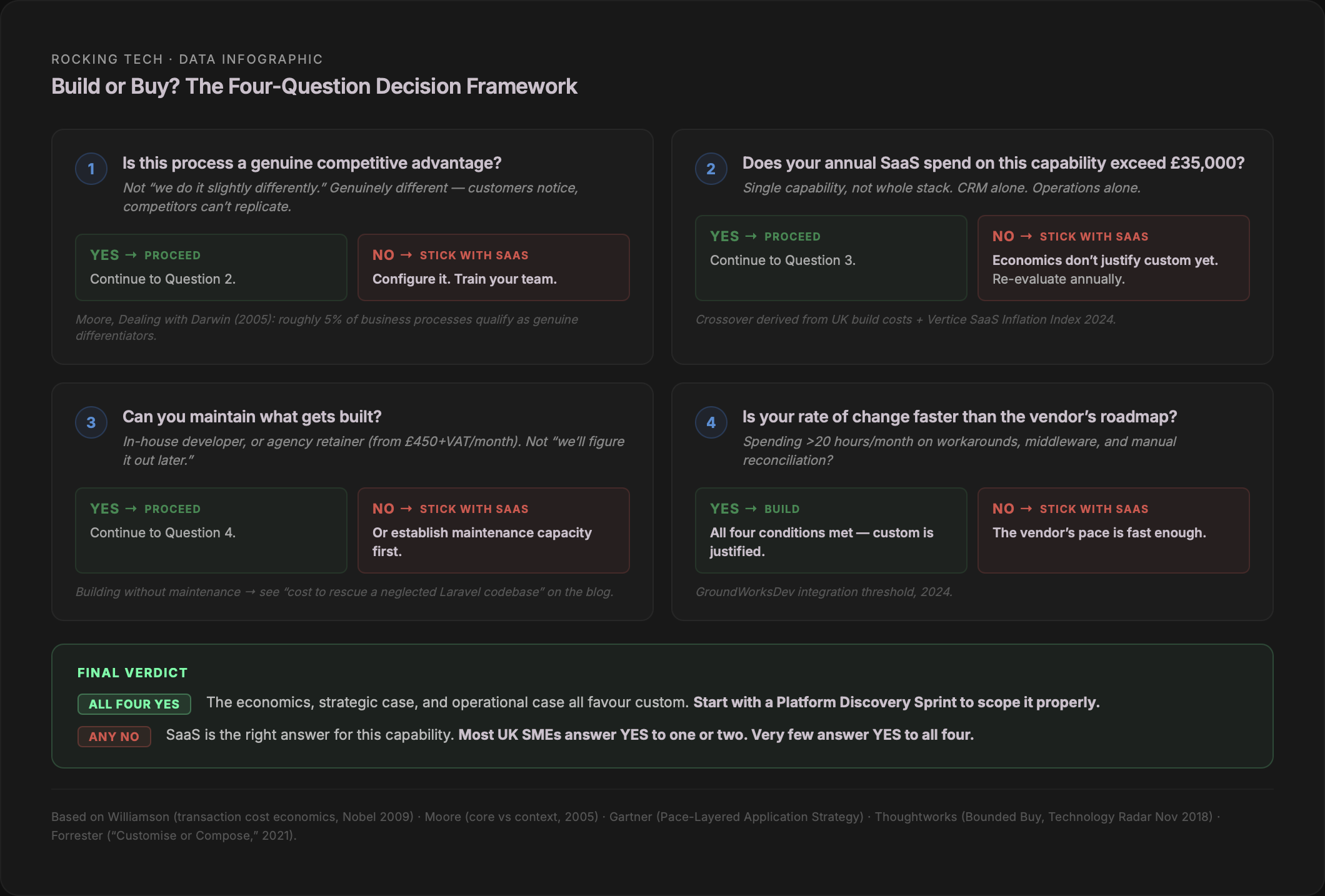
Strip the academic vocabulary and the decision that survives looks like this. Build when all four are true. Buy when any one is not.
Question 1: Is this process a genuine source of competitive advantage?
Not "we do it slightly differently" — genuinely different, in a way that customers notice and competitors cannot replicate. A proprietary matching algorithm is core. A unique client portal is core. A sales pipeline with custom properties in HubSpot is context with a custom label. Moore's research suggests roughly 5% of business processes qualify as genuinely strategic. Be ruthless with this test.
Question 2: Does your annual SaaS spend on this capability exceed £35,000?
Below that figure, the three-year economics favour SaaS even with Vertice's measured inflation. Above it, the maths tips — and the further above it you are, the more dramatically. If your annual SaaS bill for a single business capability (not the whole stack) is £50,000 or more, you are paying for a custom platform every two years and not receiving one.
Question 3: Can you maintain what gets built?
A custom platform requires security patches, dependency updates, and version upgrades. If your current developer left tomorrow, could you get the application fixed within 24 hours? If not, you need either an in-house hire or an agency retainer before you build. Building without maintenance is how rescue projects happen.
Question 4: Is your rate of change faster than the vendor's roadmap?
SaaS platforms release on their own schedules. If you need a new integration this month and the vendor's roadmap shows it in Q3 next year, you are either waiting, building a workaround, or paying for middleware. One integration consultancy's published threshold: under 20 hours per month of automation and integration work, SaaS plus middleware wins; over 20 hours per month, custom wins (GroundWorksDev, 2024). If your operations team is spending a full working week every month on Zapier flows and manual reconciliation, the answer has already tipped.
The answer is almost never all-or-nothing
The genuinely useful insight from the research is that the build-versus-buy decision is not binary. Forrester's framing is right: most successful businesses run a hybrid where commodity capability is bought and run vanilla, while genuine differentiation is built.
Your accounting should be Xero or QuickBooks. Your team messaging should be Slack or Teams. Your calendar booking should be Calendly or Cal.com. These are mature, competitive categories where the market leaders have invested hundreds of millions into solving the exact problem you face. Run them vanilla. Adapt your process to fit the tool.
Your customer-facing platform — the system your clients interact with, the workflow that is genuinely proprietary, the operational logic that competitors cannot buy off the shelf — that is where custom development earns its cost. Not because custom is inherently better, but because no SaaS vendor built a product for your specific business logic.
The practical split for most UK SMEs we work with: roughly 80% of the stack remains SaaS. The remaining 20% — the part that makes your business yours — is where a custom platform creates value. The mistake is treating the decision as a single fork in the road rather than a rolling assessment, capability by capability.
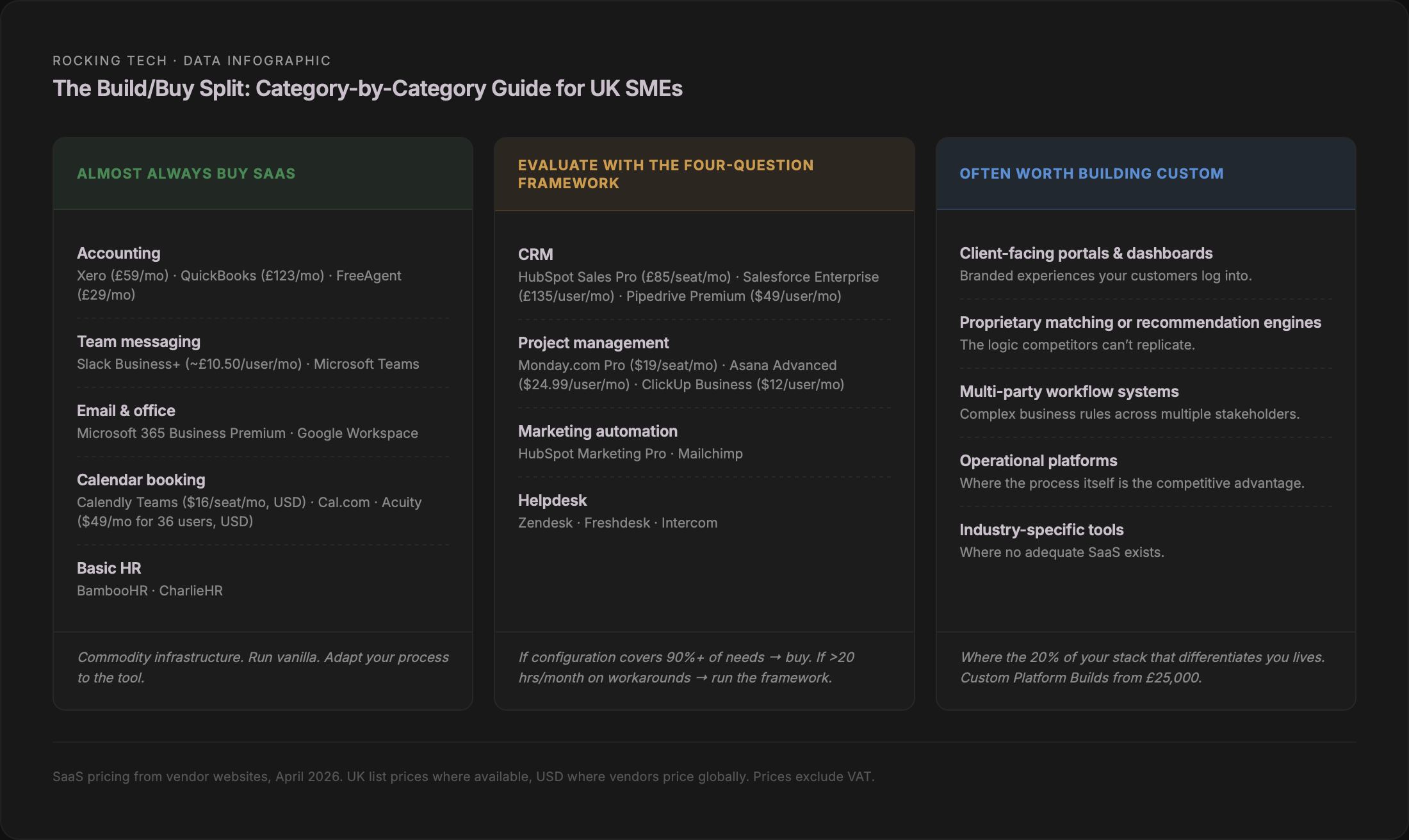
Here is a quick reference for the most common categories:
Almost always buy: Accounting (Xero, QuickBooks, FreeAgent). Team messaging (Slack, Teams). Email (Microsoft 365, Google Workspace). Calendar booking (Calendly, Cal.com, Acuity). Basic HR (BambooHR, CharlieHR). These are commodity infrastructure. Run them vanilla.
Evaluate honestly: CRM (HubSpot, Salesforce, Pipedrive). Project management (Monday.com, Asana, ClickUp). Marketing automation. Helpdesk. If configuration handles 90%+ of your needs, buy. If you are spending significant time on workarounds, the four-question framework above will tell you whether to build.
Often worth building: Client-facing portals and dashboards. Proprietary matching or recommendation engines. Multi-party workflow systems with complex business rules. Operational platforms where the process itself is competitive advantage. Industry-specific tools where no SaaS exists for your niche.
What to do if you are genuinely uncertain
If you have run the four-question framework and the answer is not obvious — you said YES to two or three but not all four, or you are unsure whether your process is genuinely differentiating or just differently configured — that uncertainty is itself useful information. It means the answer requires someone to look at your specific situation, your specific stack, and your specific processes.
That is what the Platform Discovery Sprint exists to answer.
The Sprint is a fixed-fee £4,500 engagement, delivered in three weeks. It produces a 15–20 page Platform Discovery Report covering your requirements with MoSCoW prioritisation, a one-page architecture diagram, a technology recommendation with rationale, a phased roadmap with three to four phases including timeline and budget ranges per phase, a risk assessment, and — critically — a build, buy, or hybrid recommendation that explicitly includes "don't build, use off-the-shelf" if that is the honest answer.
For businesses with an existing application that may need rescuing rather than replacing, the Sprint includes a Code Health Scorecard: automated scanning plus manual expert review, with a fix, refactor, or rebuild recommendation per component. The process requires roughly 3.5–4.5 hours of your time across four touchpoints over three weeks. The deliverable is yours regardless of whether you proceed with us — you can take it to any developer you choose.
If you proceed to a Custom Platform Build within 30 days, the £4,500 is credited in full against the build cost. If you do not, the report stands on its own.
The honest answer for your business might be HubSpot Professional plus Xero plus Calendly and a properly trained team. If so, that is what the Sprint will tell you. The honest answer might equally be that your SaaS spend has crossed the threshold, your processes are genuinely proprietary, and you need to scope the build properly before committing. Either answer saves you money. Only one of them costs £4,500 to find out.
Ready to build what nothing off-the-shelf can do?
Book a free 30-minute call. We’ll discuss what you’ve tried, what’s not working, and whether a Discovery Sprint is the right next step. If it is, you’ll know exactly what to build – and the £4,500 comes off the build if you go ahead.