· 9 min read
Why UK Software Quotes Vary 4× On the Same Brief
UK software agencies routinely quote 4× apart on the same brief. None of them is lying. Here's what they're actually pricing — and why "free" proposals cost you twice.

Anatoly Silko
Founder, Rocking Tech

Three UK software agencies can quote £28,000, £65,000 and £110,000 on the same brief. Not as a rare outlier — as a documented pattern. UK agency operators describe quote spreads of £15,000 to £80,000 on identical mobile-app briefs as a recurring pattern over the past decade (UK agency commentary, 2025). A US industry study sent an identical software brief to 97 agencies and received quotes ranging from $1,000 to $250,000 (industry email study, undated). Founders on developer forums report quotes spanning two orders of magnitude — $200 to $87,000 on the same freelance brief (r/Web_Development, 2024).
None of the agencies giving those quotes was wrong. Each was pricing a different project, because without paid scoping, every responder imagines a different scope from the same document.
When you see a quote range that wide, you're not looking at price competition. You're looking at several people solving different problems from the same brief.
This article is about why that happens, what "free" scoping actually costs, and what paid discovery is supposed to produce. At the end there's a link to ours. The logic below stands whether you work with us or not.
The fiction the buyer pays for twice
The convention in software is that scoping is free. You brief an agency, they write a proposal, you pick one. No one pays for the discovery phase because the agency "absorbs it."
The agency doesn't absorb it. You do.
UK agency-specialist accountants put numbers on this in March 2026: a serious agency pitch runs around 20 hours of senior time, worth roughly £2,000 in unbilled senior revenue at a £100/hour benchmark — and up to £15,000 to £25,000 in fully-loaded time and expenses for mid-size agencies pitching complex work (Sidekick Accounting, 2026). UK blended agency rates for senior and director time sit in the £100–£135/hour band (Wow Company BenchPress, 2025); UK senior developer contract rates run at a £525/day median (IT Jobs Watch, 2026).
That money doesn't vanish. UK agency operations software recommends building "5–20% of the total fee as a separate line" into every winning quote to cover unrecovered pitch costs (CMap). Sidekick's framing is blunter: profitable agencies spend 10–15% of target new revenue on business development and pitching (Sidekick Accounting, 2026).
Illustratively: at the 20% average proposal close rate reported across 1.3 million proposals (Proposify, State of Proposals 2024), every winning contract carries the sunk cost of roughly four that didn't convert. At Sidekick's £2,000-per-pitch baseline, that's £8,000 of unbilled senior time per win before any overhead — which has to come back somewhere. A £50,000 quote loaded at 15% contingency is, in practice, a £42,500 build plus £7,500 covering the unsuccessful pitches.
The PR industry has been more transparent about this. UK PR agencies run 27 pitches a year averaging 62 hours each, at £11,000 of annual pitch cost per agency (PRCA, 2022). Deal sizes are smaller in PR than in software, but the structural pattern is identical — and the same arithmetic applies.
Why quotes vary by 4× on the same brief
This is the part most founders find disorienting. Surely one of the agencies was wrong?
Pricing consultant Jonathan Stark describes fixed-price software quotes as pulled "from thin air" — not because agencies are dishonest, but because a fixed price against a loose specification is guesswork by definition (Stark, ongoing). UK agency commentary is consistent: a fixed price requires a fully understood scope, and without one the number is either wrong or padded with contingency (UK agency observation, 2026).
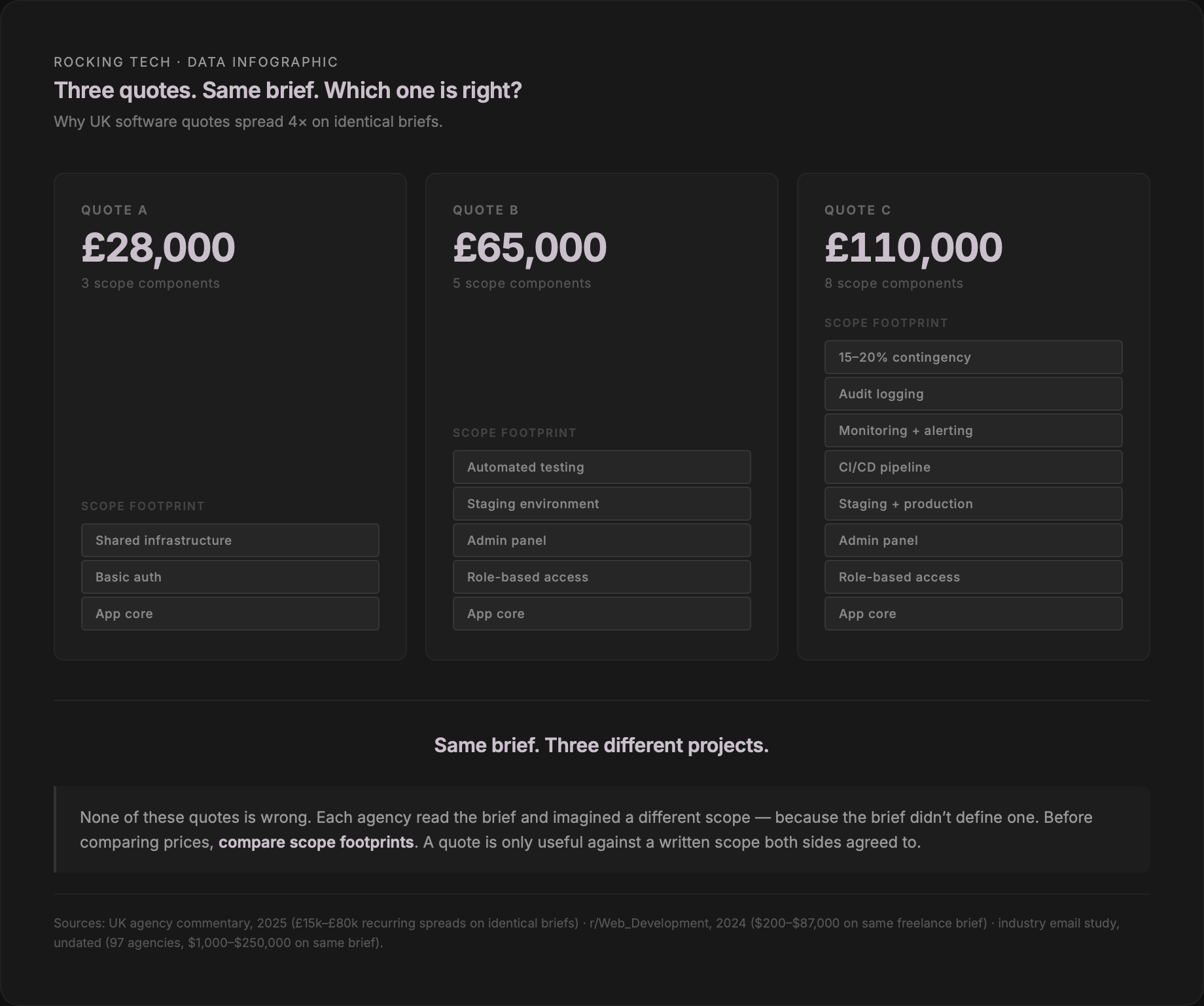
Illustratively, here's how a 4× spread typically breaks down when three capable agencies respond to the same loose brief:
- The cheapest quote typically assumes a lightweight MVP — shared infrastructure, basic authentication, minimal testing, manual deployment. It's a real quote for a real project; it's just a smaller project than the other two imagined.
- The mid-range quote typically assumes a proper admin panel, role-based access, a staging environment, transactional email infrastructure, some automated testing.
- The most expensive quote typically assumes production-grade infrastructure, automated deployment, monitoring and audit logging — plus a 15–20% contingency for the ambiguity in the brief itself.
All three can be quoted competently from the same document. None of them is pricing the same project. And the founder has no way to tell the difference until they pick one and three months later discover what "not included" meant.
The cheapest quote isn't the cheapest project. It's the project with the most change orders ahead of it.
This is why quote variance at this scale is structural, not accidental. Remove shared understanding of the problem and every responder imagines a different project. The cheapest imagines the smallest project. The most expensive imagines the most risk. None of them is pricing the thing you actually need.
What the rest of the UK economy charges for scoping
Every adjacent UK profession treats scoping as paid, fixed-fee work. Software is the outlier.
A RIBA-registered architect working to Stages 0–2 of the Plan of Work — strategic definition, preparation, brief, concept design — typically charges around £5,000–£6,000 on a £250,000 commercial build, based on industry-convention total fees of 5–10% of construction cost, of which Stages 0–2 represent roughly a third (RIBA Plan of Work, 2020). A RICS-aligned quantity surveyor's fixed-fee feasibility report on a £500,000 build runs £2,500–£5,000 at 0.5–1% of construction cost (Designing Buildings Wiki; RICS, 2022).
It gets starker at the top of the market. UK central government paid McKinsey £563,400 for a six-week vision engagement in 2020, and £3 million for an eight-week business-case diagnostic in 2021 (Privacy International, 2020; The Register, 2021). Discovery phases listed on the Government Digital Service's Digital Marketplace typically run £50,000–£150,000 for an eight-week engagement, with large programmes exceeding £500,000 (Digital Marketplace, 2016–2022). A first-stage commercial litigation review at a City firm costs £650 to £12,000+VAT depending on scope, disclosed under SRA Transparency Rules (SRA, 2018 in force; Bird & Bird price transparency, 2025).
Nobody asks an architect to design their house for free in the hope of winning the build contract. Nobody asks a KC to review their case for free in the hope of being instructed. Nobody asks a management consultancy to diagnose the problem for free in the hope of getting the transformation programme. You pay them for the diagnosis, and what they deliver is yours whether or not you hire their partner firm for the next phase.
Only software agencies scope for free. And software agencies charge for it anyway — they just hide it in the winning quote.
The sunk-cost mechanism
This isn't purely a commercial argument. The underlying mechanism is documented in operations research on diagnosis-based services. Kong, Rajagopalan and Tong's 2018 paper in Production and Operations Management models pricing in service settings with diagnosis and treatment phases, and demonstrates that customers exhibit sunk cost bias once they've paid a diagnosis fee — making them more willing to continue with the same provider into the treatment phase than they would have been without that investment (Kong, Rajagopalan & Tong, POM 2018). The paper's focus is on optimal pricing scheme design, but the sunk-cost mechanism it formalises is what makes paid discovery work as a qualifier.
The practical evidence tracks. Industry average proposal close rates sit at roughly 20% across 1.3 million proposals (Proposify, State of Proposals 2024). UK formal RFP win rates average 47% across 1,533 teams — the highest globally (Loopio 2026 RFP Trends & Benchmarks). Agencies running paid discovery consistently self-report materially higher conversion, with practitioner figures clustering around 70–99% (Sakas; Agency Mavericks; practitioner case studies, 2023–2024). Treat those paid-discovery figures as directional — paid-discovery populations are self-selected, which is the mechanism, not a flaw. A paid engagement is a filter. You want agencies who only go forward with clients who are serious, and you want to be the kind of client whom serious agencies want to work with.
This matters for the buyer, not just the agency. A free proposal is written to win your contract. A paid discovery is written to tell you the truth — including "don't build this" if that's the answer. You can feel the difference in the document when you get it.
What a trustworthy software quote actually looks like
If you're evaluating quotes right now — paid or free — run them through this checklist:
1. Paid discovery precedes the quote. A fixed price after a 30-minute call is a red flag. The scope wasn't understood. What you've received is a sales document, not a plan.
2. Stated assumptions and a rate × hours breakdown. Reverse-engineer the total. Divided by the hours, it should land at a credible UK blended rate — around £500–£600/day for senior work (IT Jobs Watch, 2026). If the numbers don't reconcile, the total is padded or the hours are fictional.
3. Explicit exclusions and a written change-request clause. What happens when something comes up mid-build that wasn't in scope? How is the rate calculated? What's the approval route? If this is vague, the agency is preserving the right to charge you later for things you assumed were included.
4. A named technical contact who will actually write the code. Not a sales engineer. Not a project manager. Not "our team." The person.
5. Milestone-linked payments. Not 50% upfront and 50% on delivery — that structure makes the second half optional for the agency if things go wrong. Payments should follow demonstrable value delivered.
6. Willing UK references and a genuine case study. A case study that describes the problem, the decisions, what was hard, and what got decided wrongly. Anything that reads like marketing copy is marketing copy.
7. It's called a "quote," not an "estimate." Jonathan Stark's test: does the agency commit to the number regardless of how long the work takes (Stark, ongoing)? If they won't, the figure isn't what you think it is.
Most of these checks fail on most free proposals. That isn't a coincidence.
What paid discovery actually produces
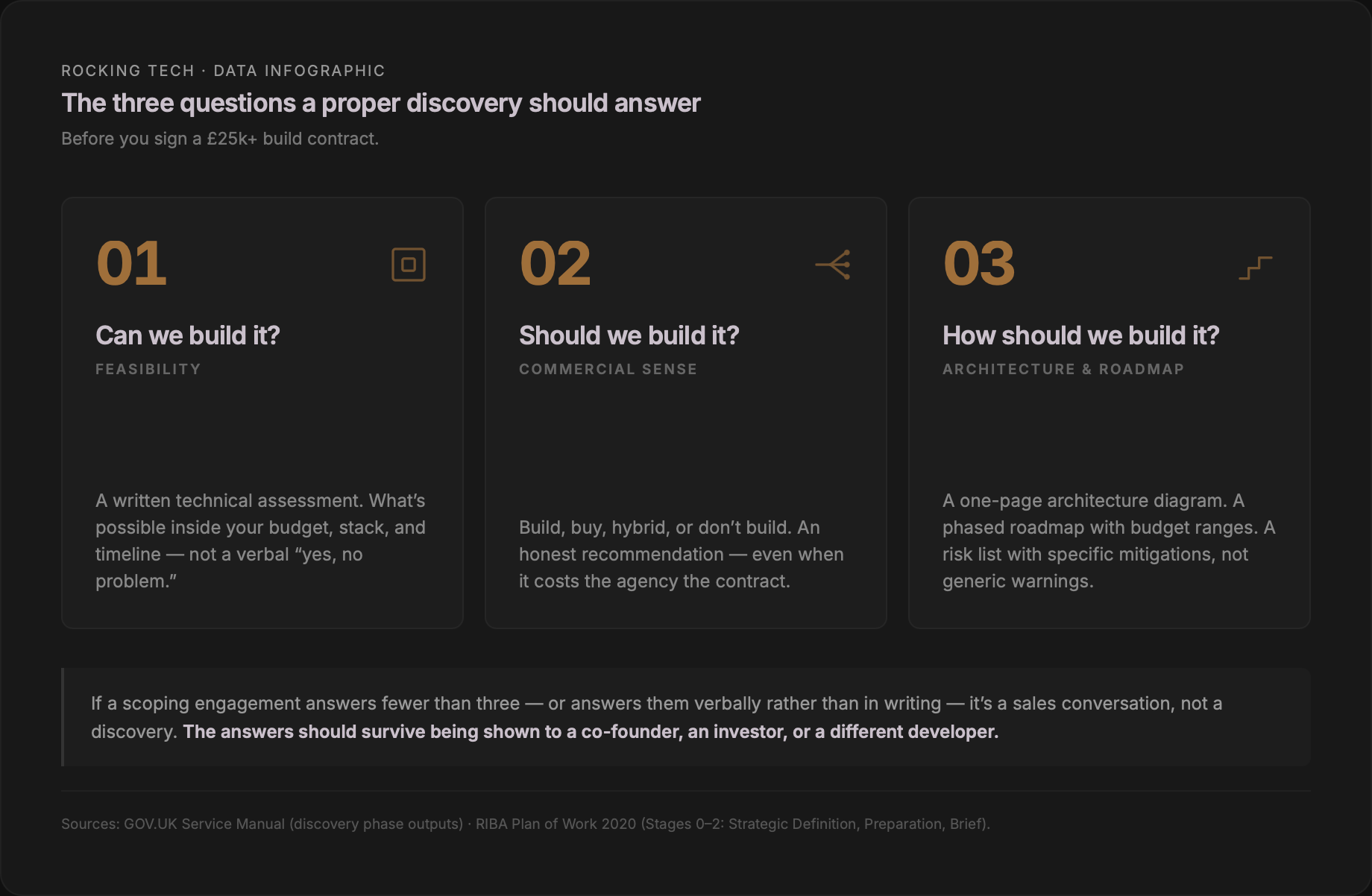
Discovery is supposed to produce a document you can act on. Before getting into what ours contains, it's worth framing what any proper scoping engagement should answer.
The Platform Discovery Sprint is our paid discovery engagement — three weeks, £4,500 + VAT fixed fee, 100% payable upfront before kickoff. Total client time is under four hours across four touchpoints: a pre-work questionnaire (30–60 minutes), a 90-minute kickoff workshop in week one, a 30-minute check-in in week two, and a 60-minute recorded presentation in week three.
The deliverable is a 15–20 page Platform Discovery Report plus supporting artefacts. Inside:
- A MoSCoW-prioritised requirements list — must-have, should-have, could-have, won't-have — documented with enough specificity that a different developer could pick it up
- A one-page architecture diagram showing how the system fits together
- A technology recommendation with clear rationale for what to use and what to avoid
- A phased roadmap with three or four phases, each with a timeline and a budget range
- A build, buy, or hybrid recommendation — including "don't build" if that's the honest answer
- A risk assessment with specific mitigations, not generic warnings
- A 60-minute recorded presentation walking the report through for your team or investors
- A Code Health Scorecard where an existing application is involved — automated scan plus expert review with a fix / refactor / rebuild recommendation per component
The report is yours. If you proceed with a Custom Platform Build within 30 days, the £4,500 is credited in full against the build cost. If you don't, the report stands on its own — you can take it to any developer you like as a brief.
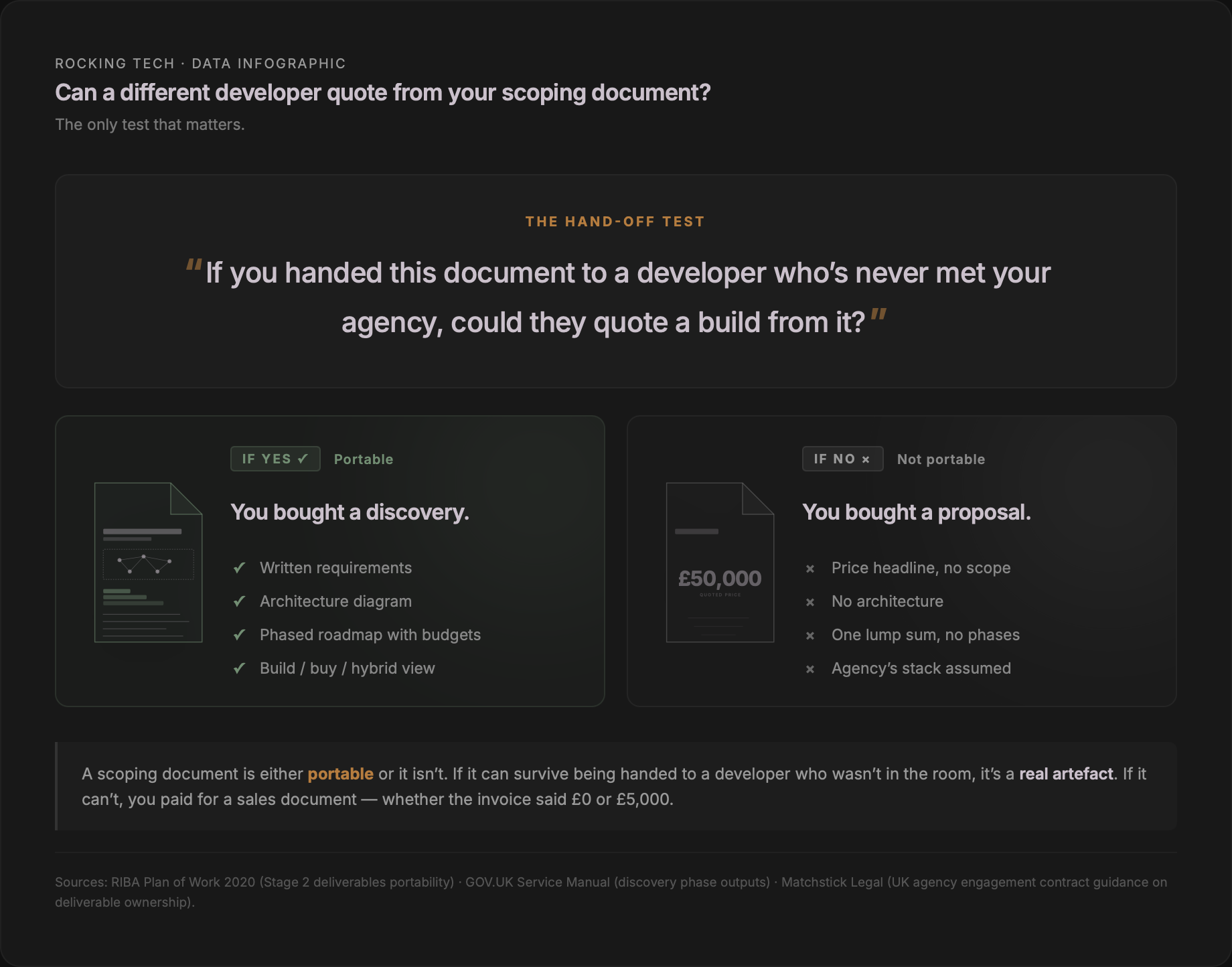
Most clients don't take it elsewhere. By the time three weeks have gone into understanding their problem properly, they'd rather continue with us than start over with someone new. That's the sunk-cost mechanism at work, and it's a feature of the model — not a trick. The option to take the report elsewhere is genuinely there, and we intend it to be.
I run every Discovery Sprint personally. You're not handed off to a junior consultant or a sales engineer. The report is signed off by the person who would also build the platform — which is why the recommendation can be "don't build with us" or "don't build at all" without anyone losing face.
The honest bit
I've rescued enough UK platform projects to know what a bad brief does to a build. The failure patterns are documented in our post on rescuing freelancer-built MVPs and our analysis of what goes wrong with AI-tool builds. Rebuild costs routinely run into five figures — on top of whatever the original build cost.
That's why we charge for scoping. Not because our time is precious — every agency's time is precious. It's because a paid engagement is the only format where our incentive is to tell you the truth, and your incentive is to hear it.
If you're about to commission a £25,000+ custom platform build, the single most important decision isn't which agency to pick. It's how you scope the project before you pick anyone.
Don't make that decision on a 30-minute call. Pay someone — us or someone else — to actually look at the problem first.
Ready to know what you’re building?
Book a free Discovery Call — 30 minutes, no commitment, no pitch. We’ll discuss your project, confirm whether discovery is the right next step, and answer any questions.