· 5 min read
AI Automation for Professional Services Firms (UK)
The firms pulling ahead in professional services are not the ones with the cleverest AI. They are the ones who worked out what to automate, what to charge for the time it frees up, and what to leave well alone.

Anatoly Silko
Founder, Rocking Tech

Most writing about AI in professional services answers the wrong question. It asks what the technology can do.
For a solicitor, an accountant or a consultant, that part is the easy part, and it is largely settled. The firms getting real value have already moved on to the question that actually pays: what happens to the economics of the firm when a task that took three hours now takes twenty minutes.
Get that right and the freed time turns into margin, capacity and faster growth. The answer is different for each of the three professions, and being ahead of it is the whole advantage.
Start with what is actually being automated, because it is more mundane, and lower risk, than the headlines suggest.
In law, the live use cases are matter intake, conflict checks, first-draft document and contract review, disclosure review and time recording. The pattern is the same across all of them. The AI handles the repetitive, rules-consistent layer, and a qualified person keeps the judgement, the privilege calls and the sign-off.
Adoption is real at the top end. 76% of the largest solicitors' firms were using AI by the end of 2024, nearly double three years earlier, while only around a third of small firms were even exploring it (SRA Risk Outlook on the use of AI in the legal market, November 2024).
That gap is open ground. A smaller firm that moves now arrives ahead of most of its market, and we have written separately on how a smaller firm gets there in four weeks.
In accountancy the automatable layer is wider and further along: transaction categorisation, bank reconciliation, VAT return assembly, management-accounts drafting and AML onboarding.
UK practices using AI extensively save an average of 18 hours and 53 minutes a week and complete tasks in 31% less time (Xero and Cebr, AI Adoption in UK Accounting, November 2025).
And the workload is about to grow. Making Tax Digital for Income Tax lands in April 2026 for more than 860,000 sole traders and landlords earning above £50,000 (HMRC; ICAEW TAXguide 01/25). The firms that have automated will absorb that volume without hiring. The firms that have not will feel every hour of it.
In consulting it is research synthesis, proposal drafting, deck production and data analysis. 77% of UK consulting firms have adopted AI and 79% report meaningful time savings (MCA Member Survey, January 2026).
The exposed work is the bottom of the pyramid, the structured production tasks. Partner judgement is the part that does not automate, and that is exactly where you want your best people spending their day.
Where the saved time actually pays
This is where the three professions split, and it is the part most automation pitches skip. We put it first, because it decides everything else.
In a firm that bills by the hour or the day, faster work means fewer billable units. PwC's 2025 Law Firm Survey found the anticipated reduction in chargeable hours across the top 100 firms rose from 11% to 16% in a single year. That is not a reason to hold back. It is a reason to settle your pricing before you automate, not after.
The firms getting this right are already moving. 54% of UK firms expect fixed-fee billing to grow (Clio Legal Trends Report, 2024), and under a fixed fee the saved hour becomes margin instead of lost income. The same move protects day-rate consultancies, where 43% of leaders already see the pressure coming (MCA, January 2026) and the ones acting on it are turning it into an edge.
Accountancy is the clean case. Compliance work is overwhelmingly fixed-fee or recurring, so a saved hour drops almost straight to margin, or gets redeployed into advisory.
That is the single biggest reason accountancy is ahead of the other two.
The firms winning with automation did not buy better AI. They decided what to charge for the hours it gave back.
The point is that the economics are knowable. Map them first and automation is pure upside. That mapping is the first thing our discovery workshop does, before a single line is built, so you never automate yourself into lower revenue.
Which processes you start with is its own discipline. We have covered how to score them before you build and how to model the return before you commission anything in more depth elsewhere.
The objections are fair, and they are already solved
The resistance in these professions is not Luddism. It is usually correct, and we would rather you raise it now, because every one of these objections has a clean answer.
The defining objection is reliability.
In June 2025 the Divisional Court ruled on two cases (Ayinde v Haringey and Al-Haroun v Qatar National Bank, [2025] EWHC 1383 (Admin)) in which lawyers had filed fabricated case citations produced by AI. The lesson is not that AI is unusable. It is that unsupervised AI is.
For accountants the loudest worries are accuracy and security. Hallucinated figures are the single biggest concern, named by 29% in one UK practitioner survey, while data security tops the separate list of implementation barriers at 62% (AccountingWEB, 2025).
For consultants it is reputational. A major firm partially refunded a government client in 2025 over a report that contained AI-fabricated references (reported October 2025, Australia).
Every one of those failures comes from the same mistake. Letting the model act unsupervised, or routing confidential client data somewhere you do not control. That is exactly what we design out.
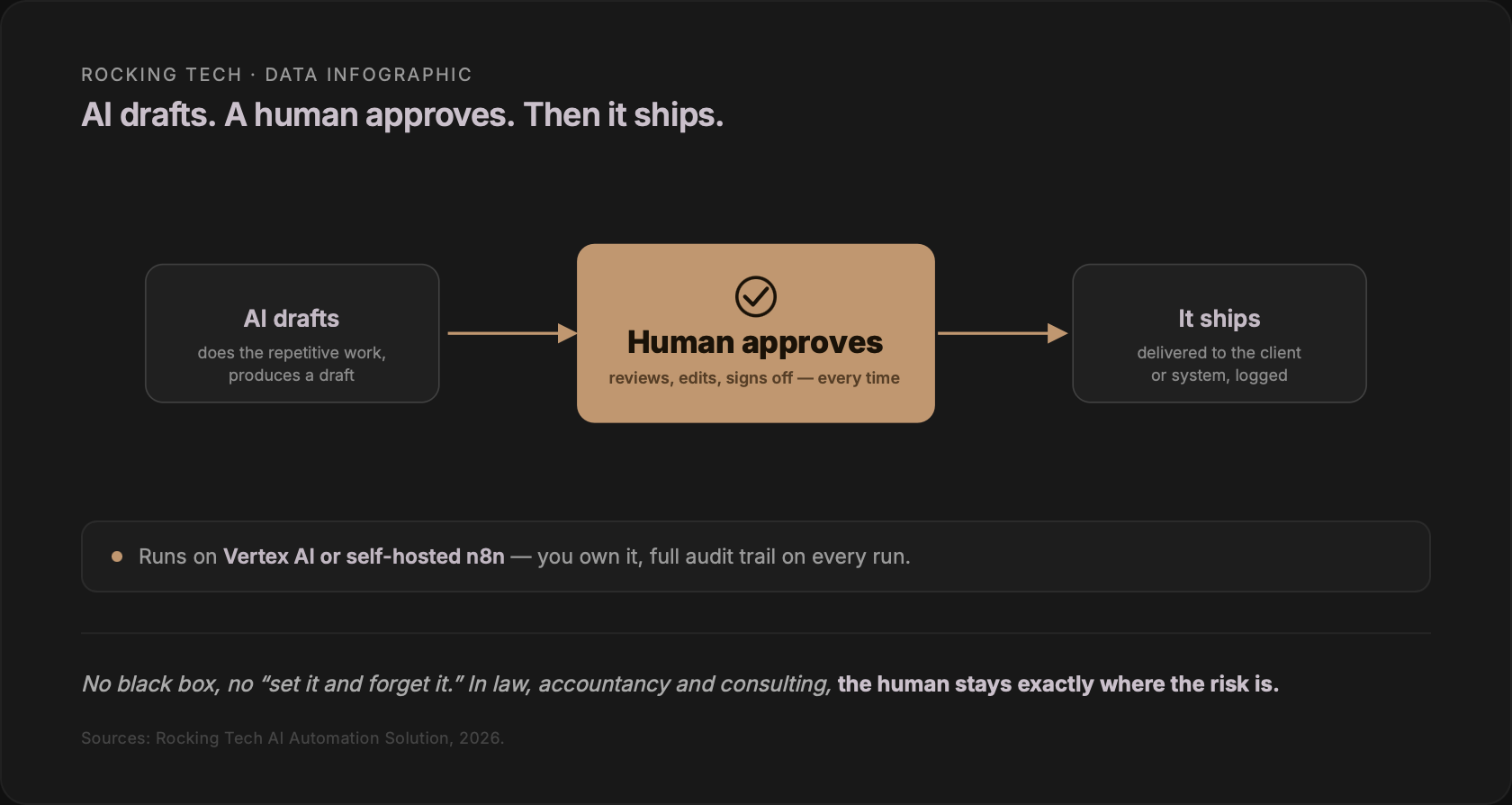
For anything touching a regulated output or sensitive data, we build human approval gates. The AI drafts the action, and a person approves it before it executes. Nothing leaves the building on the model's say-so.
Where data residency matters, we deploy on Google Vertex AI for governance, or self-hosted n8n where you own the workflows outright, rather than routing privileged material through a shared cloud account. Every automated action is recorded in an audit log. Drawing that line is the entire job, and it is a solved one.
What the engagement looks like
The engagement is deliberately narrow and fixed. £2,500 plus VAT.
A discovery workshop to map your workflows and your economics, then up to three production automations built and tested against your real data, with full documentation, a team training session and 30 days of post-launch support.
Most builds run two to six weeks. Ongoing platform costs are small and usage-based, typically £20 to £100 a month on OpenAI, or £10 to £50 self-hosting. The sweet spot is any process that eats five or more hours a week and follows a consistent pattern.
We will also tell you what to leave alone. A badly chosen process is the most common way automation projects quietly fail, and ruling things out is as valuable as building. That is the difference between automation that adds to your margin and automation that just adds to your costs.
Let us find the one thing worth automating
Book a free 30-minute consultation. We’ll look at your workflows and tell you honestly whether automating one of them is worth it. No commitment.