· 7 min read
Finding Laravel Developers in the UK: Why It's Harder Than It Looks
UK Laravel vacancies have collapsed 76% since 2024. Salaries haven't budged. The market is telling you something — and it isn't 'keep looking.'

Anatoly Silko
Founder, Rocking Tech

You have a Laravel application that needs ongoing work. Maybe your developer left. Maybe you inherited it through an acquisition, or you built it with a freelancer who stopped answering emails six months ago. Whatever the circumstances, you've arrived at the same conclusion most founders arrive at eventually: I need to hire a Laravel developer.
So you write the job spec, talk to a recruiter or two, and post it on Indeed. And then you wait. And somewhere around week five or six, with your application still unpatched and the security advisories piling up, you start wondering whether the market is broken or you're doing something wrong.
It's the market.
The numbers behind the shortage
Over the six months to May 2026, there were just 220 permanent vacancies across the UK that mentioned Laravel — representing 0.24% of all IT permanent postings (IT Jobs Watch, 2026). The same six-month window in 2024 showed 937. That's a 76% collapse in two years.
The median salary has barely moved: £55,000 nationally, with London commanding around £65,000 and roles outside the capital clustering closer to £50,000 (IT Jobs Watch, 2026). Sharply falling vacancies alongside sticky pay means the remaining roles are harder to fill, not easier. The candidates simply aren't there in the numbers they used to be.
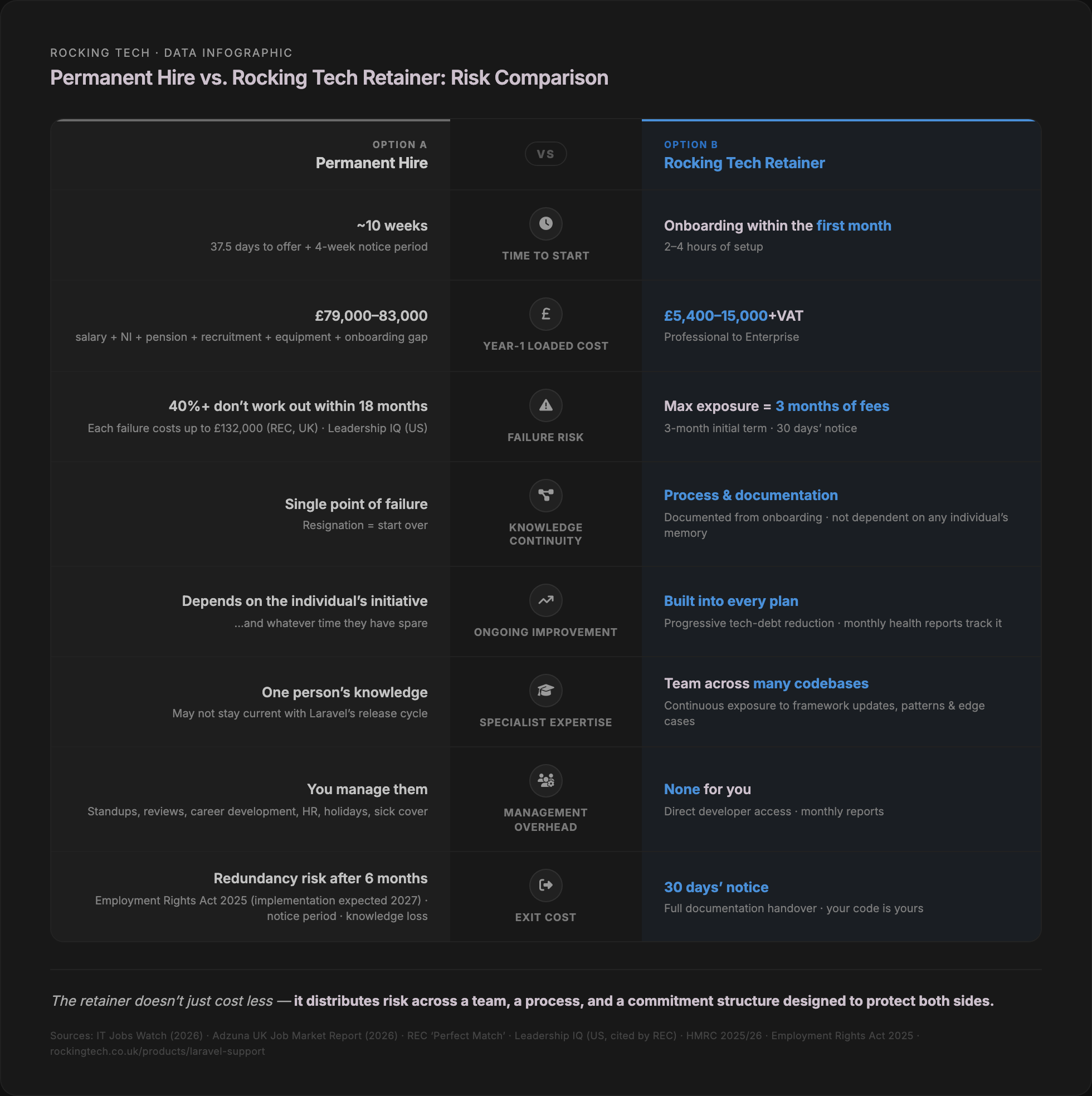
The hiring process itself takes longer than most founders budget for. The average time-to-fill for IT roles sits at 37.5 days (Adzuna UK Job Market Report, 2026). Layer on a standard four-week notice period and you're looking at roughly ten weeks between posting a role and having somebody at a desk. If your application needs security patches applied right now, ten weeks is not a plan.
Why the pool is smaller than it appears
Even the 220-vacancy figure overstates how easy it is to find the right person. A large proportion of roles that require Laravel are advertised under broader titles — "PHP Developer," "Full-Stack Developer," "Back-End Engineer." Co-occurrence data shows that 85% of UK vacancies tagged with Laravel also list generic PHP as a required skill (IT Jobs Watch, 2026), which means the candidates who could fill these roles are scattered across multiple job-title categories rather than concentrated under one searchable label.
Within the PHP ecosystem, Laravel is dominant at 64% of framework adoption (JetBrains State of PHP, 2025). But PHP as a whole is a shrinking pipeline — only 15.2% of new programmers choose it, even though 18.2% of working professionals still use it (Stack Overflow Developer Survey, 2024). The experienced base is loyal, but fewer developers are entering the pipeline every year.
Your next Laravel developer probably already has a job. A significant share of the UK's strongest Laravel talent works inside agencies that hold official Laravel Partner status or certification (Laravel, 2026). Those developers are on payroll, working across client projects, and not visible in the job market. The "available for direct hire" pool is quite a bit smaller than the "exists in the UK" pool.
Your next Laravel developer probably already has a job. The question is whether you can afford to wait ten weeks for someone who might not work out — or whether your application needs help now.
The economics of getting it wrong
The average cost of a failed mid-level hire comes in at £132,000 (REC, "Perfect Match" report). That accounts for the lost recruitment fee, wasted onboarding time, the productivity gap while the role sits empty again, and the management hours consumed by the process. The same research found that 39% of UK employers admit their interviewing and assessment processes need improvement.
US research suggests that more than 40% of new hires don't work out within eighteen months (Leadership IQ, cited by REC). The figure comes from the American market, but REC considered it relevant enough to include in their UK reporting, and most founders I speak to don't find the number surprising.
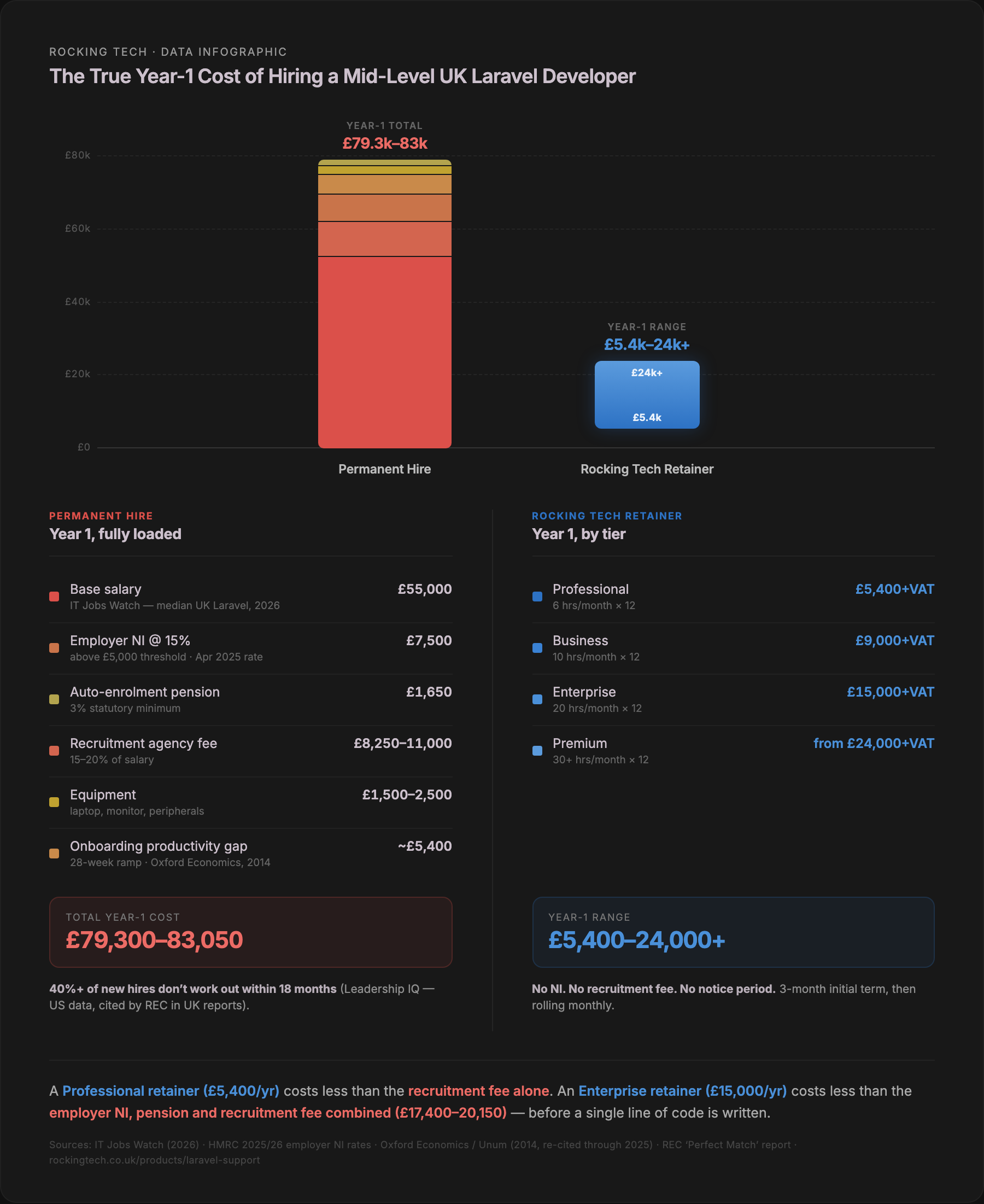
Applied to a £55,000 Laravel developer hire with a fully loaded Year 1 cost pushing towards £80,000 — employer NI at 15% (HMRC, 2025/26), pension contributions, a recruitment fee, equipment, and the 28-week ramp to productivity (Oxford Economics, 2014) — the downside exposure on a bad hire is significant.
The Employment Rights Act 2025 is also set to reduce the qualifying period for unfair dismissal claims from two years to six months, with implementation currently expected in 2027. The window for exiting a bad hire cleanly is getting narrower.
If your application needs security patches applied regularly, version upgrades managed, and technical debt kept under control, the question is whether a permanent hire is the most rational way to get them done.
Why outsourcing alone isn't the answer either
The instinct to look offshore is understandable — senior Laravel rates in South Asia and Eastern Europe run 40–70% below UK equivalents on paper (Acquaint Softtech, 2026; DistantJob, 2025). But rate cards don't tell the full story.
The difference between outsourcing that works and outsourcing that doesn't comes down to management. Unmanaged offshore arrangements — where a founder hands a brief to a remote team and hopes for the best — consistently produce scope drift, inconsistent code quality, and documentation gaps. The savings on the rate card get consumed by rework and the founder's own time spent chasing updates and reviewing output.
What makes outsourcing work is the same thing that makes any development relationship work: a technically competent principal who understands the codebase, sets standards, reviews output, and maintains documentation that means the project isn't dependent on any single person's memory. That's an expertise and management problem, not a geography problem.
For UK businesses, there's also a compliance dimension. The moment any developer — wherever they sit — accesses production data containing personal information, GDPR and UK GDPR controller-processor obligations apply. Article 28 requirements, international data transfer agreements, and transfer risk assessments all need to be in place. Most founders don't think about this until it becomes a problem.
What we actually do
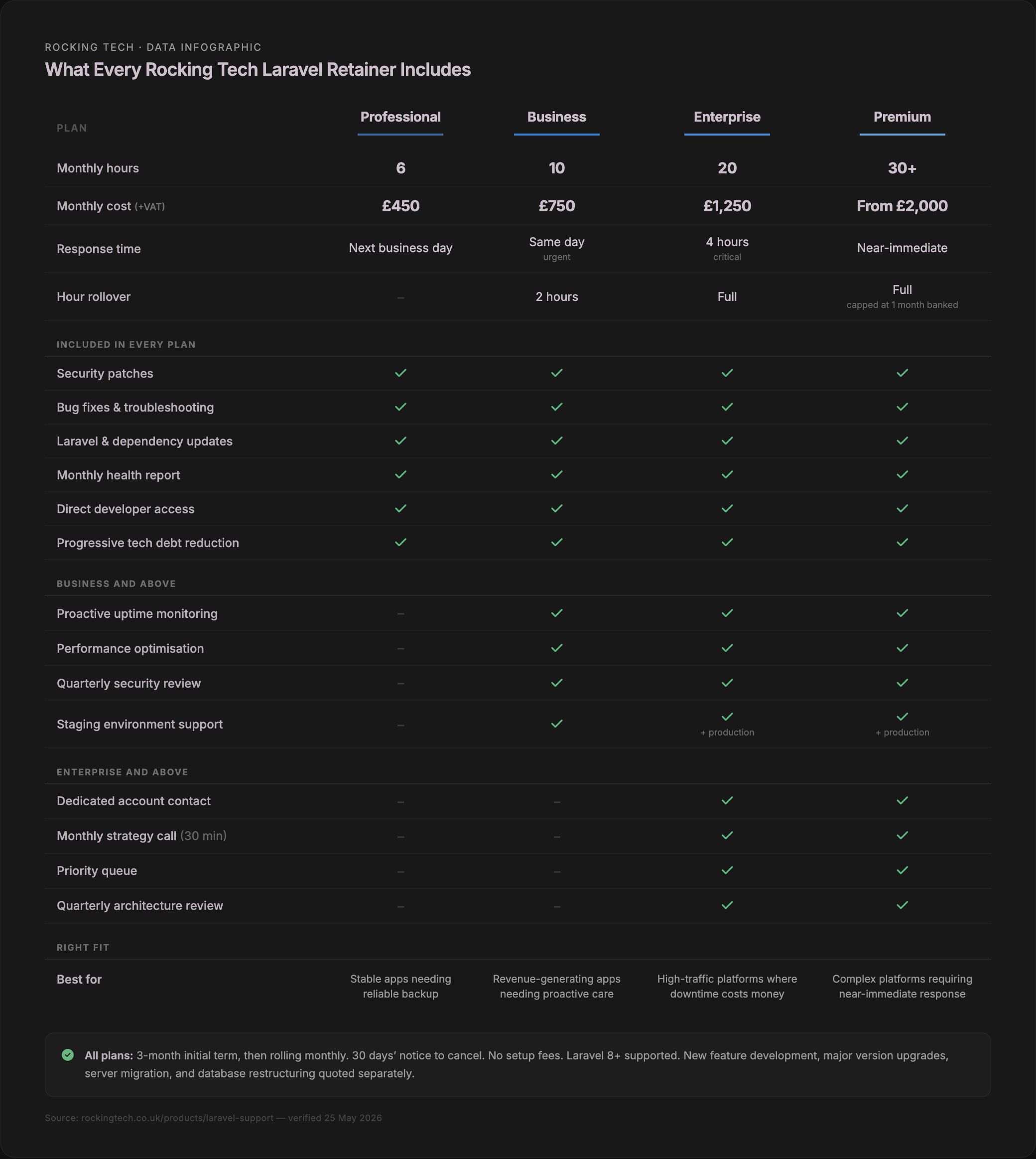
Our Laravel Support retainer runs across four tiers. The Professional plan at £450+VAT per month gives you six hours of support with next-business-day response — enough for a stable application that needs security patches, dependency updates, and the occasional bug fixed. The Business plan at £750+VAT per month gives you ten hours with same-day response for urgent issues, adds proactive uptime monitoring, performance optimisation, quarterly security reviews, and two hours of rollover. The Enterprise plan at £1,250+VAT per month gives you twenty hours with a four-hour response time for critical issues, a dedicated account contact, monthly strategy calls, priority queue placement, quarterly architecture reviews, and full hour rollover. For businesses that need 30+ hours per month, the Premium tier starts from £2,000.
Every plan includes security patches applied promptly, direct developer communication with no ticket queues, monthly activity reports, git repository management, and progressive technical debt reduction. That last one matters more than most founders realise: we don't just keep your application running at the level it's at today. Every month, we actively improve it — tidying legacy code, adding documentation, replacing outdated patterns. Over twelve months, the application you have is materially cleaner than the one you started with.
What holds it together is process and documentation. Every retainer engagement is documented from onboarding onwards — the codebase state, the hosting environment, the decisions made and the reasons behind them. That documentation is the continuity mechanism. It means the project isn't dependent on any individual's memory, and it means you always have a clear record of what's been done and why.
Things that fall outside the retainer scope — new feature development, major Laravel version upgrades, server migration, database restructuring — are scoped and quoted as separate pieces of work.
The commitment is a three-month initial term, then rolling monthly with thirty days' notice. No setup fees.
Taking over an application you didn't build
Most of our retainer clients come to us with applications that someone else built. A previous developer, a freelancer, an agency that's no longer around. This is the norm.
Onboarding typically takes two to four hours from the first month's allocation. We review the codebase, the hosting setup, and whatever documentation exists, then create a baseline assessment.
If the application is in particularly rough shape — and we'll say so upfront — we sometimes recommend a paid assessment before taking on a retainer, because trying to fix deep structural problems within a monthly maintenance budget is how retainer relationships fall apart. How to Audit a Laravel Codebase You've Inherited walks through the methodology.
For applications in reasonable condition, onboarding is straightforward. We need access to the codebase, the hosting environment, and whatever documentation exists.
Who this is for — and who it isn't
The retainer is built for three situations. Founders who'd rather focus on the business and want their application handled without managing developers. Growing companies whose technical team doesn't have Laravel expertise. And businesses with "orphaned" Laravel apps — your original developer is gone, and you need someone who can take over without starting from scratch.
It's not for everyone. If you need a full rebuild, that's a project, not a retainer. If your application isn't Laravel, we specialise and other frameworks aren't our strength. If you're shopping purely on price, we're not competing on that. And if you need 24/7 on-call support with guaranteed SLAs, we're responsive during UK business hours but we're not an enterprise NOC.
If you're not sure, a discovery call costs nothing and takes about fifteen minutes.
The maths
The UK Laravel hiring market has contracted by three-quarters in two years. The developers who remain are experienced, well-paid, and predominantly not looking. The regulatory cost of a bad hire is going up.
A Professional retainer at £5,400 per year costs less than the typical recruitment agency fee alone. An Enterprise retainer at £15,000 per year costs less than employer NI and pension contributions on a £55,000 salary. And the maximum downside — three months of retainer fees before you can walk away — is a rounding error against the £132,000 that REC says a failed mid-level hire costs.
Your application needs help now, not in ten weeks.
Stop worrying about your Laravel app
Book a free discovery call. We’ll discuss your situation and recommend the right plan.