· 13 min read
What Funded Founders Get Wrong About Their First Platform Build
The median UK Seed round is £560,000. Eighty per cent of software features are rarely or never used. Four mistakes explain why funded founders — with budget, validation and a credible CTO — still burn through runway on a platform that ships wrong.

Anatoly Silko
Founder, Rocking Tech

This is not an article about bootstrappers who hired the wrong freelancer. We have written that one. It is not about founders who built with AI tools and hit a wall — that one exists too. And it is not about whether to build custom or stick with SaaS, which is a separate decision framework entirely.
This article is about a more specific and more expensive failure: the funded founder who raised real capital, hired a credible agency or fractional CTO, and still burned through a third of their runway on a platform that either didn't ship, shipped too late, or shipped bloated. The founder who did everything right on paper — and got it wrong in four predictable, measurable ways.
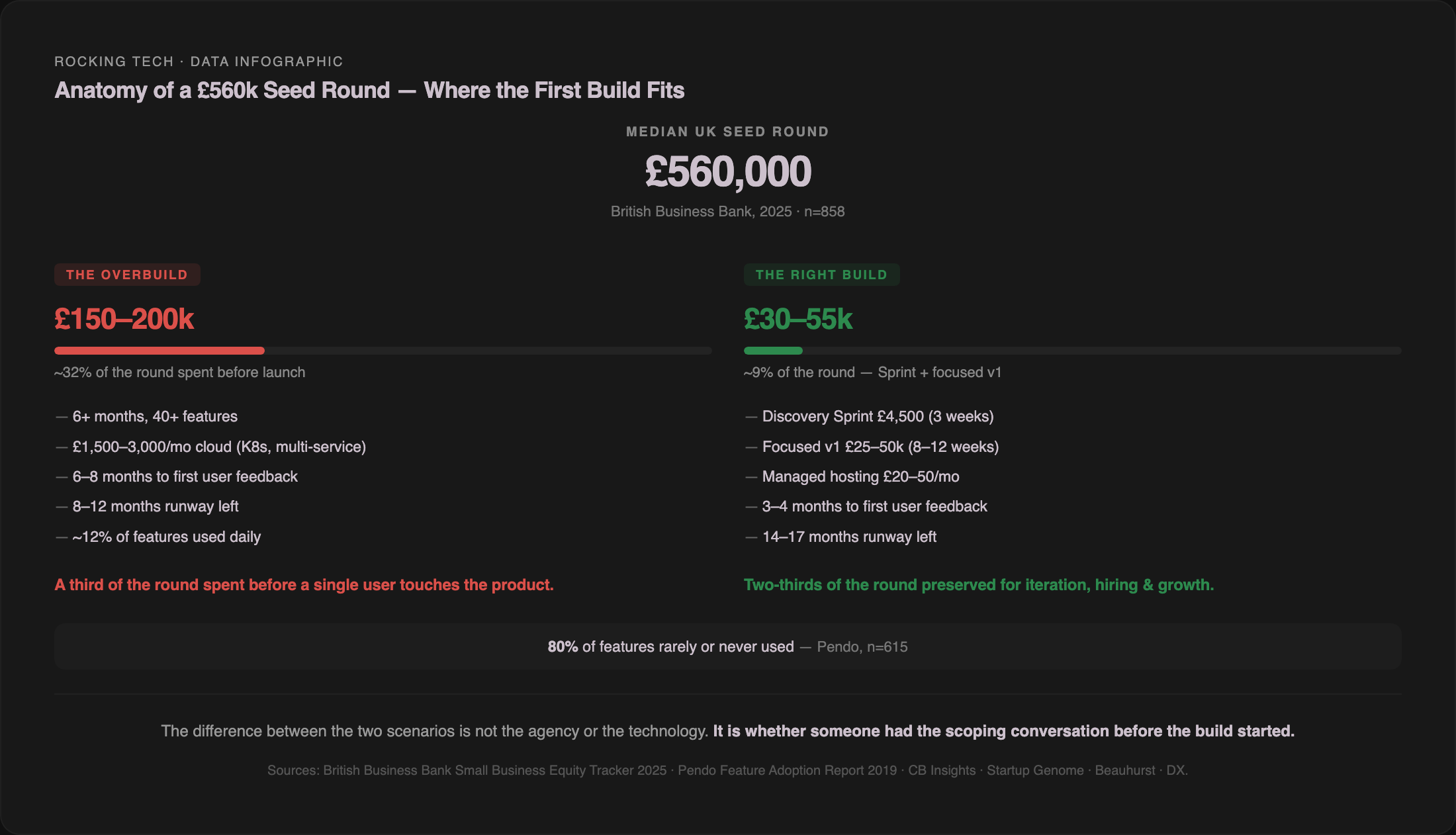
The British Business Bank's 2025 Small Business Equity Tracker, drawing on Beauhurst data across 858 UK Seed-stage deals, puts the median round at £560,000 (British Business Bank, June 2025). Not £2.4 million — that is the mean, dragged up by a small number of AI mega-rounds averaging £8.3 million each. The typical UK founder who closes a Seed round is working with closer to half a million than two.
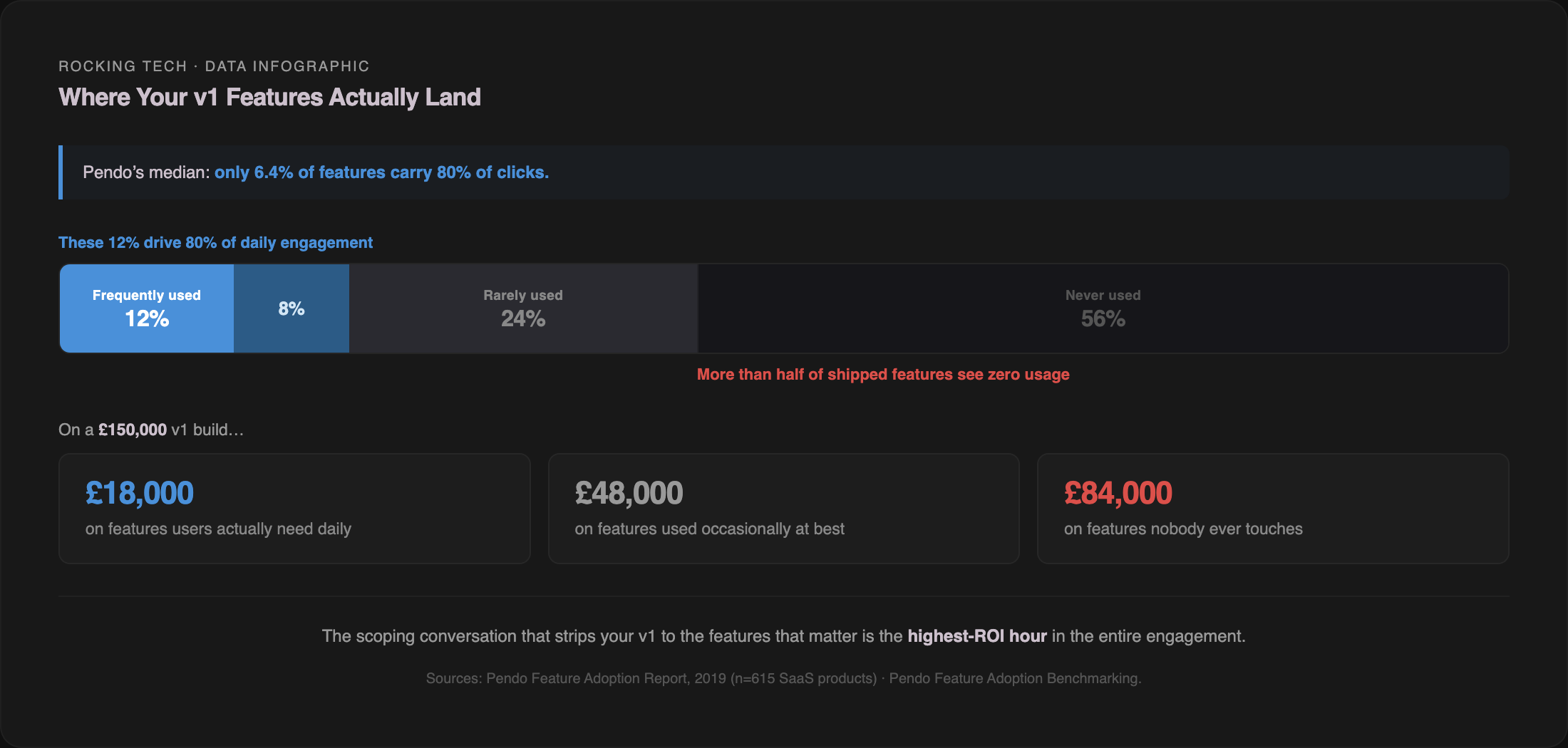
Pendo's Feature Adoption Report, analysing usage data across 615 SaaS products, found that 80% of features in the average software product are rarely or never used — with just 12% driving 80% of daily engagement (Pendo, 2019). Put those two figures next to each other and the thesis writes itself: most funded UK startups spend the single largest line of their first round building software that will not be used.
The question is not whether this happens. It is why founders with capital, some validation and a credible technical partner keep doing it.
The runway you actually have
The "eighteen months of runway" figure that circulates in every pitch-coaching session is a VC heuristic, not a measured statistic. No primary UK data source — not Beauhurst, not the British Business Bank, not HSBC Innovation Banking, not Atomico's State of European Tech — publishes an observed median runway for Seed-stage companies. The closest measured proxy comes from Carta: the median interval between Seed and Series A reached 616 days by Q2 2025 — just over 20 months — for the subset of companies that successfully raised a follow-on round. Founders who didn't raise again are not in that dataset.
What is measured is what happens to the cohort as a whole. Beauhurst tracked 2,582 UK companies incorporated in 2017 at Seed stage over five years. Twenty per cent moved to "zombie" or dead status without progressing. Only 23% scaled to a later stage. Just 2% exited. Average lifetime to failure: 2.94 years (Beauhurst, updated April 2026).
What proportion of a Seed round goes into the first technical build? Here the data goes quiet. No primary UK dataset measures it. Beauhurst, the BBB, Carta UK and Atomico do not publish the figure. Agency blogs cite 40–60% of a Seed round consumed by engineering in the first twelve months, but none trace the claim to a measured study. This is a gap worth naming honestly, because the most strategically important spending decision in a Seed-stage company is not benchmarked anywhere defensible.
What we can say is that a six-month first build on a £560,000 round — even at modest agency rates — consumes a meaningful share of a finite resource. The founder who commissions that build is not just buying software. They are buying time. And time, at Seed, is the one thing they cannot raise more of.
Eighty per cent of features in the average software product are rarely or never used. If you are building with a £560,000 Seed round, that statistic is not an abstraction — it is a budget line.
Mistake one: overbuilding v1
The instinct to build comprehensively is rational at the surface. You have raised money. Investors expect a product. The agency or CTO presents a feature list that covers every user story the team has discussed. It feels like progress to say yes to all of it.
The data says otherwise. Pendo's 2019 analysis found that across those 615 SaaS products, 56% of features were never used at all, 24% were rarely used, 8% moderately used, and only 12% frequently used. A later Pendo rolling benchmark put the median feature adoption rate — the share of features driving 80% of click volume — at 6.4%, with top-decile products reaching just 15.6% (Pendo, Feature Adoption Benchmarking). That means the median SaaS product ships roughly fifteen features for every one that matters.
The frequently recycled "Standish Group: 64% of features rarely or never used" figure deserves a caveat. The original source is a 2002 conference keynote based on only four internally developed enterprise applications at four companies. Mike Cohn confirmed the methodology directly with Standish (Mountain Goat Software, 2023). The Pendo dataset, at 615 products, is the stronger citation.
Pendo extrapolated their finding against Gartner's 2018 public cloud revenue forecast and estimated that $29.5 billion of global cloud R&D is spent annually on features that go unused (Pendo, 2019). At the scale of a UK Seed-stage company, the maths is simpler but no less painful: if your v1 has forty features and the evidence says six of them will drive 80% of actual usage, you have funded thirty-four features that will not earn their keep.
The most expensive version of this pattern is the funded startup that overbuilds to the point of non-delivery. Babylon Health raised roughly $735 million across its life, peaked at a $4.2 billion SPAC valuation, expanded into AI symptom checking, GP at Hand, Rwanda contracts and US risk-bearing population health — and entered bankruptcy in August 2023 with its UK assets sold for a fraction of a percent of peak valuation. The scope expanded faster than unit economics arrived. The product never found a floor it could stand on.
The discipline required is not to build less, but to build the right twelve per cent first. That sounds simple. It is the hardest scoping conversation in the entire engagement, and most agencies are not incentivised to have it — because a larger scope means a larger invoice. We have written separately about why the MVP often doesn't need to be an app at all and about why quotes from different agencies vary by a factor of four on the same brief. Both pieces cover adjacent territory. This article is about what happens when the brief is accepted unchallenged.
Mistake two: choosing the wrong stack for the stage
The second most expensive decision is architectural, and it is almost always made by the technical hire — the CTO, the lead developer, or the agency's architect — rather than by the founder. The pattern: someone reads an engineering blog from a company with 500 engineers and ten million users, and designs the system as if those are the constraints. They are not. The constraints are three people, zero users, and eighteen months of runway.
David Heinemeier Hansson's "Majestic Monolith" essay remains the clearest articulation of the counter-argument (Signal v. Noise, February 2016). Martin Fowler reached the same conclusion: almost all the successful microservice stories have started with a monolith that got too big and was broken up, and almost all the stories where a system was built as a microservice system from scratch have ended in serious trouble ("MonolithFirst," martinfowler.com, 2015). Thoughtworks' Technology Radar has placed microservices on Hold under the heading "Microservice envy" since 2018. It has never reached the Adopt ring — because the prerequisites (continuous delivery, infrastructure automation, observability) sit beyond most early-stage teams' capacity (InfoQ, June 2018).
The case studies are well-documented. Segment described its retreat from microservices to a monolith in 2018: at peak, three full-time engineers were needed just to keep the microservice mesh running — before a single line of product code was written. After consolidation, the team shipped 46 shared-library improvements in the first six months against 32 in all of 2016 ("Goodbye Microservices," segment.com). Amazon Prime Video's video-quality monitoring service hit a hard scaling ceiling at 5% of expected load on AWS Step Functions and Lambda, then reduced infrastructure cost by over 90% by refactoring into a single ECS container (Prime Video Tech Blog, March 2023). Shopify — processing billions of dollars in transactions — still runs a multi-million-line Ruby monolith. Their engineering blog states it plainly: no architecture is often the best architecture in the early days of a system (shopify.engineering).
The cloud-overhead numbers make the case from a different angle. Andreessen Horowitz benchmarked 50 publicly traded software companies and found that committed cloud spend averaged 50% of cost of revenue (a16z, 2021). Flexera's 2026 State of the Cloud Report puts current wasted cloud spend at 29% of total cloud bills (Flexera, 2026). For a Seed-stage startup running a Kubernetes cluster because the CTO's last employer used one, the waste is not 29% — it is closer to 90%, because the infrastructure is provisioned for traffic that does not yet exist.
A monolith on a £20-per-month managed server. Laravel, Rails, Django — pick the framework with the best hiring pool for your market. Ship it. When you have the traffic to justify splitting it apart, you will also have the revenue to fund the refactoring. The companies that started with microservices and retreated are not embarrassed outliers. They are the documented norm.
Mistake three: accepting delivery without architecture documentation
When a founder commissions an external build and accepts delivery without architecture documentation, the cost does not land immediately. It lands months later — at the next hire, the agency renewal, or the first production incident at 2am.
Stack Overflow's 2024 Developer Survey (n=65,000+, 185 countries) found that 61% of professional developers spend more than 30 minutes a day searching for answers, and roughly 25% cannot find up-to-date information within their organisation to do their job. Knowledge silos were cited as a productivity blocker by 30% of developers at least ten times a week (Stack Overflow, 2024).
Stripe's "Developer Coefficient" study (Harris Poll, 2018, n=1,000+ developers and 1,000+ C-level executives across six markets including the UK) quantified the cost more directly: developers spend an average of 17.3 hours a week on maintenance and an additional 3.8 hours a week dealing specifically with bad code — roughly half the working week on work that is not new feature development (Stripe, 2018).
The peer-reviewed "DevEx in Action" study (Forsgren, Kalliamvakou et al., ACM Queue, January 2024, n=219) found that teams providing fast responses to developers' questions report 50% less technical debt than slow-response teams (ACM Queue, 2024). DX's own benchmarking estimates that documentation problems consume 15–25% of engineering capacity in affected teams (getdx.com). And GitHub's 2021 State of the Octoverse (n=12,000+ developers, 4 million repositories) found that repositories with proper READMEs, contribution guidelines and issue templates make developers 55% more productive (GitHub, 2021).
The JetBrains 2021 Developer Ecosystem Survey (n=31,743) found that only 2% of developers use professional documentation software (JetBrains, 2021). Architecture documentation, when it exists, is almost always produced as a side activity by an engineer using a markdown editor. When it does not exist — which is the default state of most agency handovers — every subsequent developer who touches the codebase inherits a code-archaeology problem that will consume between 15% and 50% of their capacity indefinitely.
This is not a technical detail. It is a financial one. If your next hire spends 20% of their time figuring out how the system works because no one wrote it down, that is 20% of a £70,000–£90,000 salary — £14,000–£18,000 per year — spent on decoding rather than building. Over two years, across two or three hires, the absent documentation costs more than the documentation would have.
Mistake four: launching without a validation loop
The final mistake compounds all three. The founder overbuilds, on the wrong stack, without documentation — and then launches without a structured feedback loop between the build and the market. By the time real users touch the product, the runway consumed is irreversible.
CB Insights' most recent failure analysis — covering 431 venture-backed companies that shut down since 2023, with reasons retrievable for 385 — found that 70% ran out of capital, 43% suffered poor product–market fit, 29% blamed bad timing, and 19% cited unsustainable unit economics. CB Insights explicitly labels running out of capital as the final cause, not the root one (CB Insights, 2024).
The Startup Genome Project's dataset of 3,200+ high-growth internet startups remains the only large-sample quantification of pivoting. It found that 70% suffered premature scaling, and that startups pivoting once or twice raised 2.5 times more capital and had 3.6 times better user growth than those pivoting more than twice or not at all (Startup Genome, 2011). The data is from 2011 and has not been formally re-tested — but nothing has displaced it. The message has not changed: the founders who build, test, adjust and build again outperform those who build once, comprehensively, and hope.
None of the major UK accelerators — Entrepreneur First, Seedcamp, Techstars London, Antler — publishes a structured pivot rate. The absence of that data is itself a finding worth naming, because it means no UK founder can benchmark their iteration rate against a cohort.
Real founders describe the gap without euphemism. Ben Yoskovitz, revisiting the post-mortem of his $1.8 million seed-funded Standout Jobs: "I raised too much money, too early… We didn't have the validation needed to justify raising the money we did." The CB Insights post-mortem corpus contains the eCrowds founder summarising the pattern: "We spent way too much time building it for ourselves and not getting feedback from prospects — it's easy to get tunnel vision."
The validation loop does not need to be elaborate. It needs to exist. Ship a slice. Watch what users do. Instrument it from day one — because Pendo's data says that without measurement, you will not discover which 12% of your features matter until it is too late to recover the money spent on the other 88%.
What the evidence points to
Bring the numbers together and the playbook is narrow.
Ship a monolith. The pattern of retreat from microservices is documented across Segment, Prime Video and Shopify. Laravel, Rails, Django — choose the framework with the deepest hiring pool for your geography and ship a single deployable unit on a managed server. When traffic justifies splitting it, revenue will fund the refactoring.
Demand architecture documentation at delivery. Every survey from Stack Overflow to Stripe to GitHub puts its absence at 15–55% of engineering capacity. If your agency or CTO does not produce architecture documentation as a standard deliverable, they are handing you a codebase that will cost 20% more to maintain for its entire life.
Instrument feature usage from launch. Pendo's median customer sees 6.4% of features carry 80% of clicks. Without instrumentation, you are guessing which slice of your build justifies the investment — and the data says your guesses will be wrong 80% of the time.
Budget for two pivots. Startup Genome's data says founders who pivot once or twice raise 2.5 times more capital and grow 3.6 times faster. Your v1 is not the product. It is the first iteration of the product. Build it to be changed, not to be finished.
The hardest part is not finding this evidence. It is accepting that the credible CTO or agency you just hired will, by default, build the version that consumes the round — because that is what the brief asked for, and nobody pushed back.
The conversation that should happen before the build starts
There is a specific moment in every funded founder's journey where the trajectory is set. It is not the moment the code is written. It is not the moment the agency is hired. It is the moment the scope is agreed — and either someone pushes back on what does not belong in v1, or nobody does.
That conversation requires someone who understands both the technical architecture and the commercial constraints. Someone who will say "don't build that yet" when the evidence supports waiting, and "don't build that at all" when an off-the-shelf tool would serve. Someone whose incentive is to get the scope right, not to maximise the invoice.
The UK market for paid discovery — a structured, fixed-fee scoping engagement before the build — sits at £3,000–£10,000 for projects in the £25,000–£100,000 range. Most agencies do not publish pricing. Of those we reviewed, fewer than three make the scope visible on their website. The norm is still a "free proposal" process that bundles scoping into the build cost — which means the founder pays for scoping whether they realise it or not, and the agency is incentivised to scope generously.
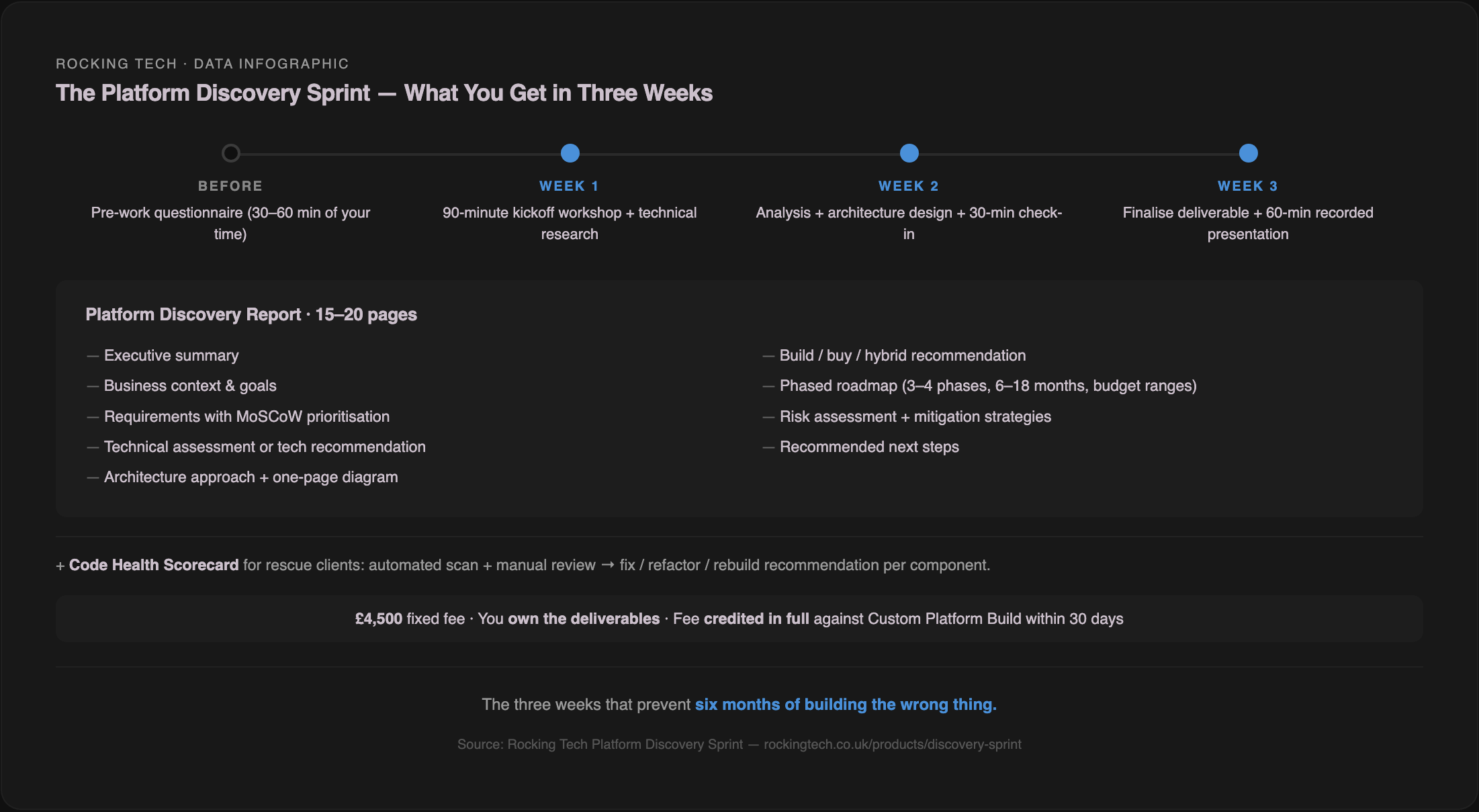
The Platform Discovery Sprint exists specifically for this moment. It is a three-week, £4,500 fixed-fee engagement. 100% upfront. The founder's time commitment is 3.5–4.5 hours across four touchpoints: a pre-work questionnaire, a 90-minute kickoff workshop, a 30-minute mid-point check-in, and a 60-minute recorded presentation of the deliverable. The deliverable is a 15–20 page Platform Discovery Report containing an executive summary, business context, requirements with MoSCoW prioritisation, a technology recommendation, an architecture diagram, a build-buy-hybrid recommendation (including "don't build, use off-the-shelf" where appropriate), a phased roadmap with 3–4 phases covering a 6–18 month horizon with budget ranges per phase, a risk assessment, and recommended next steps.
For founders with an existing codebase — whether agency-built, freelancer-built, or AI-generated — the Sprint includes a Code Health Scorecard: automated scanning with SonarQube and PHPStan plus manual expert review, producing a severity-prioritised issue list with a fix, refactor, or rebuild recommendation per component.
The report is yours. Take it to any developer. If you proceed to a Custom Platform Build within 30 days, the £4,500 is credited in full against the build cost. If you don't, the deliverable stands as a standalone engagement. The structure is deliberate: the founder gets the scoping conversation they need before committing to a build — and pays for that conversation with a document they own, rather than absorbing it invisibly into an agency's build margin.
I run every Discovery Sprint personally. The assessment is produced by the person who would also build the platform — which is why the recommendation can be "don't build with us" or "don't build at all" without anyone losing face. Ten-plus years building production platforms for funded startups, the NHS, and international professional organisations, and a Cranfield MBA, gives me a specific angle on this work: the diagnosis is technical, but the framing is always a business decision.
The four mistakes in this article are not obscure. They are the documented default. The founders who avoid them are the ones who have the scoping conversation before the build starts — and listen to the answer.
Ready to know what you’re building?
Book a free Discovery Call — 30 minutes, no commitment, no pitch. We’ll discuss your project, confirm whether discovery is the right next step, and answer any questions.